
Contents
Overview
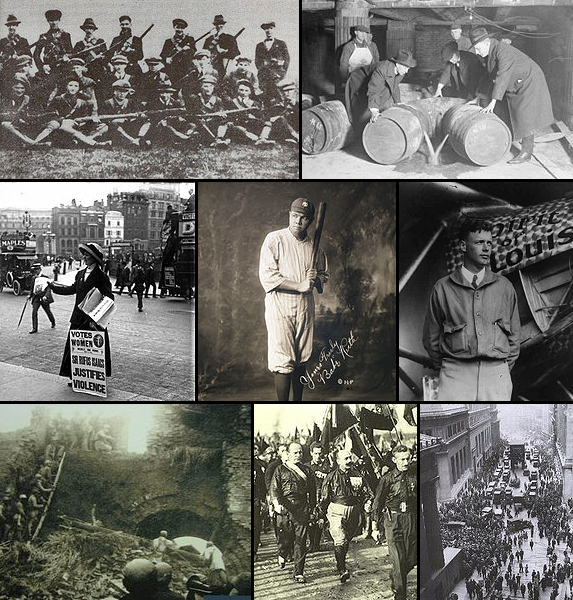
The 1920s emerged as a distinct historical epoch following the cataclysm of World War I (1914–1918), a conflict that reshaped global alliances and economies. Precursors to the decade's dynamism can be traced to the rapid industrialization of the late 19th century and the burgeoning artistic movements like Art Nouveau and Impressionism, which began to challenge traditional aesthetics. The war itself, however, acted as a brutal accelerant, disrupting established orders and creating fertile ground for new ideas and social experiments. In America, Prohibition was enacted in 1920 and repealed in 1933, fueling a culture of speakeasies and organized crime, while in Europe, nations like Germany grappled with the punitive Treaty of Versailles. The Soviet Union, meanwhile, was solidifying its post-revolutionary identity, with Lenin's New Economic Policy (NEP) implemented in 1921, a stark contrast to the later Stalinist industrialization. The decade's defining characteristic was this global divergence: a period of unprecedented prosperity and cultural effervescence in some regions, juxtaposed with political instability and economic hardship in others.
⚙️ How It Worked: The Engine of Change
The economic engine of the 1920s was powered by a confluence of technological innovation and mass production techniques, most notably Henry Ford's assembly line for the Model T automobile. This revolutionized manufacturing, making consumer goods like cars and radios accessible to a broader population, thereby fueling a culture of consumerism. The widespread adoption of electricity transformed domestic life, powering new appliances and entertainment devices. The burgeoning film industry, centered in Hollywood, became a dominant form of mass entertainment, with silent films giving way to 'talkies' by the decade's end. Advancements in aviation, exemplified by Charles Lindbergh's solo transatlantic flight in 1927, captured the public imagination and signaled a new era of global connectivity. Financial markets, particularly Wall Street, experienced a speculative boom, driven by easy credit and a widespread belief in perpetual economic growth, a sentiment that would prove tragically misplaced.
📊 Key Facts & Numbers
The 1920s saw staggering economic growth, with the United States' Gross National Product (GNP) increasing by approximately 40% between 1920 and 1929. The number of automobiles on American roads surged from around 8 million in 1920 to over 23 million by 1929, a nearly 300% increase. Radio ownership exploded, with an estimated 10 million households owning a radio by 1929, up from virtually none at the start of the decade. The stock market experienced unprecedented gains, with the Dow Jones Industrial Average climbing from around 70 points in 1920 to nearly 380 points by September 1929, a more than 400% increase. Consumer debt also rose dramatically, with installment buying becoming commonplace, allowing individuals to purchase goods like refrigerators and washing machines. By 1929, approximately 60% of American homes had electricity, a significant leap from the roughly 35% in 1920. The decade concluded with the catastrophic Wall Street Crash, which saw the market lose approximately $14 billion in a single week, wiping out fortunes and triggering the Great Depression.
👥 Key People & Organizations
A constellation of influential figures shaped the 1920s. In politics, Woodrow Wilson concluded his presidency, succeeded by Warren G. Harding, Calvin Coolidge, and Herbert Hoover in the United States, each navigating the post-war landscape. In Europe, Gustav Stresemann served as Germany's Foreign Minister, striving for reconciliation and economic recovery. Culturally, F. Scott Fitzgerald immortalized the era in novels like 'The Great Gatsby,' while Ernest Hemingway chronicled the disillusionment of the 'Lost Generation.' The jazz scene was defined by innovators like Louis Armstrong and Duke Ellington, whose music defined the 'Jazz Age.' In science, Albert Einstein's theories of relativity continued to reshape physics, and Marie Curie remained a leading figure in radioactivity research. Organizations like the League of Nations attempted to foster international cooperation, while industrial giants like General Motors and Ford Motor Company exemplified the era's manufacturing prowess.
🌍 Cultural Impact & Influence
The cultural impact of the 1920s was seismic, fundamentally altering societal norms and artistic expression. The 'Jazz Age' moniker, popularized by F. Scott Fitzgerald, speaks to the era's embrace of new, syncopated rhythms and improvisational music that challenged Victorian sensibilities. The rise of mass media, particularly radio and cinema, created a shared popular culture across vast distances, homogenizing tastes and introducing new forms of celebrity. The 'flapper' culture, with its bobbed hair, shorter skirts, and independent spirit, symbolized a new, more liberated role for women, who had gained suffrage in many Western nations during or shortly after World War I. The Harlem Renaissance, a flourishing of African American art, literature, and music centered in Harlem, produced iconic figures like Langston Hughes and Zora Neale Hurston, profoundly influencing American culture. This period also saw the rise of modernist art movements, with artists like Salvador Dalí and Pablo Picasso pushing the boundaries of visual representation, while architects like Walter Gropius championed functionalist design through the Bauhaus school.
⚡ Current State & Latest Developments
The 1920s, while a distinct historical period, continues to resonate in contemporary society. The economic principles of mass production and consumer credit that flourished then remain foundational to modern economies, though often debated for their sustainability. The cultural shifts, particularly regarding women's rights and racial equality, laid groundwork for ongoing social justice movements. The artistic innovations of the era, from jazz improvisation to modernist aesthetics, continue to inspire artists and musicians today. The cautionary tale of the speculative bubble and subsequent crash of 1929 remains a critical lesson in financial regulation and economic stability, frequently invoked during modern market downturns. Furthermore, the decade's fascination with new technologies, from radio to early cinema, foreshadows our current digital age and the pervasive influence of media and communication platforms like YouTube and TikTok.
🤔 Controversies & Debates
The 1920s is a subject of ongoing debate among historians and economists. One major controversy surrounds the extent to which the decade's prosperity was truly widespread or concentrated among the wealthy, with critics pointing to significant income inequality and the precarious financial state of farmers. The effectiveness and unintended consequences of Prohibition are also heavily debated, with arguments centering on its role in fueling organized crime versus its potential impact on public health. The political landscape of the era, marked by the rise of Fascism in Italy under Benito Mussolini and the consolidation of power in the Soviet Union under Joseph Stalin, raises questions about the fragility of democracy and the appeal of authoritarianism in times of economic and social stress. The legacy of the 'Lost Generation' and their disillusionment with post-war society is another point of contention, with some scholars arguing it fostered artistic innovation while others see it as a precursor to nihilism.
🔮 Future Outlook & Predictions
The future outlook for understanding the 1920s involves deeper analysis of its global interconnectedness and lon
Key Facts
- Category
- history
- Type
- topic