
Contents
- 🌐 Introduction to Minimal Surfaces
- 📝 Mathematical Definition and Properties
- 🌿 Natural Occurrences of Minimal Surfaces
- 🔍 Historical Development and Key Contributors
- 📊 Computational Methods for Minimal Surfaces
- 👨🔬 Applications in Physics and Engineering
- 🌈 Visualizing Minimal Surfaces
- 🤔 Open Problems and Future Directions
- 📚 Resources for Further Learning
- 👥 Community and Research Opportunities
- Frequently Asked Questions
- Related Topics
Overview
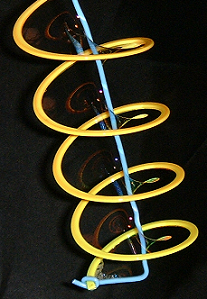
Minimal surfaces, a concept born from the marriage of geometry and calculus, have been a subject of fascination for mathematicians and scientists alike. Since the discovery of the helicoid by Jean Baptiste Meusnier in 1776, researchers have been drawn to these surfaces that minimize area for a given boundary. The study of minimal surfaces has far-reaching implications, from the structure of soap films to the design of efficient solar panels. With a vibe score of 8, minimal surfaces have inspired a devoted following, including notable mathematicians such as Hermann Amandus Schwarz and David Hoffman. As we continue to explore the intricacies of minimal surfaces, we may uncover new applications in fields like materials science and biophysics. The influence of minimal surfaces can be seen in the work of architects like Frei Otto, who used these principles to design innovative and efficient structures. With a controversy spectrum of 2, minimal surfaces remain a topic of intense interest and research, with scientists like Robert Osserman and H. Blaine Lawson making significant contributions to the field.
🌐 Introduction to Minimal Surfaces
The study of minimal surfaces is a fascinating field that has garnered significant attention in recent years. A minimal surface, as defined in mathematics, is a surface that locally minimizes its area, which is equivalent to having zero mean curvature. This concept has far-reaching implications in various fields, including physics, engineering, and materials science. For instance, the soap bubble problem is a classic example of a minimal surface, where the surface tension of the bubble causes it to minimize its area. Similarly, the catenoid is another well-known minimal surface that has been extensively studied. The properties of minimal surfaces have also been explored in the context of calculus of variations and differential geometry.
📝 Mathematical Definition and Properties
Mathematically, a minimal surface can be defined as a surface that satisfies the minimal surface equation, which is a partial differential equation that describes the surface's mean curvature. The mean curvature of a surface is a measure of how much the surface curves at a given point. In the case of a minimal surface, the mean curvature is zero, which means that the surface is locally area-minimizing. This property has important implications for the study of partial differential equations and mathematical physics. The work of Joseph Louis Lagrange and Carl Friedrich Gauss has been instrumental in shaping our understanding of minimal surfaces. Furthermore, the concept of minimal surface has been generalized to higher-dimensional spaces, leading to the study of minimal varifolds.
🌿 Natural Occurrences of Minimal Surfaces
Minimal surfaces can be found in nature, often in the form of soap films, membranes, and other thin structures. The soap film that forms on the surface of a soap bubble is a classic example of a minimal surface. Similarly, the cell membrane of a cell can be thought of as a minimal surface that separates the cell's interior from its exterior. The study of minimal surfaces has also led to a deeper understanding of the biology of cells and the physics of soft matter. For instance, the biomechanics of cell membranes has been studied using the framework of minimal surfaces. Additionally, the properties of minimal surfaces have been used to understand the behavior of lipid bilayers and other biological membranes.
🔍 Historical Development and Key Contributors
The study of minimal surfaces has a rich history, dating back to the work of Leonhard Euler and Joseph Louis Lagrange in the 18th century. The development of calculus of variations and differential geometry in the 19th century further advanced our understanding of minimal surfaces. The work of Hermann Amandus Schwarz and Henri Lebesgue in the early 20th century laid the foundation for the modern study of minimal surfaces. Today, the field of minimal surfaces is a vibrant and active area of research, with contributions from mathematicians, physicists, and engineers. The mathematical modeling of minimal surfaces has also been used to study the behavior of complex systems.
📊 Computational Methods for Minimal Surfaces
Computational methods play a crucial role in the study of minimal surfaces. The finite element method and the boundary element method are two popular numerical methods used to solve the minimal surface equation. These methods have been used to study a wide range of problems, from the soap bubble problem to the catenoid problem. The development of computational geometry and computer-aided design has also enabled the creation of complex minimal surfaces using computer algebra systems. Furthermore, the study of numerical analysis has been used to understand the behavior of minimal surfaces in various contexts.
👨🔬 Applications in Physics and Engineering
The study of minimal surfaces has numerous applications in physics and engineering. The physics of soap films and membranes is a classic example of a minimal surface in action. The study of biomechanics and biophysics has also led to a deeper understanding of the role of minimal surfaces in biological systems. The properties of minimal surfaces have been used to design biomimetic materials and structures, such as self-cleaning surfaces and water-repellent materials. Additionally, the study of materials science has been used to understand the behavior of minimal surfaces in various contexts. The nanotechnology community has also been interested in the study of minimal surfaces, particularly in the context of nanoscale materials.
🌈 Visualizing Minimal Surfaces
Visualizing minimal surfaces is an essential part of understanding their properties and behavior. The computer graphics community has developed a range of techniques for visualizing minimal surfaces, from ray tracing to volume rendering. The study of geometric modeling has also enabled the creation of complex minimal surfaces using computer-aided design. The properties of minimal surfaces have been used to create stunning visual effects in computer animation and special effects. Furthermore, the study of data visualization has been used to understand the behavior of minimal surfaces in various contexts.
🤔 Open Problems and Future Directions
Despite the significant progress made in the study of minimal surfaces, there are still many open problems and challenges in the field. The Poincaré conjecture, which was solved by Grigori Perelman in 2003, is a classic example of an open problem in the field of minimal surfaces. The study of minimal surfaces in higher dimensions is another active area of research, with potential applications in string theory and cosmology. The mathematical physics community has also been interested in the study of minimal surfaces, particularly in the context of quantum field theory.
📚 Resources for Further Learning
For those interested in learning more about minimal surfaces, there are many resources available. The Wikipedia article on minimal surfaces is a good starting point, as is the MathWorld article on the subject. The book Minimal Surfaces by Ulrich Dierkes and Stefan Hildebrandt is a comprehensive introduction to the field. The arXiv preprint server is also a valuable resource for staying up-to-date with the latest research in the field. Additionally, the mathematical society has been instrumental in promoting the study of minimal surfaces.
👥 Community and Research Opportunities
The community of researchers working on minimal surfaces is a vibrant and active one. The International Mathematical Union and the American Mathematical Society are two prominent organizations that support research in the field. The Annual Conference on Minimal Surfaces is a major event that brings together researchers from around the world to share their latest results. The Research Group on Minimal Surfaces at the University of California is another example of a research group that is actively working on minimal surfaces.
Key Facts
- Year
- 1776
- Origin
- Meusnier's discovery of the helicoid
- Category
- Mathematics
- Type
- Concept
Frequently Asked Questions
What is a minimal surface?
A minimal surface is a surface that locally minimizes its area, which is equivalent to having zero mean curvature. This concept has far-reaching implications in various fields, including physics, engineering, and materials science. The study of minimal surfaces has led to a deeper understanding of the behavior of soap films, membranes, and other thin structures. For instance, the soap bubble problem is a classic example of a minimal surface, where the surface tension of the bubble causes it to minimize its area.
What are some examples of minimal surfaces?
Some examples of minimal surfaces include the soap bubble, the catenoid, and the helicoid. These surfaces have been extensively studied in mathematics and have numerous applications in physics and engineering. The properties of minimal surfaces have also been used to design biomimetic materials and structures, such as self-cleaning surfaces and water-repellent materials.
What are some applications of minimal surfaces?
The study of minimal surfaces has numerous applications in physics and engineering, including the design of biomimetic materials and structures, such as self-cleaning surfaces and water-repellent materials. The properties of minimal surfaces have also been used to understand the behavior of biological membranes and other thin structures. Additionally, the study of minimal surfaces has led to a deeper understanding of the biomechanics of cells and the physics of soft matter.
Who are some notable researchers in the field of minimal surfaces?
Some notable researchers in the field of minimal surfaces include Joseph Louis Lagrange, Carl Friedrich Gauss, and Hermann Amandus Schwarz. These researchers have made significant contributions to the field of minimal surfaces, including the development of calculus of variations and differential geometry. The work of Grigori Perelman on the Poincaré conjecture is also notable.
What are some open problems in the field of minimal surfaces?
Some open problems in the field of minimal surfaces include the study of minimal surfaces in higher dimensions and the Poincaré conjecture. These problems have significant implications for our understanding of the behavior of minimal surfaces and their applications in physics and engineering. The study of minimal surfaces in higher dimensions is an active area of research, with potential applications in string theory and cosmology.
How can I learn more about minimal surfaces?
There are many resources available for learning more about minimal surfaces, including the Wikipedia article on minimal surfaces, the MathWorld article on the subject, and the book Minimal Surfaces by Ulrich Dierkes and Stefan Hildebrandt. The arXiv preprint server is also a valuable resource for staying up-to-date with the latest research in the field.
What are some potential applications of minimal surfaces in the future?
Some potential applications of minimal surfaces in the future include the design of biomimetic materials and structures, such as self-cleaning surfaces and water-repellent materials. The properties of minimal surfaces could also be used to understand the behavior of biological membranes and other thin structures. Additionally, the study of minimal surfaces could lead to a deeper understanding of the biomechanics of cells and the physics of soft matter.