
Contents
Overview
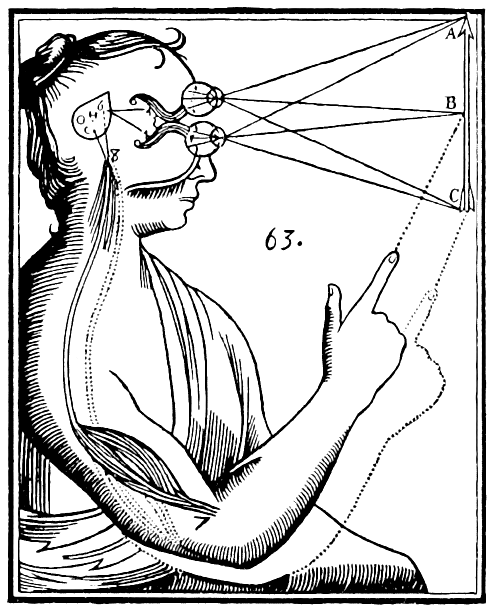
The concept of the body mind connection has its roots in ancient philosophies, with Plato and Aristotle exploring the relationship between the mind and body. However, it was René Descartes who formulated the concept of dualism, proposing that the mind and body are fundamentally distinct substances. This idea has been influential in the development of various philosophical positions, including monism, which encompasses physicalism and idealism. The work of John Locke and David Hume also contributed to the discussion, with Immanuel Kant's critiques of metaphysics and epistemology providing a foundation for modern philosophical inquiry.
💡 How It Works
Recent approaches to the body mind connection include functionalism, property dualism, and various non-reductive theories. These perspectives aim to explain how mental states, such as thoughts and feelings, can interact with the physical world. The concept of emergence has also been explored, suggesting that complex systems, such as the human brain, can exhibit properties that cannot be reduced to their individual components. Researchers like Daniel Kahneman and Amit Goswami have made significant contributions to our understanding of the body mind connection, with cognitive-behavioral therapy and mindfulness-based stress reduction emerging as effective approaches to cultivating a healthy body mind connection.
🌎 Cultural Impact
The body mind connection has significant cultural and societal implications, with many traditional practices, such as yoga and meditation, emphasizing the importance of integrating the mind and body. The work of Carl Jung and Abraham Maslow has also highlighted the role of the body mind connection in personal growth and self-actualization. Furthermore, the concept of holism has been influential in shaping our understanding of the interconnectedness of the mind and body, with systems theory providing a framework for analyzing complex systems. The body mind connection has also been explored in various art forms, including dance and music, with Martha Graham and John Cage being notable examples of artists who have investigated this connection.
🔮 Legacy & Future
As we move forward, the body mind connection will continue to be an essential area of inquiry, with potential applications in fields such as psychology, neuroscience, and medicine. The work of researchers like Andrew Weil and Deepak Chopra has already begun to explore the intersection of the body mind connection and wellness, with integrative medicine emerging as a promising approach to healthcare. As our understanding of the body mind connection deepens, we may uncover new insights into the nature of consciousness, mental states, and their relation to the physical brain and nervous system, with potential implications for our understanding of free will and personal responsibility.
Key Facts
- Year
- 17th century
- Origin
- Western philosophy
- Category
- philosophy
- Type
- concept
Frequently Asked Questions
What is the mind-body problem?
The mind-body problem is a philosophical problem that concerns the relationship between thought and consciousness in the human mind and body. It addresses the nature of consciousness, mental states, and their relation to the physical brain and nervous system. This problem has been a central issue in philosophy of mind since the 17th century, with key figures like René Descartes and Sigmund Freud contributing to the discussion. The mind-body problem raises fundamental questions about causation between mental and physical states, with implications for our understanding of free will and personal responsibility.
What is dualism?
Dualism is a philosophical position that proposes that the mind and body are fundamentally distinct substances. This idea was formulated by René Descartes and has been influential in the development of various philosophical positions, including monism and idealism. Dualism suggests that the mind is a non-physical entity that interacts with the physical body, but is not reducible to it. This perspective has been challenged by various critics, including Baruch Spinoza and David Hume, who argue that the mind and body are intimately connected and that dualism is an overly simplistic view of the human experience.
What is the significance of the body mind connection?
The body mind connection has significant implications for our understanding of consciousness, mental states, and their relation to the physical brain and nervous system. It also has practical applications in fields such as psychology, neuroscience, and medicine. The body mind connection can be influenced by various factors, including mindfulness, meditation, and yoga. By cultivating a healthy body mind connection, individuals can improve their overall well-being and quality of life. Researchers like Andrew Weil and Deepak Chopra have explored the intersection of the body mind connection and wellness, with integrative medicine emerging as a promising approach to healthcare.
How does the body mind connection relate to personal growth and self-actualization?
The body mind connection plays a crucial role in personal growth and self-actualization. By integrating the mind and body, individuals can tap into their full potential and achieve a state of optimal well-being. The work of Carl Jung and Abraham Maslow has highlighted the importance of the body mind connection in personal growth and self-actualization. Practices such as mindfulness and meditation can help individuals cultivate a healthy body mind connection and achieve greater self-awareness and self-acceptance. Furthermore, the concept of holism has been influential in shaping our understanding of the interconnectedness of the mind and body, with systems theory providing a framework for analyzing complex systems.
What are the potential applications of the body mind connection in healthcare?
The body mind connection has significant potential applications in healthcare, particularly in the fields of psychology, neuroscience, and medicine. By understanding the intricate relationship between the mind and body, healthcare professionals can develop more effective treatments for a range of conditions, including mental health disorders, chronic pain, and stress-related illnesses. The work of researchers like Andrew Weil and Deepak Chopra has already begun to explore the intersection of the body mind connection and wellness, with integrative medicine emerging as a promising approach to healthcare. Furthermore, the concept of placebo effect has highlighted the importance of the mind-body connection in shaping our response to medical treatments.