
Contents
- 🎵 Origins & History
- ⚙️ Defining the 'Middle Eastern' Identity
- 📊 Demographics & Scale
- 👥 Key Peoples & Cultural Groups
- 🌍 Global Diasporas & Influence
- ⚡ Contemporary Challenges & Dynamics
- 🤔 Controversies & Debates
- 🔮 Future Trajectories
- 💡 Cultural Expressions & Contributions
- 📚 Related Topics & Deeper Reading
- References
Overview
The concept of a 'Middle Eastern community' is deeply rooted in millennia of human interaction across a region that has served as a cradle of civilization. From the ancient Sumerians in Mesopotamia to the Phoenicians who spread their alphabet across the Mediterranean, and the Islamic Golden Age scholars who preserved and advanced knowledge, this area has always been a nexus of peoples and ideas. The Ottoman Empire, for centuries, governed a vast swathe of diverse populations, leaving a lasting imprint on the cultural and political landscapes. Post-colonial nation-building in the 20th century fragmented these historical ties, creating modern states but often failing to fully encompass the fluid identities of the peoples within them. The subsequent waves of migration, driven by economic opportunity, political instability, and conflict, have further dispersed and diversified what we now understand as the Middle Eastern community, extending its reach far beyond its geographical origins.
⚙️ Defining the 'Middle Eastern' Identity
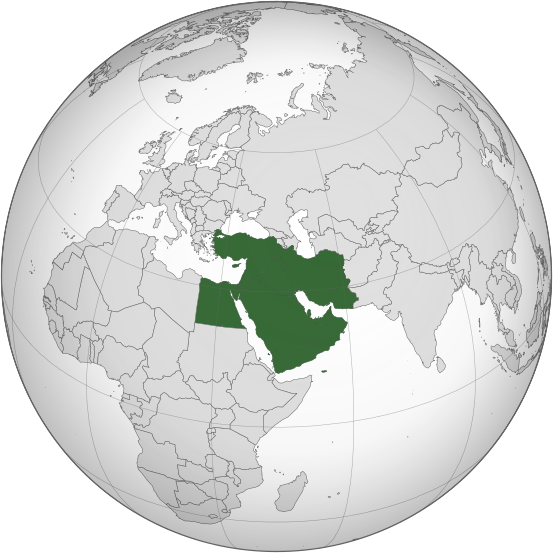
Defining 'Middle Eastern' is an exercise in navigating complex historical, linguistic, and socio-political currents. While geographically the term often refers to West Asia and parts of North Africa, the 'community' encompasses a spectrum of identities, including Arabs, Persians, Turks, Kurds, Armenians, Assyrians, and many others, each with distinct languages (Arabic, Persian, Turkish, Kurdish, Armenian, Aramaic, etc.), religious affiliations (Islam, Christianity, Judaism, Zoroastrianism, Yazidism, etc.), and cultural practices. The shared experiences of historical empires, colonial legacies, and modern geopolitical challenges often forge a sense of collective identity, even amidst profound internal differences. This shared consciousness, however, is constantly negotiated and reinterpreted by individuals and groups within the diaspora and homeland.
📊 Demographics & Scale
The sheer scale of the Middle Eastern community is staggering, both within its home region and across the globe. Beyond the core nations, significant Middle Eastern populations exist in cities like New York City, Detroit, and Los Angeles. Canada, Australia, and various European nations, particularly France, Germany, and the United Kingdom, also host substantial Middle Eastern populations, numbering in the millions collectively. This global spread means the community's demographic footprint is far larger than its geographical definition.
👥 Key Peoples & Cultural Groups
Within the broader Middle Eastern community lie numerous distinct peoples and cultural groups, each contributing to the region's rich tapestry. The Arab peoples, speaking various dialects of Arabic, form the largest linguistic group, with significant populations in countries like Saudi Arabia, Iraq, and Syria. Persians, primarily in Iran, speak Farsi and boast a literary and artistic heritage stretching back millennia. Turks, centered in Turkey, have a complex history influenced by Central Asian, Persian, and Byzantine cultures. The Kurds, a stateless nation spread across Turkey, Iran, Iraq, and Syria, maintain a distinct language and culture. Other significant groups include Armenians, Assyrians, Mizrahi Jews, and Berbers in North Africa, all of whom have unique historical narratives and cultural contributions.
🌍 Global Diasporas & Influence
Middle Eastern diasporas have established vibrant communities across the globe, acting as cultural bridges and significant economic forces. In North America, communities in Canada and the United States have built thriving businesses, cultural centers, and political advocacy groups. European nations like France, Germany, and the United Kingdom host large Middle Eastern populations, contributing to the multicultural fabric of these societies. These diasporas often play a crucial role in shaping perceptions of the Middle East, while also acting as vital links for cultural exchange, remittances, and political engagement with their homelands. The influence of Middle Eastern cuisine, music, and art can be seen in major global cities, a testament to the enduring reach of these communities.
⚡ Contemporary Challenges & Dynamics
The contemporary Middle Eastern community faces a complex web of challenges and dynamics. In diaspora, members often grapple with issues of identity, assimilation, and combating stereotypes and discrimination, particularly in the post-9/11 era. Simultaneously, there's a growing movement towards reclaiming and celebrating heritage, fostering intergenerational connections, and leveraging digital platforms to build global networks and share narratives. The rise of social media has provided new avenues for community organizing, cultural dissemination, and political discourse, allowing for unprecedented connectivity.
🤔 Controversies & Debates
The very definition of 'Middle Eastern' is a site of ongoing debate, particularly regarding the inclusion of North African countries and the precise boundaries of West Asia. The term itself, originating from early 20th-century British geopolitical strategy, is often seen as an externally imposed label that can obscure more specific national or ethnic identities. Within the community, there are discussions about the dominance of certain ethnic or linguistic groups (e.g., Arabs) over others, and the representation of minority populations like Kurds or Baha'is. Furthermore, the impact of Western foreign policy on the region and the subsequent portrayal of Middle Eastern peoples in global media remain contentious issues, fueling debates about Orientalism and cultural appropriation.
🔮 Future Trajectories
The future of the Middle Eastern community is likely to be characterized by continued global dispersion and evolving identities. As younger generations in diaspora navigate hybrid cultural landscapes, new forms of expression and belonging will undoubtedly emerge. The increasing use of digital technologies will likely strengthen transnational ties, facilitating cultural exchange and collective action across borders. Politically, the community may see a greater emphasis on transnational advocacy and the formation of alliances that transcend national boundaries. Furthermore, as climate change and resource scarcity intensify, migration patterns may shift, potentially leading to new concentrations of Middle Eastern populations in unexpected regions, further diversifying the global community.
💡 Cultural Expressions & Contributions
The cultural contributions of the Middle Eastern community are vast and have profoundly shaped global civilization. From the foundational elements of mathematics and astronomy developed during the Islamic Golden Age to the intricate artistry of Persian carpets and Islamic calligraphy, the aesthetic and intellectual heritage is immense. Cuisine, with dishes like hummus, falafel, and kebabs, has become a global phenomenon, enjoyed in virtually every major city. Music, encompassing genres from Arabic classical music to Dabke and contemporary pop, resonates worldwide. Literature, from the epic tales of One Thousand and One Nights to the works of contemporary authors like Naguib Mahfouz and Orhan Pamuk, offers profound insights into human experience. These cultural expressions are not static but continue to evolve, blending tradition with modern influences.
Key Facts
- Category
- culture
- Type
- topic