
Contents
Overview
High-speed communication refers to the transmission of digital data at extremely rapid rates, typically measured in gigabits per second (Gbps) or terabits per second (Tbps). This field encompasses the underlying technologies, protocols, and infrastructure that enable the near-instantaneous exchange of vast amounts of information across networks and devices. From the fiber optic cables crisscrossing continents to the intricate silicon chips powering our devices, high-speed communication is the invisible engine driving the digital age, underpinning everything from cloud computing and streaming services to scientific research and global finance. Its evolution is marked by a constant battle against signal degradation, latency, and bandwidth limitations, pushing innovation in areas like optical networking, advanced modulation techniques, and specialized hardware. The demand for ever-increasing speeds shows no sign of abating, promising further transformative impacts on society and technology.
🎵 Origins & History
The genesis of high-speed communication can be traced back to the telegraph's rudimentary signaling, but its modern form truly began to take shape with the advent of digital electronics and telephony in the mid-20th century. Early breakthroughs in modulation and multiplexing allowed for more data to be squeezed through existing copper wires. Companies like Corning Glass Works (now Corning Incorporated) commercialized low-loss optical fibers, paving the way for the Internet and the subsequent explosion in data traffic that necessitated ever-faster transmission methods.
⚙️ How It Works
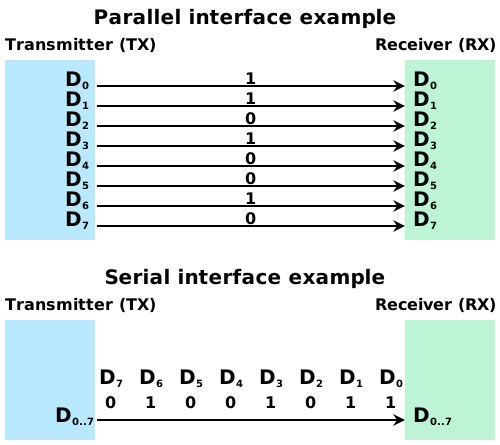
At its core, high-speed communication relies on converting data into signals that can traverse physical mediums with minimal loss and maximum speed. In fiber optic networks, this involves converting electrical signals into light pulses using lasers or LEDs, which then travel through thin strands of glass or plastic. At the receiving end, these light pulses are converted back into electrical signals. Techniques like Wavelength Division Multiplexing (WDM) allow multiple data streams to be sent simultaneously over a single fiber by using different wavelengths of light, dramatically increasing capacity. For shorter distances, such as within computer processors or between components on a circuit board, high-speed serial interfaces like PCI Express (PCIe) use differential signaling and advanced encoding schemes to achieve Gbps speeds, overcoming limitations of older parallel buses.
📊 Key Facts & Numbers
The scale of high-speed communication is staggering. The backbone of this global network relies on submarine communication cables. The 5G mobile network promises peak download speeds of up to 10 Gbps, a tenfold increase over 4G LTE speeds.
👥 Key People & Organizations
Numerous individuals and organizations have shaped the landscape of high-speed communication. Tim Berners-Lee, the inventor of the World Wide Web, created the protocols that run on these high-speed networks. Key companies driving innovation include Qualcomm and MediaTek in mobile communication, Intel and AMD in high-speed chipsets and interfaces like PCIe, and Cisco and Huawei in networking hardware. Google and Meta Platforms are also major players, investing heavily in their own global fiber optic networks and data center infrastructure to support their services.
🌍 Cultural Impact & Influence
High-speed communication has fundamentally reshaped global culture and society. The ability to transmit information instantaneously has enabled the rise of social media, streaming services, and online gaming, creating new forms of entertainment and social interaction. It has democratized access to information, fueling education and research through platforms like Wikipedia and arXiv. The gig economy and remote work, accelerated by the COVID-19 pandemic, are entirely dependent on reliable, high-speed internet access, blurring geographical boundaries for employment and collaboration.
⚡ Current State & Latest Developments
The current frontier of high-speed communication is pushing towards Terahertz (THz) frequencies for wireless transmission, though challenges with signal propagation remain significant. In optical networking, coherent optical technologies are enabling higher spectral efficiency. Companies like Nokia and Ericsson are developing next-generation 6G technologies, which aim to integrate terrestrial and non-terrestrial networks, offering ubiquitous connectivity. The integration of Artificial Intelligence (AI) into network management is also a major trend, optimizing traffic flow, predicting failures, and enhancing security in complex high-speed systems.
🤔 Controversies & Debates
A significant debate revolves around the environmental impact of high-speed communication infrastructure. The energy consumption of massive data centers and the manufacturing of complex electronic components raise concerns about carbon footprints. Another controversy surrounds the digital divide: while speeds increase, access to high-speed internet remains unevenly distributed globally and even within developed nations, exacerbating socioeconomic inequalities. Furthermore, the increasing reliance on high-speed networks for critical infrastructure raises cybersecurity concerns, with the potential for widespread disruption from sophisticated attacks on these interconnected systems.
🔮 Future Outlook & Predictions
The future of high-speed communication points towards even more integrated and pervasive connectivity. 6G networks are expected to offer not just faster speeds but also enhanced sensing capabilities and integration with the physical world. Quantum communication, utilizing quantum entanglement, promises inherently secure communication channels, though it remains largely in the research phase. The development of neuromorphic computing and optical computing could lead to entirely new paradigms for data processing and transmission, potentially bypassing current electronic limitations. Expect to see the lines between wired and wireless blur further, with seamless transitions and ubiquitous access to multi-terabit speeds.
💡 Practical Applications
High-speed communication is the bedrock of countless modern applications. It powers cloud computing services, enabling businesses and individuals to access vast computational resources and storage remotely. Streaming services like Netflix and Spotify rely on it for delivering high-definition video and audio without buffering. In scientific research, high-speed networks are essential for transferring massive datasets from experiments like the Large Hadron Collider and for enabling distributed computing projects. Virtual and Augmented Reality (VR/AR) experiences demand extremely low latency and high bandwidth to provide immersive and interactive environments. Even everyday activities like video conferencing and online banking are fundamentally dependent on robust high-speed infrastructure.
Key Facts
- Category
- technology
- Type
- topic