
Contents
Overview
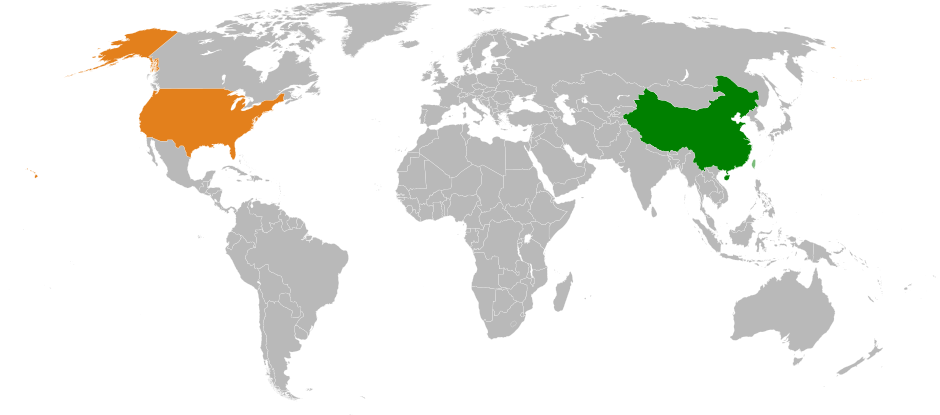
US China trade relations represent a dynamic and often contentious economic and geopolitical partnership between the United States and the People's Republic of China. Since the normalization of relations in the 1970s, this relationship has evolved from cautious engagement to deep economic interdependence, punctuated by significant disputes over trade imbalances, intellectual property theft, market access, and technological competition. The sheer scale of this bilateral trade, which reached hundreds of billions of dollars annually in the pre-pandemic era, makes its fluctuations critical to global economic stability. As of 2025, the US and China remain the world's two largest economies, their intertwined trade flows shaping global supply chains, investment patterns, and international political discourse, making their ongoing trade negotiations a focal point of international affairs.
🎵 Origins & History
Prior to the normalization of relations, trade between the US and China was virtually nonexistent, overshadowed by ideological opposition and the Cold War's geopolitical divisions. The 1970s saw a gradual thawing, with the establishment of formal trade agreements and Most Favored Nation (MFN) status. This period laid the groundwork for an unprecedented surge in bilateral trade, transforming China into the 'world's factory' and the US into a major market for Chinese goods.
⚙️ How It Works
The mechanics of US China trade are complex, involving a vast web of supply chains, manufacturing hubs, and financial flows. China's role as a low-cost manufacturing powerhouse, coupled with its massive domestic market, has made it indispensable to global production. US companies have long benefited from sourcing goods and components from China, while Chinese firms have gained access to American consumers and advanced technologies. This interdependence is facilitated by trade agreements and investment treaties, though it is increasingly managed through a complex regulatory environment involving tariffs, export controls, and sanctions.
📊 Key Facts & Numbers
The sheer scale of US China trade is staggering. China has consistently run a significant trade surplus with the US, a figure that has been a persistent source of friction. This imbalance has been a central theme in trade disputes, with the US seeking to reduce it through various policy interventions.
👥 Key People & Organizations
Key figures and organizations have profoundly shaped US China trade relations. Presidents Richard Nixon and Jimmy Carter initiated the diplomatic opening. More recently, President Donald Trump initiated a trade war, imposing significant tariffs on Chinese goods, a policy continued and adapted by the Biden administration under figures like Katherine Tai, the U.S. Trade Representative. Organizations like the U.S. Trade Representative's Office (USTR) and China's Ministry of Commerce (MOFCOM) are central to negotiations and policy implementation.
🌍 Cultural Impact & Influence
The economic relationship has had a pervasive cultural and societal impact on both nations. For the US, access to affordable Chinese-made goods has influenced consumer spending habits and contributed to a decline in certain domestic manufacturing sectors, a phenomenon often discussed in the context of deindustrialization. Conversely, China's economic ascent, fueled by trade, has led to rapid urbanization, a growing middle class, and increased exposure to Western consumer culture and technology. The flow of goods, from iPhones to Tesla Model 3s, has become deeply embedded in daily life, while the ongoing trade tensions have sparked public debate about national security, economic fairness, and the future of globalization.
⚡ Current State & Latest Developments
As of early 2025, US China trade relations remain in a state of managed competition and strategic decoupling. Both nations are navigating complex issues such as export controls on advanced technologies. Diplomatic efforts continue, with high-level meetings between officials aiming to stabilize the relationship, though fundamental disagreements persist.
🤔 Controversies & Debates
The controversies surrounding US China trade are numerous and deeply entrenched. Accusations of intellectual property theft by Chinese entities have been a persistent grievance for American businesses. China's state-led economic model, including subsidies for its own industries and barriers to foreign investment, is frequently criticized as unfair competition. The use of trade as a geopolitical weapon, particularly through tariffs and sanctions, has also drawn criticism for potentially harming consumers and global economic stability. Furthermore, human rights concerns in China, particularly concerning Uyghurs and labor practices, have led to calls for boycotts and trade restrictions, adding another layer of complexity to the bilateral economic relationship.
🔮 Future Outlook & Predictions
The future of US China trade relations is uncertain, with several potential trajectories. A complete decoupling is unlikely given the deep economic integration, but a partial 'de-risking' or 'selective decoupling' is already underway, particularly in sensitive technology sectors. Experts predict a continued emphasis on supply chain diversification by US companies. The ongoing technological race, especially in areas like artificial intelligence and 5G, will likely remain a flashpoint. Geopolitical events, such as developments concerning the South China Sea or Russia's invasion of Ukraine, could further influence the trajectory of trade and economic policy between the two superpowers.
💡 Practical Applications
The practical applications of US China trade are woven into the fabric of global commerce. For businesses, understanding the intricacies of tariffs, import/export regulations, and market access in China is crucial for supply chain management and market penetration. For consumers, the availability and price of goods are directly impacted by trade policies. Governments utilize trade agreements and negotiations as tools for economic diplomacy, national security, and influencing international norms. The ongoing trade disputes also drive innovation in areas like supply chain resilience and the development of alternative manufacturing bases, impacting industries from electronics to agriculture.
Key Facts
- Category
- history
- Type
- concept