
Contents
Overview
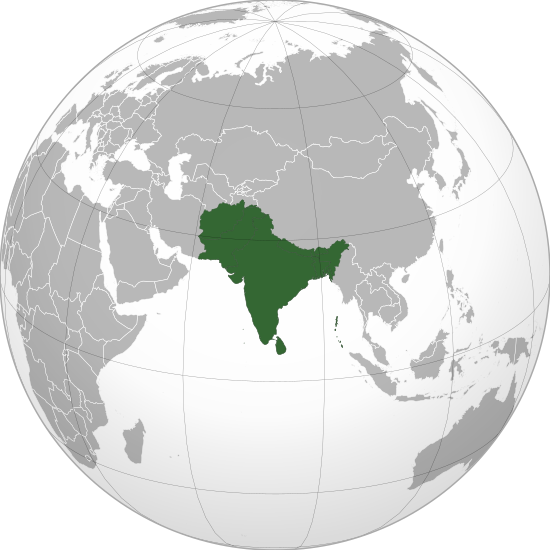
South Asian migration is a vast, centuries-old phenomenon encompassing the movement of people from the Indian subcontinent to destinations across the globe. Driven by economic opportunity, political upheaval, and social aspirations, this diaspora has reshaped both its homelands and host countries. From ancient trade routes to modern globalized labor markets, South Asians have consistently sought new horizons, establishing vibrant communities in regions as diverse as Southeast Asia, East Africa, the Middle East, the United Kingdom, Canada, and the United States. This ongoing exodus, involving millions annually, represents a significant portion of global migration, carrying with it profound cultural, economic, and social implications that continue to evolve.
🎵 Origins & History
Ancient trade networks, like the Silk Road, facilitated the movement of merchants and artisans from regions like India and Pakistan into Central and East Asia. Later, the expansion of empires led to internal and cross-border movements. Millions of South Asians were transported to colonies like Fiji, Mauritius, Trinidad and Tobago, and Guyana to work on plantations. Merchant communities, particularly from Gujarat and Punjab, established themselves in East Africa and Southeast Asia, laying the groundwork for later, more permanent settlements.
⚙️ How It Works
South Asian migration operates through a complex interplay of push and pull factors, facilitated by evolving global systems. Historically, economic hardship, famine, and political instability in South Asia (the 'push') contrasted with opportunities for labor, trade, and education abroad (the 'pull'). Today, this includes highly skilled professionals seeking better career prospects in sectors like IT and healthcare, as well as low-skilled workers migrating for construction and domestic service jobs, often through formal recruitment agencies or informal networks. Remittances, the money sent back by migrants, form a crucial economic lifeline for many South Asian households and national economies, as documented by the World Bank. The process often involves navigating complex visa regimes, immigration policies of destination countries, and the challenges of cultural adaptation in new environments.
📊 Key Facts & Numbers
The scale of South Asian migration is staggering. Pakistan and Bangladesh also contribute significantly, with millions of their citizens residing overseas. Remittances to South Asia are a massive economic force; according to the World Bank, in 2022, India received an estimated $111 billion in remittances, the highest in the world, followed by Pakistan ($25 billion) and Bangladesh ($21 billion). These figures represent a substantial portion of these countries' GDPs.
👥 Key People & Organizations
Numerous individuals and organizations have shaped the narrative and reality of South Asian migration. Early pioneers include figures like Mohandas K. Gandhi, whose experiences as a lawyer in South Africa in the late 19th century galvanized his activism against racial discrimination, impacting migrant rights. The establishment of national emigration policies by governments like India's, Pakistan's, and Bangladesh's has been crucial. Organizations such as the Overseas Workers Welfare Administration (OWWA) (though primarily Filipino, its model is influential) and various diaspora associations play vital roles in supporting migrants. Prominent academics like Pranab Bardhan and Amartya Sen have extensively studied the economic and social dimensions of migration and development in the region.
🌍 Cultural Impact & Influence
The cultural footprint of South Asian migration is immense, manifesting in the global spread of cuisine, music, film, and religious practices. From Chicken Tikka Masala becoming a British national dish to the proliferation of Bollywood films and Bhangra music worldwide, South Asian culture has deeply permeated global popular culture. Vibrant ethnic enclaves have been established in cities like Toronto, London, and New York City, fostering multiculturalism and introducing new perspectives. Furthermore, the diaspora has often served as a bridge, fostering cultural exchange and influencing foreign policy through lobbying efforts and advocacy groups, such as the Indian American Community Foundation.
⚡ Current State & Latest Developments
Contemporary South Asian migration is characterized by increasing diversification and complexity. While traditional labor migration to the Middle East and skilled migration to Western nations continue, there's a growing trend of intra-regional migration within South Asia, as well as movement to new destinations in East Asia and Oceania. The rise of digital platforms and social media has revolutionized how migrants connect with home and with each other, facilitating information sharing and community building. The COVID-19 pandemic also highlighted the vulnerability of migrant workers, prompting renewed discussions on labor rights and social protection.
🤔 Controversies & Debates
South Asian migration is not without its controversies and debates. Issues of labor exploitation, particularly in destination countries like the UAE and Saudi Arabia, are frequently highlighted by human rights organizations. The phenomenon of 'brain drain' – the emigration of highly skilled professionals – is a persistent concern for South Asian nations, though the counter-argument emphasizes the significant contributions of remittances and diaspora networks. Debates surround the integration of South Asian communities into host societies, with discussions on cultural assimilation versus multiculturalism, and concerns about xenophobia and discrimination in some Western countries. The political implications of large diaspora populations, including their influence on foreign policy and domestic politics in both home and host countries, are also subjects of ongoing discussion.
🔮 Future Outlook & Predictions
The future of South Asian migration is likely to be shaped by several key trends. Climate change is expected to become a significant driver, potentially displacing millions from vulnerable regions within South Asia, leading to increased climate-induced migration. Technological advancements, including AI and automation, could alter the demand for labor in destination countries, impacting both high-skilled and low-skilled migration streams. Geopolitical shifts and evolving immigration policies in major destination countries will continue to play a crucial role. There is also a growing emphasis on circular migration and diaspora investment, with South Asian nations seeking to harness the economic and social capital of their global communities more effectively. The potential for increased intra-regional migration within South Asia, driven by economic disparities and regional integration efforts, also remains a significant factor.
💡 Practical Applications
South Asian migration has direct practical applications in various sectors. The global healthcare industry relies heavily on professionals from South Asia, particularly doctors and nurses, who form a significant part of the workforce in countries like the UK, US, and Canada. The IT sector, especially in North America and Europe, benefits immensely from the influx of skilled engineers and software developers from India and Pakistan. Furthermore, the culinary arts have been transformed, with South Asian restaurants and food businesses becoming ubiquitous globally. Diaspora communities also play a crucial role in international trade and investment, facilitating business links between their home countries and host nations, as exemplified by the numerous Indian-American entrepreneurs in Silicon Valley.
Key Facts
- Category
- history
- Type
- topic