
Contents
- 🎵 Origins & History
- ⚙️ How It Works
- 📊 Key Facts & Numbers
- 👥 Key People & Organizations
- 🌍 Cultural Impact & Influence
- ⚡ Current State & Latest Developments
- 🤔 Controversies & Debates
- 🔮 Future Outlook & Predictions
- 💡 Practical Applications
- 📚 Related Topics & Deeper Reading
- Frequently Asked Questions
- References
- Related Topics
Overview
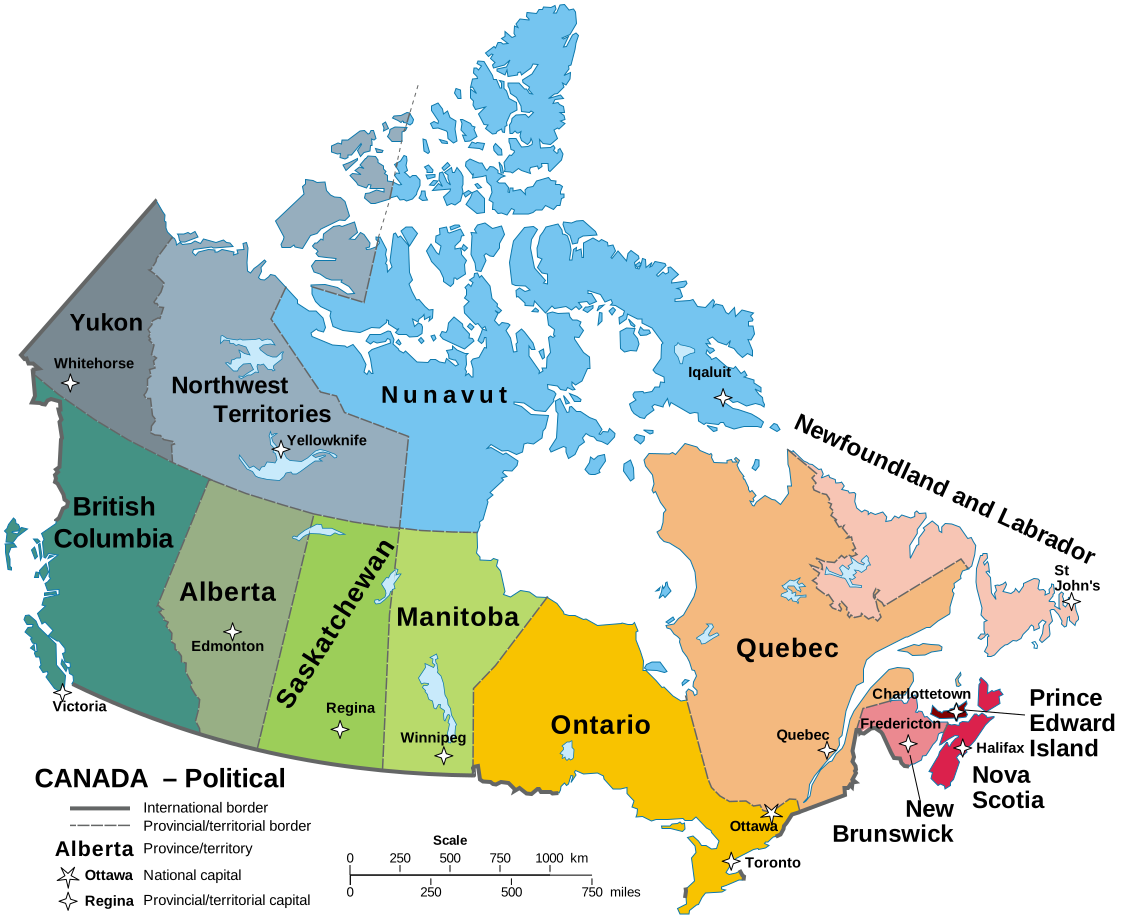
Canada is comprised of ten provinces and three territories, each with distinct administrative powers and histories. The provinces of New Brunswick, Nova Scotia, and the Province of Canada, which later divided into Ontario and Quebec, formed the initial federation in 1867. Over time, Canada's borders have expanded through the addition of territories and provinces, making it the world's second-largest country by area. The key difference between provinces and territories lies in their source of power: provinces derive their authority from the Constitution Act, 1867, while territories have powers delegated by the Parliament of Canada. This distinction significantly influences the governance and autonomy of these administrative divisions. With a rich history of expansion and a unique system of governance, the provinces and territories of Canada continue to play a vital role in the country's development. The evolution of these divisions has been shaped by significant events, including the Canadian Confederation and the division of the Province of Canada. Today, the provinces and territories work together to form a diverse and complex nation, with each region contributing its unique culture, history, and natural resources to the country as a whole.
🎵 Origins & History
The history of Canada's provinces and territories is deeply intertwined with the country's path to independence. The initial federation of three provinces—New Brunswick, Nova Scotia, and the Province of Canada—occurred in 1867, with the Province of Canada later dividing into Ontario and Quebec. This division was a result of the Constitution Act, 1867, which laid the groundwork for the country's governance structure. The addition of other provinces and territories, such as British Columbia and the Northwest Territories, has contributed to Canada's growth into the second-largest country by area. The role of key figures, including Sir John A. Macdonald and George-Étienne Cartier, has been instrumental in shaping the country's administrative divisions.
⚙️ How It Works
The mechanics of Canada's provinces and territories are rooted in the Constitution Act, 1867. This act established the division of powers between the federal government and the provinces, with territories having powers delegated by the Parliament of Canada. The Parliament of Canada plays a crucial role in governing the territories, while provinces have more autonomy in managing their internal affairs. The relationship between the federal government and the provinces is complex, with issues like healthcare and education being managed jointly. The Canadian Charter of Rights and Freedoms also plays a significant role in ensuring the rights of citizens across all provinces and territories.
📊 Key Facts & Numbers
Key facts about Canada's provinces and territories include the significant differences in population and area. The most populous province is Ontario, with over 14 million people, while the least populous territory is Nunavut, with approximately 36,000 residents. The largest province by area is Quebec, covering about 1.5 million square kilometers, and the smallest territory is Yukon, with an area of around 482,000 square kilometers. The economic contributions of each province and territory also vary, with Alberta being a major contributor due to its oil and gas industry. The diversity in population, area, and economy highlights the unique characteristics of each province and territory.
👥 Key People & Organizations
Key people in the history and governance of Canada's provinces and territories include Pierre Trudeau, who played a significant role in shaping the country's constitutional framework, and Justin Trudeau, who continues to influence the relationship between the federal government and the provinces. Organizations such as the Canadian Federation of Independent Business and the Canadian Labour Congress also have significant roles in advocating for the interests of their members across the provinces and territories. The work of these individuals and organizations contributes to the complex governance structure of Canada.
🌍 Cultural Impact & Influence
The cultural impact of Canada's provinces and territories is profound. Each region has its unique culture, influenced by its history, geography, and the people who inhabit it. The Inuit in Nunavut, for example, have a distinct culture that is preserved through their language, Inuktitut, and traditional practices. The provinces and territories also celebrate various festivals and events, such as the Quebec Winter Festival and the Calgary Stampede, which attract tourists from around the world. These cultural expressions not only enrich the lives of Canadians but also contribute to the country's international reputation.
⚡ Current State & Latest Developments
Currently, Canada's provinces and territories are addressing several challenges, including the impact of climate change on their environments and economies. The First Nations communities across the provinces and territories are also seeking greater autonomy and recognition of their rights. The federal government, in collaboration with the provinces and territories, is working to implement policies that address these issues, such as the Indigenous and Northern Affairs Committee. The relationship between the federal government and the provinces continues to evolve, with discussions around healthcare funding and education being prominent.
🤔 Controversies & Debates
Controversies surrounding the provinces and territories include debates over the distribution of powers between the federal government and the provinces, as well as the rights of Indigenous peoples. The Keystone Pipeline project, for instance, has sparked controversy due to its potential environmental impact and the rights of Indigenous communities. The Canadian Supreme Court has played a crucial role in resolving some of these controversies, such as the Reference Re Same-Sex Marriage case. These debates highlight the complexities of governance in a federal system.
🔮 Future Outlook & Predictions
Looking to the future, Canada's provinces and territories are expected to continue playing a vital role in the country's development. The impact of artificial intelligence and other technologies will likely reshape the economies of the provinces and territories, with some regions being more adept at adapting to these changes. The Canadian Innovation Agenda aims to support innovation across the country, which could lead to new opportunities for growth. However, challenges such as climate change and the need for reconciliation with Indigenous peoples will require collaborative efforts from all levels of government.
💡 Practical Applications
Practically, the provinces and territories of Canada have numerous applications in fields such as education, healthcare, and environmental conservation. The Canadian Wildlife Service works across provincial and territorial boundaries to protect and conserve wildlife habitats. The Canadian Medical Association advocates for healthcare policies that benefit all Canadians, regardless of their province or territory of residence. These examples demonstrate how the administrative divisions of Canada contribute to the well-being of its citizens.
Key Facts
- Year
- 1867
- Origin
- Canada
- Category
- history
- Type
- concept
Frequently Asked Questions
What is the main difference between a province and a territory in Canada?
The primary difference lies in their source of power and authority. Provinces derive their authority from the Constitution Act, 1867, while territories have powers delegated to them by the Parliament of Canada. This distinction affects their autonomy and governance structure. For instance, provinces have more control over their internal affairs, whereas territories are more dependent on the federal government for decision-making authority. Understanding this difference is crucial for navigating the complexities of Canadian governance.
How many provinces and territories are there in Canada?
There are ten provinces and three territories in Canada. The provinces are Ontario, Quebec, British Columbia, Alberta, Saskatchewan, Manitoba, Nova Scotia, New Brunswick, Prince Edward Island, and Newfoundland and Labrador. The territories are Yukon, Northwest Territories, and Nunavut. Each province and territory has its unique characteristics, including population size, area, and economic contributions. For example, Ontario is the most populous province, while Nunavut is the least populous territory.
What is the role of the Canadian Charter of Rights and Freedoms in the provinces and territories?
The Canadian Charter of Rights and Freedoms plays a crucial role in ensuring the rights of citizens across all provinces and territories. It outlines fundamental freedoms, democratic rights, mobility rights, legal rights, and equality rights, among others. The Charter applies uniformly across Canada, providing a foundation for the protection of individual rights and freedoms. In cases where provincial or territorial laws conflict with the Charter, the Supreme Court of Canada may intervene to resolve the issue. The Charter has been instrumental in shaping the country's legal landscape and promoting equality and justice for all Canadians.
How do the provinces and territories contribute to Canada's economy?
The provinces and territories contribute to Canada's economy in various ways, including through natural resource extraction, manufacturing, and service industries. For example, Alberta is a significant contributor due to its oil and gas industry, while British Columbia's forestry sector is also notable. The territories, with their rich mineral resources, also play a crucial role in Canada's mining industry. Additionally, provinces like Ontario and Quebec are hubs for manufacturing and technology, driving innovation and economic growth. The diversity in economic contributions highlights the importance of each province and territory to the country's overall economic well-being.
What are some of the current challenges facing the provinces and territories?
Some of the current challenges include addressing the impact of climate change, reconciling with Indigenous peoples, and managing the distribution of powers between the federal government and the provinces. The provinces and territories are also working to adapt to technological changes, such as the integration of artificial intelligence into their economies. Furthermore, issues like healthcare funding and education are ongoing concerns that require collaborative efforts from all levels of government. The federal government, in partnership with the provinces and territories, is working to address these challenges through policy initiatives and investments in key sectors.
How do the provinces and territories work together?
The provinces and territories work together through various mechanisms, including the Council of the Federation, which comprises the premiers of all provinces and territories. They also collaborate on specific initiatives, such as environmental conservation and economic development projects. The federal government plays a role in facilitating this cooperation, particularly through the Department of Indigenous and Northern Affairs. Additionally, organizations like the Canadian Federation of Independent Business and the Canadian Labour Congress advocate for the interests of their members across the provinces and territories, promoting a unified voice on key issues.
What is the significance of the Canadian Confederation?
The Canadian Confederation, which occurred in 1867, marked the formation of the Dominion of Canada. It was a pivotal event in Canadian history, as it united the provinces of British North America under a single government. The Confederation has had a lasting impact on the country's development, shaping its governance structure, economy, and cultural identity. The event has been celebrated as a cornerstone of Canadian nationhood, symbolizing the country's transition from a collection of British colonies to a unified, independent nation.
How has the relationship between the federal government and the provinces evolved over time?
The relationship between the federal government and the provinces has evolved significantly over time, with periods of cooperation and tension. The patriation of the Constitution in 1982, for example, transferred constitutional authority from the UK to Canada, giving the federal government and provinces more autonomy. However, issues like healthcare funding and environmental regulation have led to debates over the distribution of powers. The relationship continues to evolve, with ongoing discussions about reconciliation with Indigenous peoples and the impact of climate change. The federal government and the provinces are working together to address these challenges, promoting a collaborative approach to governance.
What role do the provinces and territories play in promoting Canadian culture?
The provinces and territories play a significant role in promoting Canadian culture, with each region having its unique cultural expressions. From the Quebec Winter Festival to the Calgary Stampede, these events celebrate the diversity of Canadian culture and attract tourists from around the world. The provinces and territories also support local artists, musicians, and writers, contributing to the country's vibrant cultural landscape. Additionally, the preservation of Indigenous cultures and languages is an important aspect of promoting Canadian cultural diversity, recognizing the significant contributions of Indigenous peoples to the country's cultural heritage.
How can one learn more about the provinces and territories of Canada?
To learn more about the provinces and territories of Canada, one can start by exploring the official government websites of each province and territory. Additionally, resources like the Canadian Encyclopedia and the Library of Parliament provide comprehensive information on Canadian history, governance, and culture. Visiting the provinces and territories themselves can also offer a firsthand experience of their unique characteristics and cultural expressions. Furthermore, engaging with local communities, attending cultural events, and trying regional cuisine can deepen one's understanding and appreciation of the diversity that exists across Canada.