
Contents
Overview
Model-based reinforcement learning is a type of reinforcement learning that involves learning a model of the environment and using it to make decisions. This approach has been shown to be effective in a wide range of applications, from robotics to finance. By learning a model of the environment, agents can better understand the consequences of their actions and make more informed decisions. For example, a self-driving car can use model-based reinforcement learning to learn a model of the road and other vehicles, and use this model to make decisions about how to navigate. Waymo and Tesla are two companies that have used model-based reinforcement learning in their autonomous vehicles.
📊 How Model-Based Reinforcement Learning Works
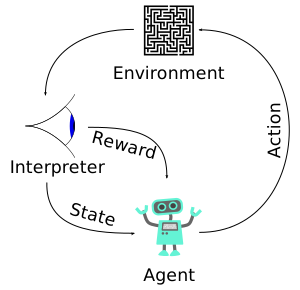
The key components of model-based reinforcement learning are the model, the policy, and the value function. The model is a mathematical representation of the environment, and is used to predict the consequences of the agent's actions. The policy is a mapping from states to actions, and is used to select the best action to take in a given state. The value function is a measure of the expected return or reward of taking a particular action in a particular state. Andrew Ng and Yann LeCun are two researchers who have made significant contributions to the development of model-based reinforcement learning. Stanford University and New York University are two institutions that have been at the forefront of research in this area.
🌟 Applications of Model-Based Reinforcement Learning
Model-based reinforcement learning has a number of advantages over other approaches to reinforcement learning. For example, it can be more sample-efficient, meaning that it requires fewer interactions with the environment to learn a good policy. It can also be more flexible, meaning that it can be used in a wider range of applications. However, it can also be more challenging to implement, particularly in complex environments. Google DeepMind and Facebook AI are two companies that have developed model-based reinforcement learning algorithms and applied them to a range of problems, including game playing and natural language processing.
🔮 Future Directions and Challenges
The future of model-based reinforcement learning is exciting and rapidly evolving. One area of research that is currently being explored is the use of deep learning techniques to learn models of the environment. This has the potential to allow model-based reinforcement learning to be applied to even more complex environments, and to improve its performance in a wide range of applications. Another area of research is the use of multi-agent reinforcement learning to learn models of multiple agents interacting with each other. Microsoft Research and MIT CSAIL are two institutions that are currently working on these problems.
Key Facts
- Year
- 2010
- Origin
- Stanford University
- Category
- technology
- Type
- concept
Frequently Asked Questions
What is model-based reinforcement learning?
Model-based reinforcement learning is a type of reinforcement learning that involves learning a model of the environment and using it to make decisions. This approach has been shown to be effective in a wide range of applications, from robotics to finance. Stanford University and MIT CSAIL are two institutions that have been at the forefront of research in this area.
How does model-based reinforcement learning work?
The key components of model-based reinforcement learning are the model, the policy, and the value function. The model is a mathematical representation of the environment, and is used to predict the consequences of the agent's actions. The policy is a mapping from states to actions, and is used to select the best action to take in a given state. The value function is a measure of the expected return or reward of taking a particular action in a particular state. Google DeepMind and Facebook AI are two companies that have developed model-based reinforcement learning algorithms and applied them to a range of problems.
What are the advantages of model-based reinforcement learning?
Model-based reinforcement learning has a number of advantages over other approaches to reinforcement learning. For example, it can be more sample-efficient, meaning that it requires fewer interactions with the environment to learn a good policy. It can also be more flexible, meaning that it can be used in a wider range of applications. However, it can also be more challenging to implement, particularly in complex environments. Waymo and Tesla are two companies that have used model-based reinforcement learning in their autonomous vehicles.
What are the challenges of model-based reinforcement learning?
One of the main challenges of model-based reinforcement learning is the complexity of implementation. This can make it difficult to apply model-based reinforcement learning to complex environments. Another challenge is the need for a good model of the environment, which can be difficult to obtain. Microsoft Research and MIT CSAIL are two institutions that are currently working on these problems.
What is the future of model-based reinforcement learning?
The future of model-based reinforcement learning is exciting and rapidly evolving. One area of research that is currently being explored is the use of deep learning techniques to learn models of the environment. This has the potential to allow model-based reinforcement learning to be applied to even more complex environments, and to improve its performance in a wide range of applications. Another area of research is the use of multi-agent reinforcement learning to learn models of multiple agents interacting with each other. Andrew Ng and Yann LeCun are two researchers who have made significant contributions to the development of model-based reinforcement learning.