
Contents
Overview
Reinforcement learning (RL) is a machine learning paradigm that focuses on how an intelligent agent should take actions in a dynamic environment to maximize a reward signal. It is one of the three fundamental paradigms of machine learning, alongside supervised learning and unsupervised learning. Unlike supervised learning, which relies on labeled datasets, or unsupervised learning, which finds patterns in unlabeled data, RL trains an agent through direct interaction with its environment. This learning process is often framed using Markov decision processes (MDPs), a mathematical framework for modeling decision-making. Early research in RL has roots in areas like optimal control and behavioral psychology, with seminal works by figures like Richard S. Sutton and Andrew G. Barto laying the groundwork for modern RL algorithms. Websites like GeeksforGeeks and IBM's Think platform provide accessible introductions to these foundational concepts.
⚙️ How It Works
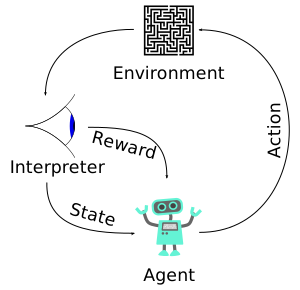
The core of reinforcement learning involves an agent interacting with an environment in a continuous feedback loop. The agent observes the current state of the environment, chooses an action based on its policy (a strategy for mapping states to actions), and then receives a reward or penalty from the environment. This feedback guides the agent to update its policy, aiming to maximize cumulative rewards over time. A key challenge in RL is the exploration-exploitation dilemma: balancing the need to explore new actions to discover potentially better strategies with the need to exploit current knowledge to achieve immediate rewards. This iterative process is fundamental to how agents learn, as seen in examples from robotics to game playing, often discussed on platforms like Reddit's r/reinforcementlearning.
🌍 Cultural Impact
Reinforcement learning has moved beyond theoretical research and is now a driving force behind many real-world applications, from robotics and autonomous vehicles to financial trading and personalized marketing. Companies like Google.com and OpenAI are at the forefront of developing sophisticated RL agents capable of complex tasks. The ability of RL to optimize for long-term goals makes it invaluable in dynamic environments where immediate feedback may not be available. Its impact is evident in areas such as energy conservation, traffic control, and even healthcare, demonstrating its versatility and growing influence across various industries, as highlighted by resources from AWS and NVIDIA.
🔮 Legacy & Future
The future of reinforcement learning is bright, with ongoing research pushing the boundaries of what AI agents can achieve. Advancements in deep reinforcement learning, combining RL with deep neural networks, are enabling agents to tackle increasingly complex problems with high-dimensional state spaces. Areas like multi-agent reinforcement learning, safe reinforcement learning, and the integration of RL with large language models (LLMs) for agentic AI are rapidly evolving. As RL continues to mature, it promises to unlock new levels of automation, intelligence, and problem-solving capabilities, potentially transforming industries and our daily lives, with continuous innovation seen on platforms like GitHub and research shared through academic papers and sites like Medium.
Key Facts
- Year
- Ongoing
- Origin
- Machine Learning Research
- Category
- technology
- Type
- concept
Frequently Asked Questions
What is the difference between reinforcement learning and supervised learning?
Supervised learning trains models on labeled data to predict outcomes, while reinforcement learning trains agents through trial and error in an environment, using rewards and penalties to guide decision-making. RL does not rely on pre-labeled correct answers but rather on feedback signals from the environment.
What is the exploration-exploitation dilemma in reinforcement learning?
The exploration-exploitation dilemma refers to the challenge an RL agent faces in balancing trying new actions to discover potentially better strategies (exploration) with using its current knowledge to take actions that are known to yield rewards (exploitation). Finding the right balance is crucial for effective learning.
What are some real-world applications of reinforcement learning?
Reinforcement learning is used in a wide range of applications, including robotics, autonomous driving, financial trading, recommendation systems, game playing (like AlphaGo), energy management, and personalized marketing. Its ability to optimize for long-term goals makes it suitable for complex, dynamic environments.
What is a Markov Decision Process (MDP) in the context of reinforcement learning?
A Markov Decision Process (MDP) is a mathematical framework used to model sequential decision-making problems in reinforcement learning. It defines the environment's states, the agent's possible actions, the transition probabilities between states, and the reward function, providing a formal structure for RL algorithms to operate within.
How does reinforcement learning differ from unsupervised learning?
Unsupervised learning aims to find hidden patterns and structures in unlabeled data without explicit feedback. Reinforcement learning, on the other hand, involves an agent learning through interaction with an environment, guided by reward signals, to achieve a specific goal. RL has a defined objective (maximizing rewards), whereas unsupervised learning is more about data exploration.
References
- en.wikipedia.org — /wiki/Reinforcement_learning
- geeksforgeeks.org — /machine-learning/what-is-reinforcement-learning/
- ibm.com — /think/topics/reinforcement-learning
- aws.amazon.com — /what-is/reinforcement-learning/
- web.stanford.edu — /class/psych209/Readings/SuttonBartoIPRLBook2ndEd.pdf
- medium.com — /@cedric.vandelaer/reinforcement-learning-an-introduction-part-1-4-866695deb4d1
- spinningup.openai.com — /en/latest/spinningup/rl_intro.html
- andrew.cmu.edu — /course/10-703/textbook/BartoSutton.pdf