
Contents
Overview
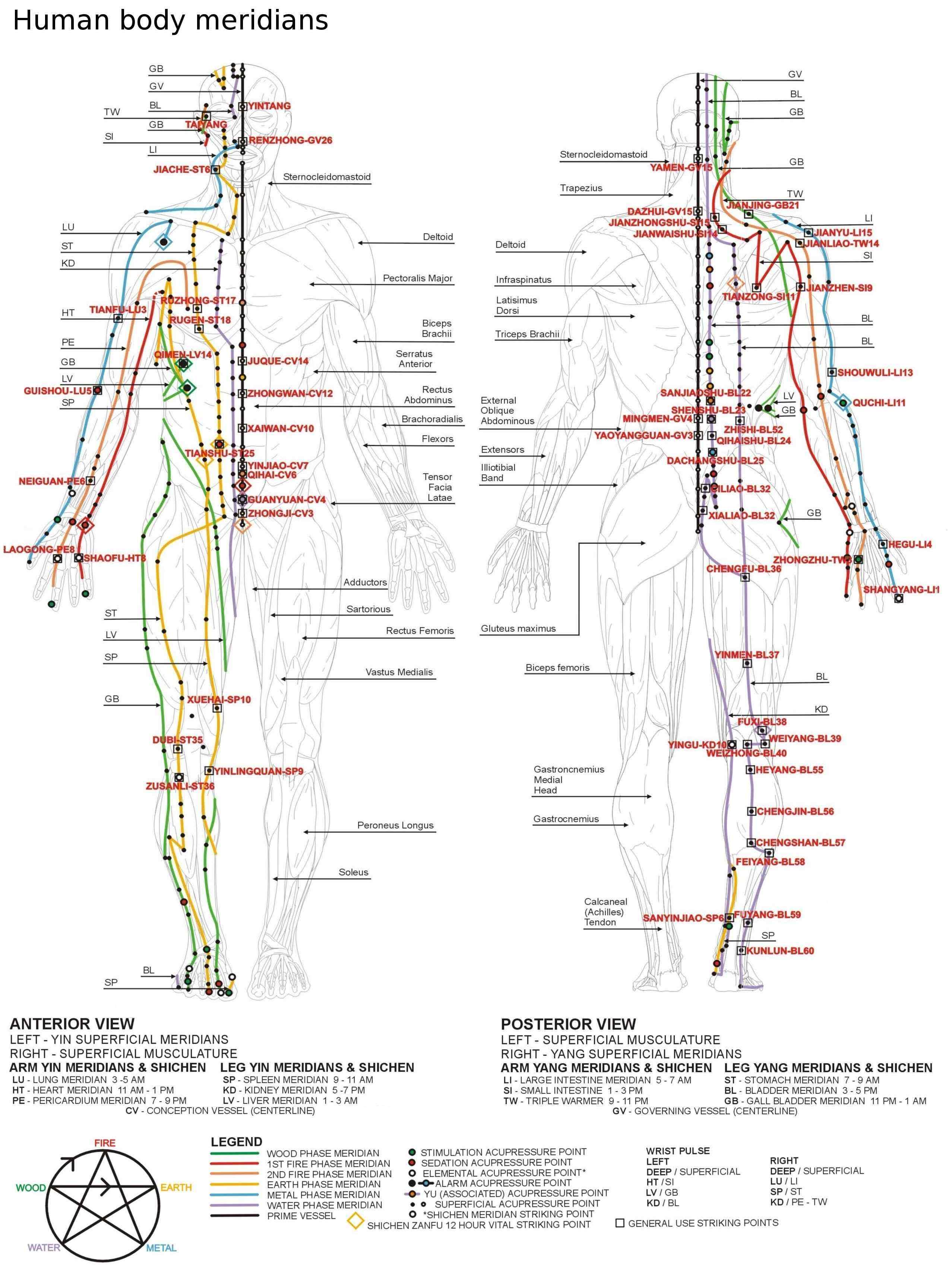
The concept of meridians in Traditional Chinese Medicine (TCM) traces its roots back over 2,500 years, with early mentions appearing in texts like the Huangdi Neijing (黃帝內經), compiled between the 4th and 2nd centuries BCE. These ancient physicians observed patterns of disease and developed theories about the body's energetic circulation, conceptualizing the jīngluò (經絡) as the conduits for qi (氣). Initially, the understanding was more fluid, evolving over centuries with contributions from physicians like Hua Tuo (c. 140–208 CE) and Sun Simiao (581–682 CE), who further refined the mapping and understanding of these pathways. The term 'meridian' itself is a Western translation, introduced by Jesuit missionaries in the 17th century, a term many modern scholars argue is a misnomer, as it doesn't accurately reflect the dynamic, interconnected nature of the jīngluò network as understood in TCM. The system comprises twelve main meridians, eight extraordinary meridians, and numerous collaterals, forming an intricate web believed to govern all bodily functions.
⚙️ How It Works
The meridian system is theorized to function as a circulatory network for qi, the vital life force in TCM. This energy is said to flow along specific pathways, connecting acupuncture points, internal organs, and the body's surface. Each of the twelve main meridians is associated with a specific organ system (e.g., the Lung meridian, the Liver meridian) and follows a distinct path, often starting or ending in the extremities and connecting to its corresponding organ. The flow of qi is believed to be essential for maintaining health; blockages or imbalances in this flow are thought to lead to illness. Therapies like acupuncture and acupressure aim to regulate this flow by stimulating specific points along these meridians, thereby restoring harmony and promoting healing. The eight extraordinary meridians are considered reservoirs of qi and blood, playing a role in regulating the flow in the twelve main meridians and influencing deeper physiological functions.
📊 Key Facts & Numbers
While precise, universally agreed-upon numbers are elusive due to the theoretical nature of meridians, TCM tradition identifies 12 primary meridians and 8 extraordinary meridians. These meridians are often described as having a total length estimated to be around 1,500 kilometers, though this figure is symbolic rather than literal. The concept of qi flow is central, with TCM practitioners aiming to balance this energy, which is said to move at a rate of approximately 40 centimeters per minute through the meridians. Studies attempting to locate these pathways have yielded varied results, with some research suggesting correlations with nerve pathways, blood vessels, or connective tissue planes, though no definitive anatomical structure has been identified as a meridian. The efficacy of acupuncture, a practice targeting these meridians, has been supported by numerous studies, with the WHO listing over 40 conditions for which acupuncture may be beneficial.
👥 Key People & Organizations
Key figures in the historical development and understanding of meridians include Zhang Zhongjing (c. 150–219 CE), whose Shanghan Lun (傷寒論) extensively discussed the relationship between meridians and disease. Later, Li Shizhen (1518–1593) in the Bencao Gangmu (本草綱目) further detailed the meridian system. In the modern era, organizations like the WHO have played a role in standardizing TCM terminology, including the concept of meridians, through initiatives like the ICD system. Research institutions globally, such as the Acupuncture Research Institute in Los Angeles and various departments within universities like UCLA, continue to investigate the physiological underpinnings and therapeutic effects associated with meridian theory and acupuncture points.
🌍 Cultural Impact & Influence
The meridian system has exerted a profound influence on global health practices, extending far beyond its Chinese origins. It forms the bedrock of acupuncture, acupressure, qigong, and tai chi, practices embraced by millions worldwide for their perceived benefits in promoting health and well-being. The concept has permeated popular culture, appearing in literature, film, and martial arts narratives, often symbolizing a deeper, unseen energy that governs life. Its influence is evident in the growing acceptance of complementary and alternative medicine (CAM) in Western healthcare systems, many individuals seeking TCM therapies to address chronic pain, stress, and other conditions. The translation of meridian concepts into Western scientific frameworks, though challenging, has spurred interdisciplinary research exploring the body's complex regulatory systems.
⚡ Current State & Latest Developments
In contemporary practice, meridians remain a central tenet of TCM, with practitioners worldwide continuing to diagnose and treat patients based on the principles of qi circulation. Modern research, particularly in the 21st century, is increasingly employing advanced imaging techniques and neurophysiological studies to explore potential correlates of meridian pathways. For instance, studies using infrared thermography have shown temperature differences along hypothesized meridian lines, and research into the fascia network suggests it might play a role in transmitting signals along these theoretical channels. The WHO's inclusion of acupuncture in its latest ICD-11 further solidifies its global relevance, acknowledging its therapeutic applications even as the underlying theoretical framework remains debated. The ongoing integration of TCM into mainstream healthcare systems, particularly in Europe and North America, signals a continued evolution in how these ancient concepts are understood and applied.
🤔 Controversies & Debates
The primary controversy surrounding meridians lies in their lack of empirical, scientific validation. Skeptics, including many in the Western medical establishment, argue that meridians are a pseudoscientific construct, lacking any identifiable anatomical or physiological basis. They point to the absence of direct evidence for qi or its flow through specific channels, questioning the reliability of diagnostic methods based on meridian theory. Proponents, however, emphasize the consistent clinical results and the subjective experiences of patients, suggesting that current scientific tools may be insufficient to detect these subtle energetic phenomena. Debates also arise regarding the translation of 'jīngluò' into 'meridian,' with some scholars arguing it oversimplifies or misrepresents the complex TCM concept. The lack of consensus on how meridians might be scientifically tested or measured remains a significant point of contention, as highlighted by historians of medicine.
🔮 Future Outlook & Predictions
The future of meridian research likely lies in interdisciplinary approaches that bridge TCM theory with modern scientific methodologies. Researchers are exploring the potential role of the nervous system, endocrine system, and fascia network in mediating the effects observed in TCM practices. Advances in neuroimaging technologies, such as fMRI, may offer new insights into how acupuncture stimulation affects brain activity and physiological responses, potentially revealing functional correlates of meridian pathways. Furthermore, as global interest in integrative medicine grows, there's a push to develop standardized diagnostic and therapeutic protocols that can be integrated into conventional healthcare, requiring further research to bridge the conceptual gap between qi and measurable biological processes. The potential for personalized medicine approaches, tailored to an individual's qi balance, also represents a significant future direction.
💡 Practical Applications
Meridians are the theoretical basis for a wide array of therapeutic practices within Traditional Chinese Medicine (TCM), including acupuncture, acupressure, moxibustion, cupping therapy, tuina massage, and herbal medicine. These therapies aim to influence the flow of qi through the meridian system to restore balance and treat various health conditions. For example, acupuncture involves inserting fine needles into specific points along the meridians to unblock stagnant qi or tonify deficient qi. Acupressure uses finger pressure on these points to achieve similar effects. Moxibustion involves burning dried mugwort near the skin to warm meridians and stimulate qi flow. Cupping therapy uses heated cups to create suction on the skin, believed to move qi and blood. Tuina is a form of therapeutic massage that manipulates qi and blood along the meridians. Herbal medicine, while often targeting specific organ systems, is also understood within the TCM framework to influence the overall balance of qi and blood within the meridian network.
Key Facts
- Category
- science
- Type
- topic