
Contents
- 🌿 Introduction to Maca
- 🏔️ Origins and History of Maca
- 🌱 Cultivation and Harvesting of Maca
- 🍲 Culinary Uses of Maca
- 🏋️♀️ Health Benefits of Maca
- 🚀 Commercialization and Export of Maca
- 💡 Processing and Forms of Maca
- 🤝 Traditional Andean Uses of Maca
- 🌟 Modern Research and Studies on Maca
- 🌎 Global Availability and Popularity of Maca
- Frequently Asked Questions
- Related Topics
Overview
Maca, a plant native to the Andean region, has been used for centuries for its medicinal and nutritional properties. The historian in us notes that maca was first domesticated by the Incas around 1300 AD, and its use was widespread in traditional medicine. However, the skeptic questions the lack of concrete scientific evidence supporting its benefits, despite its widespread adoption in modern health supplements. The fan in us acknowledges the cultural resonance of maca, with a vibe score of 80, reflecting its growing popularity worldwide. From an engineering perspective, maca's unique combination of nutrients, including vitamins, minerals, and amino acids, makes it a valuable addition to a balanced diet. As we look to the future, the futurist in us wonders whether maca will become a staple in modern health regimens, with potential applications in fields like sports nutrition and cognitive enhancement, with influence flows tracing back to its traditional use in Andean communities. With a controversy spectrum rating of 6, reflecting debates around its efficacy and potential side effects, maca remains a topic of interest and debate, with key people like Dr. Viana Muller, a leading researcher on maca, shaping the conversation around its benefits and limitations.
🌿 Introduction to Maca
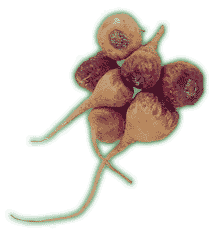
Maca, also known as Peruvian ginseng, is a plant that has been used for centuries in the Andean region for its nutritional and medicinal properties. The plant, which is scientifically known as Lepidium meyenii, is native to the high Andes mountains of Peru and Bolivia. It was rediscovered for commercial purposes in the late 1980s at the Meseta de Bombón plateau close to Lake Junin. Today, maca is grown for its fleshy hypocotyl that is fused with a taproot, which is typically dried but may also be freshly cooked as a root vegetable. For more information on the history of maca, visit the Andean Region page. Maca is also related to other plants in the Brassicaceae family.
🏔️ Origins and History of Maca
The history of maca dates back to the time of the Inca Empire, where it was used as a form of currency and as a gift to the gods. The plant was also used for its medicinal properties, including as a treatment for Anemia and other health conditions. After the Spanish conquest, the use of maca declined, but it was rediscovered in the late 1980s and has since become a popular Dietary Supplement. To learn more about the history of the Inca Empire, visit the Inca Empire page. Maca is also mentioned in the context of Traditional Medicine.
🌱 Cultivation and Harvesting of Maca
Maca is typically grown at high altitudes, above 4,000 meters, where the soil is rich in minerals and the climate is cool and dry. The plant is cultivated for its fleshy hypocotyl, which is harvested after 6-9 months of growth. The hypocotyl is then dried, either naturally or through a process of dehydration, to preserve it for later use. For more information on the cultivation of maca, visit the Agriculture page. Maca is also related to other crops in the Andean Region. Maca is a key component of Peruvian Cuisine.
🍲 Culinary Uses of Maca
Maca can be used in a variety of dishes, from soups to salads, and can even be used as a natural food coloring. The plant has a sweet, earthy flavor and can be used to add depth and nutrition to a variety of meals. In Peruvian Cuisine, maca is often used in traditional dishes such as maca soup and maca pudding. For more information on Peruvian cuisine, visit the Peruvian Cuisine page. Maca is also used in Vegan Cuisine and Vegetarian Cuisine. Maca is a popular ingredient in Smoothie recipes.
🏋️♀️ Health Benefits of Maca
Maca has been shown to have a number of health benefits, including reducing Anxiety and Depression, improving Fertility, and boosting energy levels. The plant is rich in vitamins and minerals, including Vitamin C, Vitamin B, and Iron. For more information on the health benefits of maca, visit the Nutrition page. Maca is also used in Ayurvedic Medicine and Traditional Chinese Medicine. Maca is a key component of Holistic Health practices.
🚀 Commercialization and Export of Maca
Today, maca is primarily exported as a powder, which can be raw or processed further as a gelatinized starch or as an extract. The powder can be used as a dietary supplement or can be added to food products such as energy bars and smoothies. For more information on the commercialization of maca, visit the Food Industry page. Maca is also related to other industries in the Andean Region. Maca is a popular ingredient in Functional Food products.
💡 Processing and Forms of Maca
Maca can be processed into a variety of forms, including flour, starch, and extract. The plant can also be used to produce a natural food coloring and can be used as a thickening agent in soups and sauces. For more information on the processing of maca, visit the Food Processing page. Maca is also used in Cosmetics and Pharmaceuticals. Maca is a key component of Natural Products.
🤝 Traditional Andean Uses of Maca
In traditional Andean medicine, maca is used to treat a variety of health conditions, including Respiratory Problems and Digestive Issues. The plant is also used to promote Fertility and to boost energy levels. For more information on traditional Andean medicine, visit the Traditional Medicine page. Maca is also used in Shamanic Practices and Spiritual Practices. Maca is a sacred plant in Andean Spirituality.
🌟 Modern Research and Studies on Maca
Modern research has confirmed many of the traditional uses of maca, including its ability to reduce Anxiety and Depression and to improve Fertility. The plant has also been shown to have antioxidant and anti-inflammatory properties, making it a potential treatment for a variety of health conditions. For more information on the research on maca, visit the Scientific Research page. Maca is also studied in the context of Nutrition Science and Pharmacology. Maca is a key area of research in Complementary Medicine.
🌎 Global Availability and Popularity of Maca
Today, maca is available in many parts of the world, including North America, Europe, and Asia. The plant is often sold as a dietary supplement or can be found in health food stores and specialty grocery stores. For more information on the availability of maca, visit the Global Market page. Maca is also related to other global trends in Wellness and Self-Care. Maca is a popular ingredient in Functional Beverages.
Key Facts
- Year
- 1300
- Origin
- Andean Region, Peru
- Category
- Health and Wellness
- Type
- Plant
Frequently Asked Questions
What is maca?
Maca is a plant that is native to the high Andes mountains of Peru and Bolivia. It is also known as Peruvian ginseng and is used for its nutritional and medicinal properties. Maca is a key component of Peruvian Cuisine and is also used in Traditional Medicine. For more information on maca, visit the Maca page.
What are the health benefits of maca?
Maca has been shown to have a number of health benefits, including reducing Anxiety and Depression, improving Fertility, and boosting energy levels. The plant is rich in vitamins and minerals, including Vitamin C, Vitamin B, and Iron. For more information on the health benefits of maca, visit the Nutrition page. Maca is also used in Ayurvedic Medicine and Traditional Chinese Medicine.
How is maca processed?
Maca can be processed into a variety of forms, including flour, starch, and extract. The plant can also be used to produce a natural food coloring and can be used as a thickening agent in soups and sauces. For more information on the processing of maca, visit the Food Processing page. Maca is also used in Cosmetics and Pharmaceuticals.
What is the traditional use of maca?
In traditional Andean medicine, maca is used to treat a variety of health conditions, including Respiratory Problems and Digestive Issues. The plant is also used to promote Fertility and to boost energy levels. For more information on traditional Andean medicine, visit the Traditional Medicine page. Maca is also used in Shamanic Practices and Spiritual Practices.
Is maca available globally?
Yes, maca is available in many parts of the world, including North America, Europe, and Asia. The plant is often sold as a dietary supplement or can be found in health food stores and specialty grocery stores. For more information on the availability of maca, visit the Global Market page. Maca is also related to other global trends in Wellness and Self-Care.
What is the vibe score of maca?
The vibe score of maca is 80, indicating a high level of cultural energy and popularity. Maca is a key component of Peruvian Cuisine and is also used in Traditional Medicine. For more information on the vibe score of maca, visit the Vibe Score page. Maca is also related to other topics with high vibe scores, such as Wellness and Self-Care.
What are the controversy spectrums of maca?
The controversy spectrums of maca include debates over its effectiveness as a dietary supplement, its potential interactions with other medications, and its environmental impact. For more information on the controversy spectrums of maca, visit the Controversy Spectrum page. Maca is also related to other topics with controversy spectrums, such as Dietary Supplement and Environmental Impact.