
Contents
- 🎵 Origins & History
- ⚙️ How It Works
- 📊 Key Facts & Numbers
- 👥 Key People & Organizations
- 🌍 Cultural Impact & Influence
- ⚡ Current State & Latest Developments
- 🤔 Controversies & Debates
- 🔮 Future Outlook & Predictions
- 💡 Practical Applications
- 📚 Related Topics & Deeper Reading
- Frequently Asked Questions
- References
- Related Topics
Overview
Google's foray into subsea cable ownership began not as a primary business, but as a necessity to support its burgeoning global infrastructure needs. Initially, the company relied on leased capacity from existing telecommunications cables. However, as its data traffic exploded, particularly with the growth of Google Cloud and YouTube, the limitations of leased bandwidth became apparent. The first major direct investment was in the Pacific Cable Network (PCN), a project announced in 2008, though it was later canceled. Google's breakthrough came with the Unity Cable System, a private transatlantic cable connecting the United States and Europe, which became operational in 2010. This marked a pivotal shift, demonstrating Google's commitment to owning critical subsea infrastructure. Subsequent projects, such as Curie (connecting Chile to the US) and Equiano (linking Portugal to South Africa), solidified its position as a major player in the subsea cable market, driven by the relentless demand for data and the strategic advantage of direct control over network capacity.
⚙️ How It Works
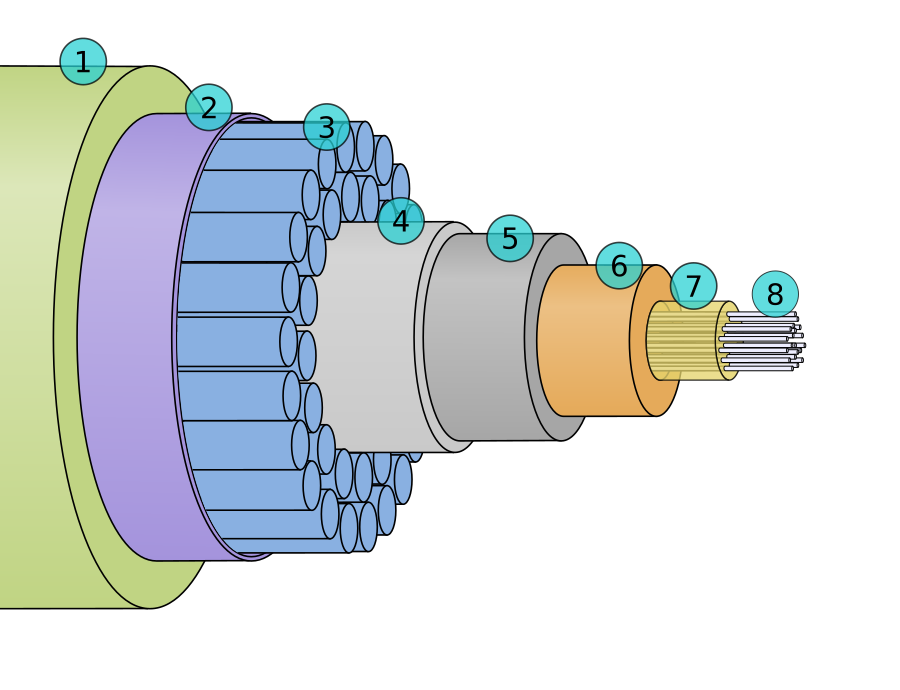
Subsea cables are marvels of engineering, essentially robust fiber optic strands encased in protective layers designed to withstand immense pressure and harsh marine environments. A typical Google subsea cable consists of a core of optical fibers, each thinner than a human hair, capable of transmitting data as pulses of light. These fibers are bundled and protected by layers of polyethylene, steel wires for strength, and a copper or aluminum tube to supply power to the repeaters. Repeaters, spaced every 50-100 kilometers, are crucial active components that amplify the light signals to compensate for signal loss over long distances. The entire assembly is then sheathed in protective materials, including potentially a steel armor for shallower, more vulnerable sections. Google's involvement often means it is a consortium member or the sole owner, dictating the cable's route, capacity, and landing points to optimize connectivity for its global data centers and user base.
📊 Key Facts & Numbers
Google's subsea cable network is vast and growing, representing a significant portion of the world's internet backbone. As of early 2024, Google has invested in or fully owns over 20 major subsea cable systems, totaling more than 170,000 kilometers of fiber optic cable. The company's most ambitious project, Grace Hopper, alone spans approximately 16,000 kilometers. These cables boast capacities ranging from tens to hundreds of terabits per second (Tbps), with newer systems like Hummingbird designed to exceed 400 Tbps. Google's direct investment in subsea cables is estimated to be in the billions of dollars, a figure that continues to climb with ongoing projects. For instance, the Equiano cable, completed in 2022, has a projected capacity of 144 Tbps. These investments are critical for supporting the over 2.7 billion daily searches and 1 billion hours of video watched on YouTube alone.
👥 Key People & Organizations
While Google itself is the primary entity, several key individuals and organizations have been instrumental in its subsea cable strategy. Sundar Pichai, CEO of Alphabet Inc., oversees the overarching strategy that necessitates such infrastructure. Ursula Burns, former CEO of Xerox, played a role in early discussions about digital infrastructure needs during her tenure on Google's board. Companies like SubCom and ASN are the primary manufacturers and installers of these complex cables, working closely with Google's engineering teams. Google's own infrastructure teams, often led by senior directors of network infrastructure, are responsible for planning, negotiating consortium agreements, and overseeing the deployment of these multi-billion dollar projects. The International Telecommunication Union (ITU) also plays a regulatory role in the broader landscape of global connectivity.
🌍 Cultural Impact & Influence
Google's subsea cables are not just conduits for data; they are powerful symbols of the company's global reach and influence. By controlling key undersea routes, Google can prioritize its own traffic, reduce latency for users accessing its services from remote locations, and offer competitive bandwidth to cloud customers. This infrastructure investment has a ripple effect, potentially lowering internet costs in regions where its cables land and fostering digital economic growth, as seen with the Equiano cable's impact on Africa. Furthermore, these cables are becoming strategic assets, with geopolitical implications, as highlighted by concerns over data sovereignty and the security of global communication networks, particularly in regions like the Strait of Hormuz. The sheer scale of Google's subsea network underscores its role as a foundational pillar of the modern internet.
⚡ Current State & Latest Developments
The relentless expansion of Google's subsea cable network continues unabated. In 2023 and 2024, the company has been actively involved in the deployment and activation of several new systems. The Grace Hopper cable, connecting the United States, the United Kingdom, and Spain, became operational in late 2022, significantly boosting transatlantic capacity. The Hummingbird cable, linking Asia and North America, is under construction and expected to be operational by 2025. Google is also involved in regional projects like the Le Vasa cable initiative in the Pacific, aiming to improve connectivity for island nations. The company's ongoing investments reflect a strategy to ensure robust, low-latency connectivity for its expanding portfolio of services, including its rapidly growing AI offerings, which demand immense data processing power.
🤔 Controversies & Debates
The extensive deployment of subsea cables by tech giants like Google is not without its controversies. A primary concern revolves around data sovereignty and security. Critics argue that by owning and controlling these critical data arteries, companies like Google gain immense power over global information flow, raising questions about censorship, surveillance, and the potential for data to be exploited. The routing of cables can also have geopolitical implications, with nations vying for landing rights and control over these digital chokepoints. Environmental concerns are also raised, though the industry has made strides in minimizing impact; however, the physical laying of cables can still affect marine ecosystems. Furthermore, the immense cost and complexity of these projects can create barriers to entry for smaller players, potentially leading to a more consolidated and less competitive internet infrastructure landscape.
🔮 Future Outlook & Predictions
The future of Google's subsea cable strategy points towards continued expansion and diversification. Expect further investments in high-capacity, transcontinental routes, particularly those connecting emerging markets in Asia, Africa, and South America, as these regions represent significant growth potential for Google's services. The company is likely to explore more direct ownership models, reducing reliance on consortiums and gaining greater control over network architecture. As AI and VR technologies mature, the demand for ultra-low latency and massive bandwidth will only increase, driving the need for even more advanced subsea cable systems. Google may also play a larger role in developing new cable technologies, such as higher fiber counts or more energy-efficient repeaters, to meet these escalating demands. The strategic importance of these cables will likely elevate their profile in international relations and digital infrastructure policy.
💡 Practical Applications
Google's subsea cables serve a dual purpose: enabling its own vast array of services and acting as a commercial offering. For Google's internal operations, these cables are fundamental to delivering services like Google Drive, Google Meet, and Google Photos with optimal performance. They are also critical for powering Google Cloud's global network, providing essential connectivity for businesses and developers worldwide. Beyond internal use, Google often sells capacity on its cables to other companies, including telecommunications providers, content delivery networks, and other tech firms, generating revenue and further solidifying its role as a global infrastructure provider. This dual-use model allows Google to amortize the enormous costs of cable deployment while simultaneously enhancing its competitive edge in the cloud computing market.
Key Facts
- Year
- 2008-present
- Origin
- Global
- Category
- technology
- Type
- technology
Frequently Asked Questions
What is the primary purpose of Google's subsea cables?
The primary purpose of Google's subsea cables is to provide the massive bandwidth and low latency required to support its global services, such as Search, YouTube, Google Drive, and Google Cloud. By owning these cables, Google ensures reliable, high-speed connectivity for its users and infrastructure, bypassing the limitations of leased bandwidth and gaining greater control over data routing and network performance.
How many subsea cables does Google own or invest in?
As of early 2024, Google has invested in or fully owns over 20 major subsea cable systems, spanning more than 170,000 kilometers. This extensive network represents a significant portion of the world's internet backbone, with ongoing projects continually expanding its reach and capacity. Notable examples include the transatlantic Grace Hopper and the Africa-connecting Equiano.
Are Google's subsea cables used for commercial purposes beyond Google's own services?
Yes, Google often sells capacity on its subsea cables to other companies. This includes telecommunications providers, content delivery networks, and other enterprises that require high-bandwidth, low-latency connectivity. This commercialization strategy helps Google recoup its substantial investments in cable infrastructure and further solidifies its position as a key global internet infrastructure provider.
What are the main concerns regarding Google's subsea cable ownership?
Key concerns include data sovereignty and national security, as Google's control over these digital arteries raises questions about potential surveillance and censorship. Geopolitical implications arise from the strategic importance of cable landing points and routing. Environmental impacts on marine ecosystems during cable laying are also a consideration, although the industry is working to mitigate these effects. Finally, the immense cost can lead to market consolidation.
How do subsea cables work and what makes them so important?
Subsea cables are essentially robust fiber optic strands laid on the ocean floor, transmitting data as pulses of light. They are protected by multiple layers of insulation and reinforcement to withstand extreme pressure and marine conditions. Repeaters are strategically placed along the cable to amplify the light signals over long distances. These cables are critical because they form the backbone of the global internet, carrying the vast majority of international data traffic, enabling instant communication and access to information worldwide.
What is the future outlook for Google's subsea cable investments?
Google is expected to continue its aggressive expansion in subsea cable infrastructure, focusing on connecting emerging markets and supporting the increasing demands of AI, VR, and other data-intensive technologies. Future investments will likely target new routes, higher capacities, and more energy-efficient technologies. The company may also explore more direct ownership models to maximize control and flexibility over its global network.
How do Google's subsea cables impact regions where they land?
When Google's subsea cables land in new regions, they can significantly boost local internet capacity, reduce latency, and potentially lower connectivity costs. This improved infrastructure can foster digital economic growth, support the development of local tech industries, and enhance access to global information and services for businesses and consumers. The Equiano cable's impact on Africa is a prime example of this transformative potential.