
Contents
Overview
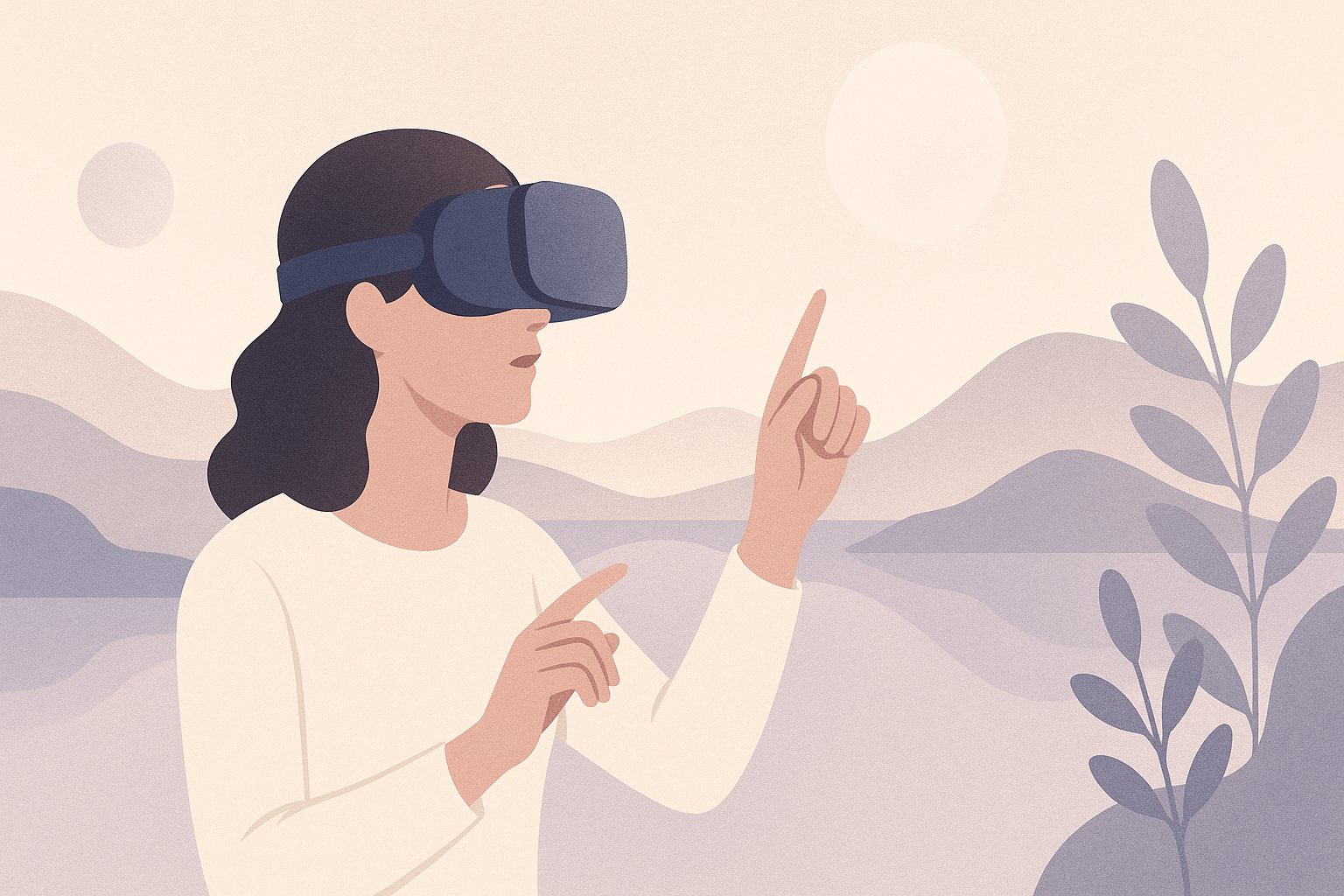
Virtual Reality is a technology that delivers fully immersive digital experiences where users interact with computer-generated simulations as if physically present. Unlike traditional computing interfaces confined to flat screens, VR replaces your visual field with a three-dimensional virtual environment, transporting your sense of presence away from the physical world and into the digital simulation. The core concept lies in convincing your brain that you're experiencing a different reality through a combination of stereoscopic displays, spatial audio, and motion tracking. This creates an embodied presence—the psychological feeling of actually being physically present in a simulation rather than observing it from the outside. This sense of presence makes VR a fundamentally unique medium compared to traditional 2D digital formats.
⚙️ How VR Technology Works
VR technology operates by presenting information to your senses that your brain interprets as reality, delivered entirely through technology rather than physical experience. The most common VR device is the head-mounted display (HMD) or VR headset, which provides a stereoscopic 3D view of the virtual environment directly to the user's eyes. Motion sensors track the user's physical movements and translate them into corresponding actions within the virtual world, while haptic devices provide tactile feedback to enhance immersion. High-resolution monitors and sophisticated graphics rendering techniques produce vivid, lifelike images with realistic lighting, textures, and depth perception. Some advanced systems incorporate additional sensory elements like spatial audio, and experimental technologies such as Olorama's digital scent synthesizer have even added olfactory experiences to fully immersive settings. Users typically wear special equipment including headsets, motion controllers, data gloves, and in some cases full-body gear like treadmills or stationary bicycles to interact with and navigate through the 3D space.
🌍 Applications & Use Cases
Virtual Reality has established itself across numerous industries and applications. In entertainment and gaming, VR provides immersive gaming experiences that represent some of the most advanced consumer applications. Education utilizes VR for medical training, safety instruction, and military simulation where users can practice high-stakes scenarios without real-world risk. Healthcare applications include surgical training and therapeutic treatments, while manufacturing and heavy industry use VR for equipment training and process simulation. Retail environments employ VR for product visualization and virtual shopping experiences, and remote communication platforms leverage VR for more engaging virtual meetings and social interactions. Additional applications include fitness training, artistic creation, heritage preservation, and research environments where VR enables cost-effective experimentation and exploration.
🔮 The Future of Immersion
Virtual Reality technology continues to evolve as a key component of the broader spatial computing and extended reality (XR) ecosystem. Fully immersive VR, which completely blocks out the physical environment and replaces it entirely with virtual content, remains a field still in its infancy but has made significant inroads into gaming and healthcare with growing interest across other sectors. The technology sits within the reality-virtuality continuum, distinct from related technologies like Augmented Reality (which overlays digital elements onto the physical world) and Mixed Reality (which enables more sophisticated digital-physical interactions). As hardware becomes more sophisticated, content more compelling, and applications more practical, VR is positioned to become an increasingly important communication platform that enables users to share not just moments but entire experiences and adventures with others.
Key Facts
- Year
- 2026
- Origin
- Conceptualized in 1980s-1990s; consumer adoption accelerated 2010s-2020s
- Category
- technology
- Type
- technology
Frequently Asked Questions
How is Virtual Reality different from Augmented Reality?
Virtual Reality completely immerses users in a fully simulated virtual environment where they cannot see the physical world around them. Augmented Reality, by contrast, overlays digital elements such as virtual screens, 3D holograms, or interactive data onto the physical reality, allowing users to remain in their physical environment while seeing digital content overlaid on their surroundings. VR replaces your visual field entirely, while AR enhances it.
What hardware do I need to experience Virtual Reality?
The most essential piece of VR hardware is a head-mounted display (HMD) or VR headset, which provides a stereoscopic 3D view of the virtual environment. Most VR experiences also require motion sensors to track your movements, motion controllers or haptic devices for interaction, and often a connection to a PC or gaming console. Some advanced setups include full-body equipment like treadmills, stationary bicycles, data gloves, or bodysuits to enhance immersion and provide tactile feedback.
What does 'sense of presence' mean in Virtual Reality?
Sense of presence refers to the psychological feeling of actually being physically present in a virtual simulation rather than observing it from the outside. It's created through a combination of stereoscopic displays (3D visuals), spatial audio, and motion tracking that convinces your brain you're experiencing a different reality. This embodied presence is what makes VR fundamentally unique compared to watching content on a flat screen.
What are the main industries using Virtual Reality today?
Virtual Reality is actively used across gaming and entertainment, education (medical and military training), healthcare (surgical training and therapy), manufacturing and heavy industry (equipment training), retail (product visualization), remote communication and social platforms, fitness training, artistic creation, and heritage preservation. Enterprise applications continue to expand as organizations recognize VR's value for training, simulation, and cost-effective experimentation.
Is Virtual Reality still in development, or is it mature technology?
Fully immersive Virtual Reality is still in its infancy as a technology, though it has made important inroads into gaming and healthcare with growing interest across other sectors. While consumer VR headsets are commercially available and increasingly sophisticated, the field continues to evolve with improvements in hardware, content quality, and practical applications. VR is positioned as an emerging communication platform with significant growth potential as technology becomes more advanced and accessible.
References
- treeview.studio — /blog/virtual-reality-complete-guide
- vationventures.com — /glossary/virtual-reality-definition-explanation-and-use-cases
- techtarget.com — /whatis/definition/virtual-reality
- en.wikipedia.org — /wiki/Virtual_reality
- ixdf.org — /literature/topics/virtual-reality
- intel.com — /content/www/us/en/tech-tips-and-tricks/virtual-reality-vs-augmented-reality.htm
- classvr.com — /resource-hub/blog/what-is-virtual-reality/
- forwork.meta.com — /blog/virtual-reality-guide/