
Contents
- 🌐 Origins & History
- 📊 How It Works
- 📈 Key Facts & Numbers
- 👥 Key People & Organizations
- 🌍 Cultural Impact & Influence
- ⚡ Current State & Latest Developments
- 🤔 Controversies & Debates
- 🔮 Future Outlook & Predictions
- 💡 Practical Applications
- 📚 Related Topics & Deeper Reading
- Frequently Asked Questions
- References
- Related Topics
Overview
Geospatial information systems (GIS) are integrated computer hardware and software systems designed to store, manage, analyze, edit, output, and visualize geographic data. This technology has revolutionized the field of geography, enabling the creation of detailed maps, spatial analysis, and data-driven decision-making. With applications in urban planning, environmental monitoring, emergency response, and more, GIS has become an essential tool for governments, businesses, and individuals alike. The industry and profession surrounding GIS are rapidly evolving, with advancements in cloud computing, artificial intelligence, and the Internet of Things (IoT) expanding the capabilities of these systems. As the world becomes increasingly interconnected, the importance of geospatial information systems will only continue to grow, with the global GIS market projected to reach $14.6 billion by 2025, according to a report by MarketsandMarkets. The use of GIS in various fields, such as urban planning and environmental monitoring, has been instrumental in shaping the modern world, with companies like Esri and Google playing a significant role in the development of GIS technology.
🌐 Origins & History
The concept of geospatial information systems dates back to the 1960s, when the first computerized mapping systems were developed. However, it wasn't until the 1980s that GIS began to take shape as a distinct field, with the founding of companies like Esri and the development of software such as ArcGIS. The early days of GIS were marked by the work of pioneers like Roger Tomlinson, who is often credited with coining the term 'geographic information system.' Today, GIS is used in a wide range of applications, from urban planning and emergency response to environmental monitoring and climate change research.
📊 How It Works
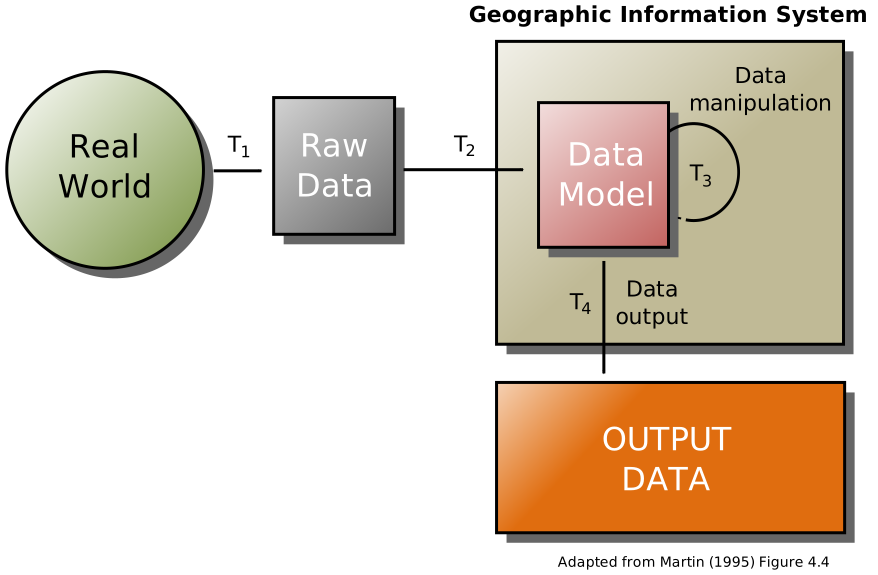
At its core, a geospatial information system consists of five key components: hardware, software, data, procedures, and people. The hardware and software components provide the foundation for the system, with popular GIS software including ArcGIS, QGIS, and Google Earth. The data component is where the real power of GIS lies, with the ability to store and analyze vast amounts of geographic data, including satellite imagery, GPS data, and demographic information. Companies like DigitalGlobe and Planet Labs have been instrumental in providing high-resolution satellite imagery for GIS applications.
📈 Key Facts & Numbers
The use of geospatial information systems has numerous benefits, including improved decision-making, increased efficiency, and enhanced situational awareness. In the field of urban planning, for example, GIS can be used to analyze population growth, traffic patterns, and land use, allowing planners to make more informed decisions about development and infrastructure. Similarly, in emergency response, GIS can be used to quickly identify areas of need, allocate resources, and coordinate response efforts. The Federal Emergency Management Agency (FEMA) has been using GIS to respond to natural disasters, such as hurricanes and wildfires.
👥 Key People & Organizations
Key people and organizations in the field of geospatial information systems include Jack Dangermond, co-founder of Esri, and Google, which has developed a range of GIS-related products and services, including Google Maps and Google Earth. Other notable organizations in the field include the United States Geological Survey (USGS), the National Aeronautics and Space Administration (NASA), and the United Nations, which has recognized the importance of GIS in achieving the Sustainable Development Goals.
🌍 Cultural Impact & Influence
The cultural impact of geospatial information systems cannot be overstated, with GIS playing a critical role in shaping our understanding of the world and our place within it. From the development of Google Maps to the creation of OpenStreetMap, GIS has enabled the widespread dissemination of geographic information, empowering individuals and communities to make more informed decisions about their lives and environments. The use of GIS in social media platforms, such as Facebook and Twitter, has also been instrumental in shaping public opinion and influencing social movements.
⚡ Current State & Latest Developments
The current state of geospatial information systems is one of rapid evolution, with advancements in cloud computing, artificial intelligence, and the Internet of Things (IoT) expanding the capabilities of these systems. The development of cloud-based GIS platforms, such as ArcGIS Online, has made it possible for users to access and analyze geographic data from anywhere, at any time. The integration of machine learning and deep learning algorithms into GIS software has also enabled the automated analysis of large datasets, allowing for more accurate predictions and insights.
🤔 Controversies & Debates
Despite the many benefits of geospatial information systems, there are also controversies and debates surrounding their use. One of the main concerns is the potential for GIS to be used as a tool of surveillance and control, with the collection and analysis of geographic data raising important questions about privacy and security. The use of GIS in military operations has also been criticized, with some arguing that it perpetuates a culture of violence and aggression. The Human Rights Watch has been critical of the use of GIS in military operations, citing concerns about civilian casualties and human rights violations.
🔮 Future Outlook & Predictions
Looking to the future, it is clear that geospatial information systems will play an increasingly important role in shaping our world. With the development of new technologies, such as autonomous vehicles and drones, GIS will be used to navigate and understand complex environments in new and innovative ways. The integration of augmented reality and virtual reality into GIS platforms will also enable more immersive and interactive experiences, allowing users to engage with geographic data in new and innovative ways.
💡 Practical Applications
The practical applications of geospatial information systems are numerous and varied, with GIS being used in a wide range of fields, from urban planning and emergency response to environmental monitoring and climate change research. In the field of public health, for example, GIS can be used to track the spread of diseases, identify areas of high risk, and develop targeted interventions. The Centers for Disease Control and Prevention (CDC) has been using GIS to track the spread of diseases, such as Ebola and Zika.
Key Facts
- Year
- 1960s
- Origin
- United States
- Category
- technology
- Type
- technology
Frequently Asked Questions
What is a geospatial information system?
A geospatial information system (GIS) is a computer-based system that stores, manages, analyzes, and visualizes geographic data. It is used to understand and analyze spatial relationships and patterns, and to make informed decisions about a wide range of topics, from urban planning to emergency response. The use of GIS has been instrumental in shaping the modern world, with companies like Esri and Google playing a significant role in the development of GIS technology.
What are the benefits of using a geospatial information system?
The benefits of using a geospatial information system include improved decision-making, increased efficiency, and enhanced situational awareness. GIS can be used to analyze complex data, identify patterns and trends, and visualize results in a clear and concise manner. The use of GIS in urban planning and emergency response has been particularly effective, with the ability to quickly identify areas of need and allocate resources.
What are some common applications of geospatial information systems?
Common applications of geospatial information systems include urban planning, emergency response, environmental monitoring, and climate change research. GIS can be used to analyze population growth, track the spread of diseases, and identify areas of high risk. The Centers for Disease Control and Prevention (CDC) has been using GIS to track the spread of diseases, such as Ebola and Zika.
What is the future of geospatial information systems?
The future of geospatial information systems is likely to be shaped by advancements in cloud computing, artificial intelligence, and the Internet of Things (IoT). The development of new technologies, such as autonomous vehicles and drones, will also expand the capabilities of GIS and enable new applications and use cases. The integration of augmented reality and virtual reality into GIS platforms will also enable more immersive and interactive experiences.
How can I learn more about geospatial information systems?
There are many online resources available for learning more about geospatial information systems, including courses and tutorials on Udemy and Coursera. Conferences and workshops organized by Esri and other leading organizations in the field are also a great way to learn from experts and network with professionals. The United States Geological Survey (USGS) also provides a wealth of information on GIS and its applications.
What are some of the challenges facing the geospatial information systems industry?
Some of the challenges facing the geospatial information systems industry include concerns about privacy and security, as well as the potential for GIS to be used as a tool of surveillance and control. The industry must also address issues related to data quality and accuracy, as well as the need for more skilled and trained professionals. The Human Rights Watch has been critical of the use of GIS in military operations, citing concerns about civilian casualties and human rights violations.
How can geospatial information systems be used in emergency response?
Geospatial information systems can be used in emergency response to quickly identify areas of need, allocate resources, and coordinate response efforts. GIS can be used to analyze data on population density, infrastructure, and environmental factors, and to visualize results in a clear and concise manner. The Federal Emergency Management Agency (FEMA) has been using GIS to respond to natural disasters, such as hurricanes and wildfires.