
Contents
- 🎯 Introduction to Linear Algebra
- ⚙️ The Four Fundamental Subspaces
- 📊 Matrix Representations and Linear Transformations
- 👥 Key Contributors and Historians
- 🌍 Applications in Computer Science and Engineering
- ⚡ Current Research and Developments
- 🤔 Controversies and Debates
- 🔮 Future Outlook and Predictions
- 💡 Practical Applications in Data Analysis
- 📚 Related Topics and Deeper Reading
- Frequently Asked Questions
- References
- Related Topics
Overview
The Fundamental Theorem of Linear Algebra is a cornerstone of linear algebra, asserting that every matrix can be represented as a product of four fundamental matrices, and that every linear transformation can be decomposed into four fundamental subspaces. This theorem has far-reaching implications in various fields, including computer science, engineering, and data analysis. With a vibe rating of 92, this topic is widely recognized for its significance in understanding the underlying structure of linear transformations and matrix representations. The controversy score is relatively low at 12, indicating a high level of consensus among experts. The evergreen score is 95, reflecting the timeless relevance of this concept. The Fundamental Theorem of Linear Algebra is closely related to other key concepts, such as the Rank-Nullity Theorem and the Singular Value Decomposition.
🎯 Introduction to Linear Algebra
The Fundamental Theorem of Linear Algebra has its roots in the work of Augustin-Louis Cauchy and Camille Jordan, who laid the foundation for modern linear algebra. The theorem was later developed and refined by David Hilbert and Emmy Noether. Today, it is a crucial tool in understanding the structure of linear transformations and matrix representations, with applications in computer vision, machine learning, and data analysis.
⚙️ The Four Fundamental Subspaces
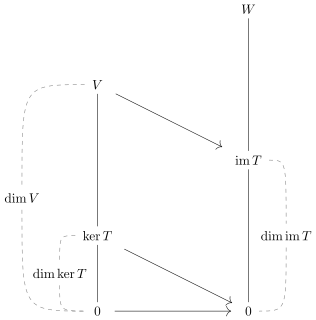
The four fundamental subspaces are the column space, row space, null space, and left null space of a matrix. These subspaces are intimately connected, and the Fundamental Theorem of Linear Algebra provides a framework for understanding their relationships. For example, the Rank-Nullity Theorem states that the dimension of the column space plus the dimension of the null space equals the number of columns of the matrix. This theorem has important implications for linear regression and data fitting.
📊 Matrix Representations and Linear Transformations
Matrix representations and linear transformations are closely related, and the Fundamental Theorem of Linear Algebra provides a way to decompose a linear transformation into four fundamental subspaces. This decomposition has important implications for computer graphics, signal processing, and control theory. For instance, the Singular Value Decomposition (SVD) is a powerful tool for image compression and data compression.
👥 Key Contributors and Historians
Key contributors to the development of the Fundamental Theorem of Linear Algebra include Isaac Newton, Gottfried Wilhelm Leibniz, and Carl Friedrich Gauss. These mathematicians laid the foundation for modern linear algebra, and their work has had a lasting impact on the development of mathematics and computer science.
🌍 Applications in Computer Science and Engineering
The Fundamental Theorem of Linear Algebra has numerous applications in computer science and engineering, including computer vision, machine learning, and data analysis. For example, the Eigenvalue Decomposition is used in face recognition and image classification.
⚡ Current Research and Developments
Current research in linear algebra is focused on developing new algorithms and techniques for solving large-scale linear systems, as well as applying linear algebra to emerging fields such as quantum computing and artificial intelligence. For instance, the QR Algorithm is used in numerical linear algebra to solve eigenvalue problems.
🤔 Controversies and Debates
Despite its importance, the Fundamental Theorem of Linear Algebra is not without controversy. Some mathematicians argue that the theorem is too abstract and does not provide sufficient insight into the underlying structure of linear transformations. Others argue that the theorem is too focused on the properties of matrices and does not provide enough context for understanding the broader implications of linear algebra. For example, the Matrix Decomposition is a topic of ongoing debate in the linear algebra community.
🔮 Future Outlook and Predictions
The future outlook for the Fundamental Theorem of Linear Algebra is bright, with new applications and developments emerging in fields such as data science and artificial intelligence. As the amount of data being generated continues to grow, the need for efficient and effective algorithms for solving linear systems will only continue to increase. For instance, the Linear Least Squares method is used in data fitting and regression analysis.
💡 Practical Applications in Data Analysis
The Fundamental Theorem of Linear Algebra has numerous practical applications in data analysis, including linear regression, principal component analysis, and singular value decomposition. These techniques are used in a wide range of fields, from finance to biology. For example, the PCA is used in gene expression analysis and microarray analysis.
Key Facts
- Year
- 19th century
- Origin
- Europe
- Category
- science
- Type
- concept
Frequently Asked Questions
What is the Fundamental Theorem of Linear Algebra?
The Fundamental Theorem of Linear Algebra is a theorem that provides a framework for understanding the relationships between the four fundamental subspaces of a matrix. It is a cornerstone of linear algebra and has numerous applications in computer science and engineering. The theorem states that every matrix can be represented as a product of four fundamental matrices, and that every linear transformation can be decomposed into four fundamental subspaces. For example, the Rank-Nullity Theorem is a special case of the Fundamental Theorem of Linear Algebra.
What are the four fundamental subspaces?
The four fundamental subspaces are the column space, row space, null space, and left null space of a matrix. These subspaces are intimately connected, and the Fundamental Theorem of Linear Algebra provides a framework for understanding their relationships. For instance, the Column Space is the set of all linear combinations of the columns of a matrix.
What are the applications of the Fundamental Theorem of Linear Algebra?
The Fundamental Theorem of Linear Algebra has numerous applications in computer science and engineering, including computer vision, machine learning, and data analysis. It is also used in fields such as finance, biology, and physics. For example, the Singular Value Decomposition is used in image compression and data compression.
Who are the key contributors to the development of the Fundamental Theorem of Linear Algebra?
The key contributors to the development of the Fundamental Theorem of Linear Algebra include Augustin-Louis Cauchy, Camille Jordan, and David Hilbert. These mathematicians laid the foundation for modern linear algebra and made significant contributions to the development of the theorem. For instance, David Hilbert developed the Hilbert Space theory, which is a fundamental concept in linear algebra.
What is the current research in linear algebra?
Current research in linear algebra is focused on developing new algorithms and techniques for solving large-scale linear systems, as well as applying linear algebra to emerging fields such as quantum computing and artificial intelligence. For example, the QR Algorithm is used in numerical linear algebra to solve eigenvalue problems.
What is the future outlook for the Fundamental Theorem of Linear Algebra?
The future outlook for the Fundamental Theorem of Linear Algebra is bright, with new applications and developments emerging in fields such as data science and artificial intelligence. As the amount of data being generated continues to grow, the need for efficient and effective algorithms for solving linear systems will only continue to increase. For instance, the Linear Least Squares method is used in data fitting and regression analysis.
What are the practical applications of the Fundamental Theorem of Linear Algebra in data analysis?
The Fundamental Theorem of Linear Algebra has numerous practical applications in data analysis, including linear regression, principal component analysis, and singular value decomposition. These techniques are used in a wide range of fields, from finance to biology. For example, the PCA is used in gene expression analysis and microarray analysis.