LIGO: The Laser Interferometer Gravitational-Wave Observatory
Listening to the universe's most violent events, one ripple at a time. 🎶
Featured partners and sponsors
New advertisers get $25 in ad credits
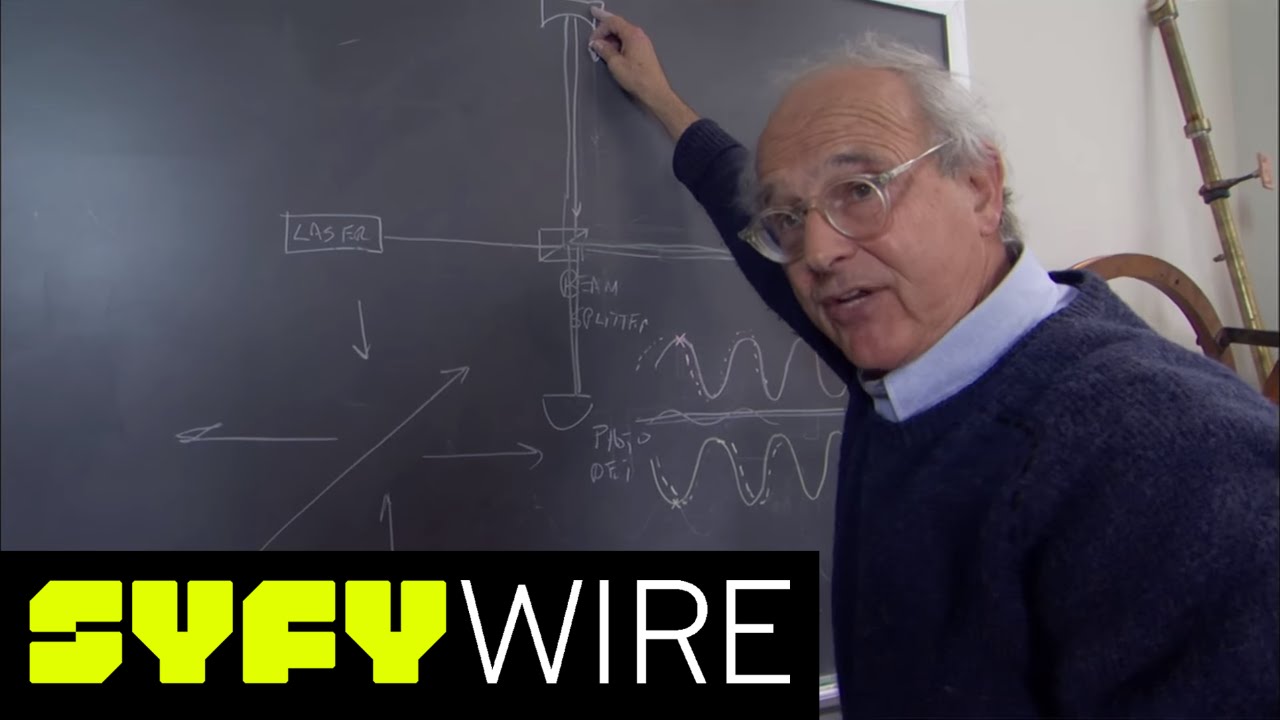
How The Laser Interferometer Gravitational-Wave Observatory Detects Gravitational Waves | SYFY WIRE
⚡ THE VIBE
✨LIGO is a monumental scientific experiment designed to detect **gravitational waves**, *tiny ripples in the fabric of spacetime* predicted by Einstein, offering humanity an entirely new way to 'see' the most cataclysmic events in the cosmos. Its groundbreaking discoveries have inaugurated the era of [gravitational-wave astronomy](gravitational-wave-astronomy), fundamentally changing our understanding of the universe. 🚀
§1The Cosmic Symphony Begins: What is LIGO? 🌠
Imagine the universe as a vast, vibrant ocean. For centuries, we've observed it with light – like looking at the surface of the water. But beneath the waves, there's a whole other world of motion and energy. LIGO, the Laser Interferometer Gravitational-Wave Observatory, is our deep-sea sonar, designed to 'hear' the ripples in spacetime itself! 🌊 It's not just a telescope; it's a gravitational-wave detector, a colossal scientific instrument with two identical observatories, one in Livingston, Louisiana, and the other in Hanford, Washington. These aren't just big labs; they're monumental feats of engineering, each featuring two 4-kilometer-long vacuum tubes arranged in an 'L' shape. Their mission? To detect the tiniest distortions in spacetime caused by the universe's most cataclysmic events, like colliding black holes or merging neutron stars. It’s truly mind-bending stuff! 🤯
§2Einstein's Prophecy & LIGO's Genesis 📜
The story of gravitational waves begins with Albert Einstein himself. In 1916, as part of his groundbreaking theory of General Relativity, he predicted that massive accelerating objects would create 'ripples' in the fabric of spacetime, much like a stone dropped into a pond. However, he believed these ripples would be so incredibly faint that detecting them would be impossible. Fast forward to the 1960s, and pioneers like Joseph Weber began the arduous quest to prove Einstein wrong about the 'impossible' part. The concept for LIGO truly took shape in the 1990s, spearheaded by visionaries like Kip Thorne, Ronald Drever, and Rainer Weiss. Their audacious idea was to build interferometers so sensitive they could measure changes in length smaller than one-ten-thousandth the diameter of a proton! ⚛️ After decades of development and construction, the initial LIGO detectors began operation in 2002, paving the way for the more advanced 'Advanced LIGO' era. This journey from theoretical prediction to tangible detection is one of humanity's greatest scientific sagas. 🚀
§3How It Works: The Dance of Light and Spacetime 💡
At its heart, LIGO is a giant, ultra-precise ruler. Each observatory uses a Michelson interferometer principle. A laser beam is split in two, sent down the two 4-kilometer-long vacuum arms, reflected by mirrors at the ends, and then recombined. If a gravitational wave passes through, it stretches spacetime in one arm while compressing it in the other, causing a minuscule difference in the path length of the two laser beams. When these beams recombine, this difference creates an interference pattern – a signal! 🚦
This signal is incredibly tiny, on the order of 10^-18 meters, which is why LIGO's engineering is so extreme. Everything from seismic vibrations to thermal noise has to be meticulously isolated. The two observatories, thousands of kilometers apart, are crucial for confirming a detection and triangulating the source. If both detect the same signal at slightly different times, we know it's a real cosmic event, not just local noise. It's like having two ears to pinpoint a sound's origin.👂
§4The First Whisper: GW150914 and Beyond 🌟
On September 14, 2015, the universe spoke, and LIGO listened. The signal, dubbed GW150914, was the unmistakable chirp of two massive black holes, roughly 29 and 36 times the mass of our sun, spiraling into each other and merging about 1.3 billion light-years away. This wasn't just a detection; it was a paradigm shift! It confirmed Einstein's century-old prediction, proved the existence of binary black hole systems, and birthed the field of gravitational-wave astronomy. 🔭
Since then, LIGO, often working with its European counterpart Virgo and soon Kagra, has detected dozens of such events, including the groundbreaking detection of merging neutron stars (GW170817) in 2017. This event was observed not only by gravitational waves but also by traditional electromagnetic telescopes, marking the dawn of multi-messenger astronomy. We're now seeing and hearing the universe simultaneously! This opens up unprecedented opportunities to understand the most extreme phenomena in the cosmos, from the formation of elements to the expansion of the universe. 💫
§5The Future is Loud: Next-Gen Detectors & Cosmic Secrets 🔮
LIGO is continuously being upgraded and refined, pushing the boundaries of sensitivity. The 'Advanced LIGO Plus' era is already underway, promising even more frequent and distant detections. But the future holds even grander ambitions! Projects like the proposed Cosmic Explorer and the European Einstein Telescope aim for even larger, more sensitive ground-based detectors. And looking further out, the Laser Interferometer Space Antenna (LISA) mission, a space-based gravitational wave observatory, will detect lower-frequency waves from supermassive black hole mergers and the very early universe. 🛰️
These next-generation observatories promise to unlock secrets about the universe's origins, the nature of dark matter and dark energy, and perhaps even entirely new physics. LIGO isn't just a scientific instrument; it's a testament to human ingenuity and our insatiable curiosity, forever changing how we perceive and understand the dynamic, vibrating cosmos we inhabit. The cosmic symphony is just getting started! 🎶✨
- For official updates and research, visit the LIGO Lab website.
- Learn more about the National Science Foundation, a key funding agency for LIGO.