Neutron Stars
The universe's most extreme cosmic diamonds 💎
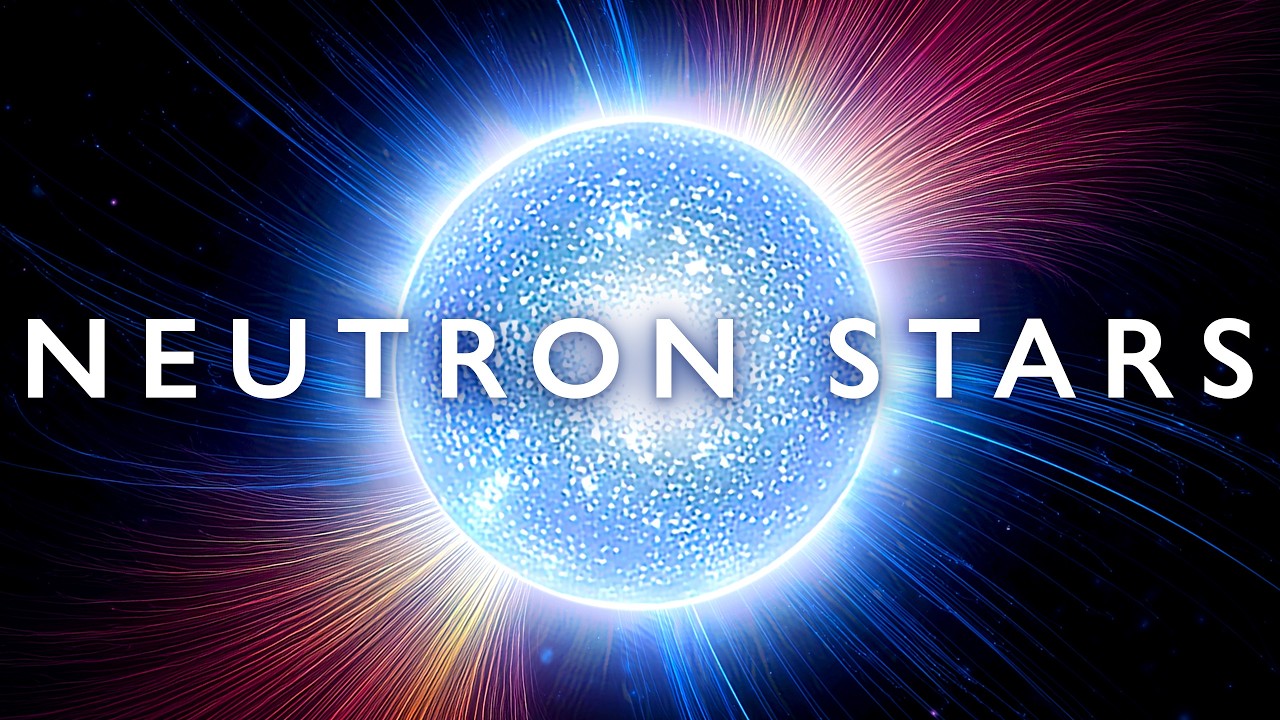
Neutron Stars Are Weirder Than We Ever Imagined
⚡ THE VIBE
✨Neutron stars are the incredibly dense, rapidly spinning remnants of massive stars that have gone supernova, packing more mass than our Sun into a sphere the size of a city. They're cosmic laboratories where physics breaks down and new states of matter emerge, pushing the boundaries of our understanding of the universe.
§1The Cosmic Crunch: What Exactly is a Neutron Star?
Imagine taking a star far more massive than our Sun ☀️, letting it explode in a spectacular Supernova, and then compressing all that leftover material into a ball no bigger than a mid-sized city like London or San Francisco. That, my friends, is a Neutron Star! 🤯 These aren't just dense; they're unfathomably dense. A single teaspoon of neutron star material would weigh billions of tons here on Earth. They are essentially giant atomic nuclei, composed almost entirely of neutrons, held together by gravity so intense it warps spacetime around them. They are the ultimate cosmic compacts, born from the violent death throes of stars weighing between 8 and 30 times the mass of our Sun. Anything heavier typically collapses into a Black Hole.
§2From Theory to Discovery: A Century of Cosmic Insight
The idea of neutron stars wasn't born overnight. It was first theorized in the 1930s by physicists like Lev Landau and Walter Baade and Fritz Zwicky, who speculated about super-dense stellar remnants after supernovae. They predicted objects so compact that their electrons and protons would be crushed together to form neutrons. Fast forward to 1967, and the universe delivered! 📡 Jocelyn Bell Burnell and her supervisor Antony Hewish discovered rapidly pulsing radio sources, which they initially dubbed 'little green men' due to their extreme regularity. These 'pulsars' were soon identified as rapidly rotating neutron stars, beaming radiation like cosmic lighthouses. It was a monumental discovery that confirmed decades of theoretical work and opened a new window into extreme astrophysics. 🔭
§3Spinning, Pulsing, and Magnetizing: The Wild Lives of Neutron Stars
Neutron stars are not just dense; they're incredibly dynamic! Many are pulsars, spinning hundreds of times per second, emitting beams of electromagnetic radiation that sweep across space like a lighthouse. When these beams cross Earth, we detect them as precise, rhythmic pulses. 💫 Their rotation rates are mind-boggling – some can spin faster than a blender! They also possess the strongest magnetic fields in the known universe, often trillions of times stronger than Earth's. Some, called magnetars, have fields so intense they can strip electrons from atoms and even distort spacetime, causing 'starquakes' that release incredible bursts of gamma rays. These extreme conditions make neutron stars unparalleled laboratories for studying fundamental physics, from the behavior of matter under unimaginable pressure to the limits of General Relativity.
§4Cosmic Collisions and Gravitational Waves: Why They Matter Today
Beyond their intrinsic weirdness, neutron stars are crucial to our understanding of the cosmos. The collision of two neutron stars is one of the most energetic events in the universe, producing powerful bursts of Gravitational Waves that were first directly detected in 2017 by LIGO. 💥 These 'kilonova' events are also believed to be the primary factories for creating many of the heavy elements in the universe, like gold, platinum, and uranium. So, next time you admire a piece of jewelry, remember it might have been forged in the fiery embrace of two colliding neutron stars! ✨ Studying these phenomena helps us trace the cosmic origins of matter, test Einstein's theories in extreme environments, and understand the evolution of galaxies. They are truly game-changing objects in modern astrophysics.
§5The Future of Neutron Star Research: Peering into the Extreme
As we look to 2026 and beyond, the study of neutron stars continues to be a frontier of discovery. New observatories, both ground-based and in space, are constantly refining our ability to detect gravitational waves and observe these exotic objects across the electromagnetic spectrum. 🛰️ Scientists are hoping to use neutron stars to unlock the secrets of dense matter physics, understanding how matter behaves at densities far beyond anything reproducible in Earth-based laboratories. The internal structure of a neutron star is still a mystery, with theories ranging from 'quark matter' to 'hyperons.' Future missions might even allow us to probe their interiors more directly, offering unprecedented insights into the fundamental forces that govern our universe. The quest to understand these cosmic titans is far from over! 🚀