
Contents
Overview
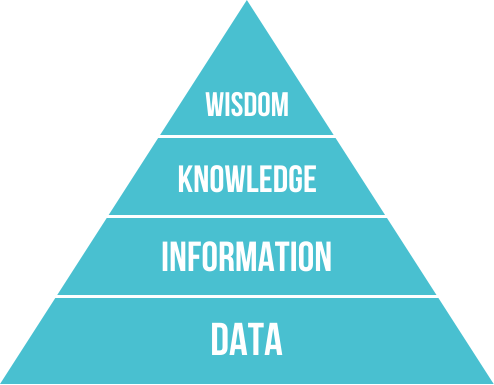
The Data-Information-Knowledge-Wisdom (DIKW) pyramid is a conceptual framework that posits a hierarchy of understanding, moving from raw data to actionable wisdom. At its base, data consists of discrete symbols or signals. When data is processed, contextualized, and organized, it becomes information. Information, when synthesized and understood through experience and insight, transforms into knowledge. Finally, wisdom represents the application of knowledge with judgment, ethics, and foresight. Popularized in the late 20th century by figures like Russell Ackoff and Milan Zeleny, the DIKW model has become a ubiquitous visual metaphor in fields ranging from artificial intelligence and big data analytics to organizational management and philosophy of science. Despite its widespread adoption, the precise definitions of each tier and the nature of the transitions between them remain subjects of ongoing academic debate.
🎵 Origins & History
The conceptual roots of the DIKW pyramid stretch back further than commonly acknowledged, with precursors evident in ancient philosophical inquiries into understanding and truth. Russell Ackoff, a seminal figure in operations research and systems thinking, is widely credited with popularizing the model. Milan Zeleny, an influential scholar in management science, also contributed significantly to its development and discussion. Robert W. Lucky, an engineer and executive at Bell Labs, further discussed these concepts, highlighting the practical implications for technological development. Early discussions often framed it as a linear progression, a visual tool to articulate the journey from raw facts to profound insight, influencing early information science and management information systems thinking.
⚙️ How It Works
The DIKW pyramid operates by defining distinct levels of cognitive processing and value. Data, the base layer, comprises raw, uninterpreted facts, figures, or symbols (e.g., '100', 'red', 'Paris'). Information emerges when data is processed, organized, and given context, answering 'who,' 'what,' 'where,' and 'when' questions (e.g., 'The temperature in Paris is 100 degrees Fahrenheit'). Knowledge is derived from information through synthesis, pattern recognition, and understanding relationships, answering 'how' questions (e.g., 'Knowing that 100 degrees Fahrenheit is extremely hot, and understanding weather patterns, I know this indicates a heatwave'). Wisdom, the apex, involves applying knowledge with judgment, ethics, and foresight, answering 'why' questions and guiding decision-making towards optimal outcomes (e.g., 'Given this heatwave, I understand the need to conserve water and protect vulnerable populations'). Each level builds upon the one below, adding meaning, context, and utility.
📊 Key Facts & Numbers
While precise quantifiable metrics for each level are elusive, the scale of data generated globally underscores the pyramid's relevance. The value of information processing is reflected in the global big data and analytics market, which is a significant industry. Knowledge management systems are a significant industry. The ultimate value of wisdom, though harder to quantify, is implicitly measured in the billions saved by effective decision-making in sectors like finance, healthcare, and national security, and the trillions lost due to poor judgment or lack of foresight.
👥 Key People & Organizations
Several key individuals and organizations have shaped the discourse around the DIKW pyramid. Russell Ackoff (1919-2009), a professor at the University of Pennsylvania, was instrumental in articulating the hierarchy and its implications for organizational effectiveness. Milan Zeleny (b. 1942), a professor at Fordham University, has extensively explored the philosophical underpinnings and practical applications of the model, particularly in relation to systems thinking and management science. Robert W. Lucky (b. 1936), a former executive at Bell Labs, provided an engineering perspective on the transition from data to wisdom. Academic institutions like the Wharton School and MIT Sloan School of Management have fostered research and teaching in areas directly related to the DIKW hierarchy, including business intelligence and data analytics.
🌍 Cultural Impact & Influence
The DIKW pyramid has permeated business strategy, academic curricula, and popular understanding of information processing. Its visual simplicity makes it an accessible metaphor for explaining complex cognitive processes, influencing how professionals in fields like marketing, product management, and policy-making conceptualize and utilize data. The model's influence can be seen in the design of business intelligence tools and data visualization techniques, which aim to guide users from raw data to actionable insights. It has also seeped into popular culture, appearing in discussions about AI capabilities and the nature of human intelligence, often serving as a shorthand for the progression of understanding.
⚡ Current State & Latest Developments
In 2024, the DIKW pyramid continues to be a foundational concept in the burgeoning fields of AI and machine learning. AI systems are increasingly sophisticated at processing vast datasets (data) and identifying patterns (information), but the leap to genuine knowledge and wisdom remains a significant research frontier. Companies like Google AI and OpenAI are developing models that exhibit emergent knowledge, yet the ethical application of this knowledge (wisdom) is a critical ongoing challenge. The proliferation of generative AI tools like ChatGPT has brought the DIKW hierarchy into sharp focus, as users grapple with discerning reliable information from plausible-sounding but inaccurate outputs, highlighting the persistent need for human wisdom in navigating AI-generated content.
🤔 Controversies & Debates
The DIKW pyramid is not without its critics and controversies. A primary debate centers on the linearity and distinctness of its levels. Skeptics argue that the transitions are not always clear-cut, and that knowledge can sometimes inform the interpretation of data, creating a feedback loop rather than a strict hierarchy. The definition of 'wisdom' itself is particularly contentious, with some scholars questioning whether it can be objectively defined or achieved through purely analytical means, suggesting it requires subjective experience, ethical frameworks, and perhaps even consciousness, elements difficult to model computationally. Furthermore, the model has been criticized for being overly Western-centric and potentially overlooking non-linear or culturally specific ways of knowing.
🔮 Future Outlook & Predictions
The future of the DIKW pyramid is intrinsically linked to advancements in AI and cognitive science. As AI systems become more capable of synthesizing information and demonstrating forms of knowledge, the challenge will be to imbue them with or guide them towards wisdom. This may involve developing new ethical frameworks for AI decision-making, exploring hybrid human-AI systems where human wisdom complements AI's analytical power, or even re-evaluating the pyramid itself in light of emergent forms of intelligence. Predictions suggest that by 2030, AI will be capable of generating novel scientific hypotheses (knowledge), but the ultimate validation and application of these hypotheses will still heavily rely on human wisdom and ethical oversight.
💡 Practical Applications
The DIKW pyramid finds practical application across numerous domains. In business intelligence, it guides the development of dashboards and reports that transform raw sales figures (data) into market trends (information), competitive insights (knowledge), and strategic recommendations (wisdom). In healthcare, patient records (data) are processed into diagnostic information, medical knowledge is applied to treatment plans, and experienced clinicians exercise wisdom in managing complex patient care. In education, students progress from memorizing facts (data) to understanding concepts (information), applying principles (knowledge), and developing critical thinking and ethical reasoning (wisdom). Even in everyday life, we use the pyramid to make decisions, from interpre
Key Facts
- Category
- philosophy
- Type
- topic