
Contents
Overview
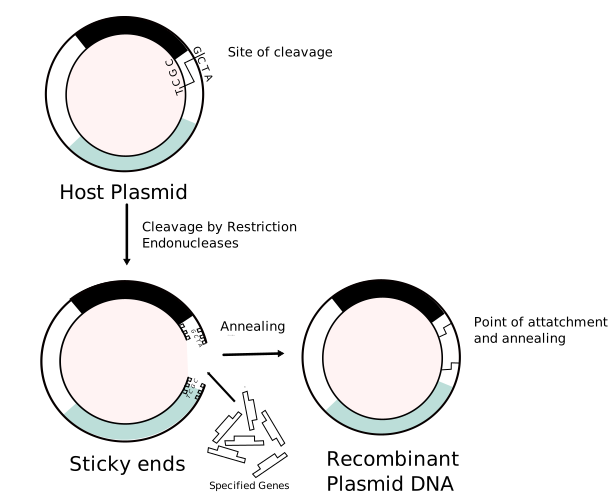
The quest to isolate and purify biological molecules stretches back to the dawn of biochemistry. Early efforts in the late 19th and early 20th centuries focused on extracting enzymes and other proteins from natural sources like plant tissues and animal organs. Pioneers like James B. Sumner demonstrated that biological molecules could be isolated in a pure, crystalline form, a feat that earned him a Nobel Prize. The advent of recombinant DNA technology, particularly the work of Stanley Cohen and Herbert Boyer, dramatically escalated the need for sophisticated purification methods. Suddenly, cells could be engineered to produce vast quantities of specific proteins, like human insulin, but these recombinant proteins were mixed with a cellular soup requiring rigorous separation. This spurred the development of industrial-scale chromatography and filtration techniques.
⚙️ How It Works
At its core, biotechnology purification relies on exploiting differences in the physical and chemical properties between the target biomolecule and impurities. Common techniques include chromatography, which separates molecules based on their differential interaction with a stationary phase (e.g., affinity, ion-exchange, size exclusion, hydrophobic interaction). Filtration is another critical step, employing membranes with specific pore sizes to remove particles, cells, or even viruses (e.g., tangential flow filtration, sterile filtration). Centrifugation uses centrifugal force to pellet or separate components based on density. Other methods involve precipitation (using salts or solvents to selectively precipitate proteins), electrophoresis, and extraction. The specific sequence of techniques is tailored to the target molecule and the nature of the contaminants, often involving multiple orthogonal steps to achieve the required purity, which can exceed 99% for biopharmaceuticals.
📊 Key Facts & Numbers
The scale of purification in biotechnology is staggering. A single batch of a monoclonal antibody therapeutic might start with thousands of liters of cell culture fluid, yielding only kilograms of purified product. The cost of goods for biologics is heavily influenced by purification, with downstream processing often accounting for 50-70% of total manufacturing costs. For instance, the production of adalimumab (Humira), a blockbuster biologic, involves extensive purification steps that contribute significantly to its multi-billion dollar annual revenue. The efficiency of purification directly impacts yield; a 1% improvement in recovery can translate to millions of dollars in savings for a high-volume therapeutic.
👥 Key People & Organizations
Numerous individuals and organizations have shaped the field of biotechnology purification. Robert Burns Woodward made foundational contributions to organic synthesis that informed early purification strategies. Companies like GE Healthcare Life Sciences (now Cytiva), Merck KGaA (through its MilliporeSigma division), and Sartorius AG are major players, developing and supplying the resins, filters, and equipment essential for purification. Academic institutions like MIT, Stanford University, and the University of Cambridge host leading research groups pushing the boundaries of separation science. The Bio-Process Technology Consortium and the International Society for Pharmaceutical Engineering (ISPE) are key industry bodies that foster collaboration and set standards.
🌍 Cultural Impact & Influence
The impact of purification techniques on society is profound, enabling the widespread availability of treatments for diseases previously considered untreatable. The development of vaccines like the mRNA COVID-19 vaccines relied heavily on rapid, scalable purification of mRNA and lipid nanoparticles. Similarly, the production of gene therapies, such as Luxturna for inherited retinal disease, requires meticulous purification of viral vectors. Beyond medicine, these techniques are vital for producing enzymes used in industrial processes (e.g., in detergents, food production), biofuels, and advanced materials, demonstrating their pervasive influence across scientific and industrial sectors.
⚡ Current State & Latest Developments
The current landscape of biotechnology purification is characterized by a drive towards continuous manufacturing and process intensification. Companies are moving away from traditional batch processing towards integrated, continuous downstream operations, aiming to reduce footprint, improve efficiency, and lower costs. Innovations include single-use technologies, advanced membrane chromatography, and multi-column continuous chromatography systems, such as simulated moving bed (SMB) chromatography. The development of novel affinity ligands and resins with higher capacity and selectivity is ongoing, driven by the increasing complexity of therapeutic molecules like bispecific antibodies and antibody-drug conjugates (ADCs). The integration of process analytical technology (PAT) for real-time monitoring and control is also a major trend, promising more robust and predictable purification processes.
🤔 Controversies & Debates
Despite its critical role, biotechnology purification is not without its controversies and challenges. There's ongoing debate about the environmental impact of purification, particularly the large volumes of water and solvents used, and the disposal of single-use consumables. The validation and regulatory oversight of purification processes are also areas of intense scrutiny; ensuring consistent product quality and patient safety requires rigorous validation, which can be time-consuming and expensive. Furthermore, the potential for leachables and extractables from chromatography resins and filtration membranes, as well as the challenge of removing highly potent impurities like prions or endotoxins to extremely low levels, are persistent concerns.
🔮 Future Outlook & Predictions
The future of biotechnology purification is likely to be shaped by further integration of automation, artificial intelligence (AI), and machine learning (ML). AI is being explored for optimizing purification protocols, predicting process performance, and identifying potential issues before they arise. Continuous manufacturing will become more prevalent, with fully integrated, end-to-end bioprocessing lines. Novel separation modalities, such as picosecond pulsed electric field (PS-PEF) processing and advanced membrane technologies, are on the horizon. The purification of increasingly complex modalities, including exosomes, extracellular vesicles, and personalized cell therapies, will demand new and innovative approaches. Expect a greater emphasis on 'design of experiments' (DoE) and Quality by Design (QbD) principles to build inherent quality into purification processes from the outset, reducing reliance on end-product testing alone.
💡 Practical Applications
Biotechnology purification techniques are indispensable across a vast array of applications. In the pharmaceutical industry, they are used to produce monoclonal antibodies for cancer and autoimmune diseases, recombinant proteins for hemophilia and growth disorders, and vaccines for infectious diseases. In diagnostics, they enable the isolation of specific antigens or antibodies for use in assays like ELISA and lateral flow tests. The food and beverage industry employs purification to produce enzymes for baking, brewing, and dairy processing, as well as to clarify juices and wines. Industrial biotechnology utilizes these methods to recover enzymes for biofuels, detergents, and bioplastics. Even in academic research, purification is fundamental for studying protein functi
Key Facts
- Category
- technology
- Type
- topic