
Contents
Overview
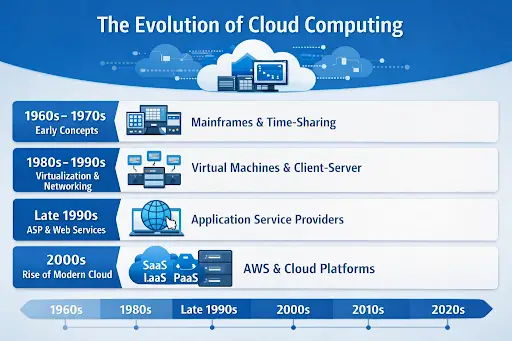
The conceptual seeds of cloud computing were sown as early as the 1960s with the idea of time-sharing, where multiple users could access a single mainframe computer. This evolved into distributed computing in the 1970s and 1980s, envisioning interconnected systems accessible via virtual networks. The true acceleration, however, came with the rise of the internet in the 1990s and the advent of virtualization technologies. Pioneers like J.C.R. Licklider, with his vision of an 'Intergalactic Computer Network,' and early time-sharing systems funded by DARPA for Project MAC, laid the foundational principles. The development of ARPANET in 1969 by figures like Bob Taylor and Larry Roberts was crucial, paving the way for the internet that would eventually host cloud services. Companies like IBM, with its VM operating system in 1972, and telecommunications firms offering virtual private networks (VPNs) in the 1990s, further contributed to the infrastructure.
⚙️ How It Works
Cloud computing, in essence, is an on-demand service model where computing resources—servers, storage, databases, and applications—are accessed over the internet. This utility-based approach, predicted by Professor John McCarthy in 1961, allows users to pay only for what they consume, eliminating the need for significant upfront investment in hardware and infrastructure. The process involves third-party vendors owning and maintaining the cloud infrastructure, offering services like Infrastructure as a Service (IaaS), Platform as a Service (PaaS), and Software as a Service (SaaS). Key components include robust cloud infrastructure, flexible deployment models (Public, Private, Hybrid, Multi-Cloud), and comprehensive cloud management tools for resource provisioning, monitoring, cost optimization, and security. The internet acts as the primary conduit, enabling this global accessibility and resource sharing, as highlighted by the growth of services like Amazon Web Services (AWS) launched in 2006, followed by Microsoft Azure and Google Cloud Platform.
🌍 Cultural Impact
The widespread adoption of the internet and the subsequent emergence of cloud computing have profoundly reshaped cultural interactions and access to information. Platforms like Salesforce, which pioneered delivering software over the internet in 1999, demonstrated the potential for on-demand services. The internet itself, evolving from ARPANET, has become a primary channel for communication, collaboration, and information dissemination, as noted by research on internet usage and its impact on interpersonal communications. This digital transformation has enabled new forms of social connection, online learning, and entertainment, fundamentally altering daily life and business operations. The ability to access vast amounts of data and services from anywhere has democratized access to knowledge and tools, fostering innovation and new business models, as seen in the growth of e-commerce and social media platforms.
🔮 Legacy & Future
The legacy of early cloud concepts and internet expansion continues to shape the technological landscape. The evolution from mainframe computing and distributed systems to modern cloud platforms, including the rise of hyperscale data centers and globally federated cloud ecosystems, signifies a continuous drive for scalability, cost-effectiveness, and accessibility. Emerging trends like edge computing, AI-optimized architectures, and quantum computing integration suggest that cloud technology will remain central to future advancements. Persistent challenges, however, such as security vulnerabilities, regulatory complexities, and vendor lock-in, necessitate ongoing innovation and strategic planning. The ongoing development of cloud services by major providers like Amazon, Google, and Microsoft, alongside open-source initiatives like OpenStack, underscores the dynamic and ever-expanding nature of this transformative technology.
Key Facts
- Year
- 1960s-2000s
- Origin
- Global
- Category
- technology
- Type
- concept
Frequently Asked Questions
When did the concept of cloud computing begin?
The conceptual roots of cloud computing can be traced back to the 1960s with the idea of time-sharing, where multiple users could access a single mainframe. This evolved through distributed computing in the 1970s and 1980s, but the significant acceleration came with the rise of the internet in the 1990s and the development of virtualization technologies.
What role did the internet play in the development of cloud computing?
The internet provided the essential network infrastructure that enabled the widespread adoption of cloud computing. It allowed for the remote access of computing resources and services, transforming them into an on-demand utility accessible from anywhere, a vision championed by figures like J.C.R. Licklider.
Who were some key figures or companies in the early development of cloud computing?
Key figures include J.C.R. Licklider, who envisioned an 'Intergalactic Computer Network,' and John McCarthy, who predicted computing as a utility. Companies like IBM, with its VM operating system, and later Salesforce, which pioneered delivering software over the internet, played significant roles. The launch of Amazon Web Services (AWS) in 2006 marked a major milestone.
What are the core principles of cloud computing?
Cloud computing operates on the principle of providing on-demand access to shared computing resources over the internet. Key aspects include utility-based pricing (pay-per-use), scalability, flexibility, and the delivery of services through models like IaaS, PaaS, and SaaS, managed by third-party vendors.
How did cloud computing and the internet impact society and business?
The widespread adoption of the internet and cloud computing has revolutionized access to information, communication, and business operations. It has enabled new business models, fostered global collaboration, reduced costs, and provided unprecedented flexibility, fundamentally transforming how individuals and organizations interact and function.
References
- dataversity.net — /articles/brief-history-cloud-computing/
- geeksforgeeks.org — /cloud-computing/evolution-of-cloud-computing/
- en.wikipedia.org — /wiki/History_of_cloud_computing
- careerera.com — /blog/history-of-cloud-computing
- medium.com — /@thecloudfairy/before-the-cloud-5ce6986162c2
- arxiv.org — /html/2512.06800v1
- bcs.org — /articles-opinion-and-research/history-of-the-cloud/
- newops.it — /en/cloud-computing-from-history-to-an-abc-for-beginners/