
Contents
Overview
Saddle surfaces provide a tangible, albeit imperfect, visual aid for understanding negative curvature, a key concept in describing certain cosmological models. Cosmology, on the other hand, is the scientific study of the universe's origin, evolution, and large-scale structure, employing sophisticated theories and observational data. While saddle surfaces are a tool within the broader discussion of cosmology, they are not synonymous with it.
📊 Side-by-Side Comparison
| Feature | Saddle Surfaces | Cosmology | |---|---|---| | Nature | Geometric shape with negative curvature | Scientific study of the universe | | Primary Use | Analogy for negative curvature, visualization | Understanding the universe's origin, structure, and fate | | Curvature | Always negative | Can be flat, positive, or negative (though evidence points to flat) | | Scale | Local geometric concept | Encompasses the entire universe | | Evidence-Based | Mathematical definition | Relies on observational data and theoretical models | | Complexity | Relatively simple to visualize | Highly complex, involving general relativity and quantum mechanics | | Analogy vs. Reality | An analogy for certain universe models | The scientific endeavor to understand reality |
✅ Saddle Surfaces Pros & Cons
Pros: * Intuitive Visualization: Saddle surfaces offer a readily understandable visual representation of negative curvature, which is crucial for grasping concepts like hyperbolic geometry. This is particularly helpful when discussing the 'open' universe model, as seen in demonstrations at Harvard Natural Sciences Lecture Demonstrations. * Educational Tool: They serve as effective teaching aids in explaining non-Euclidean geometry, demonstrating how triangles on such surfaces have angle sums less than 180 degrees, a concept explored in various scientific discussions, including those found on Reddit. * Foundation for Models: The mathematical properties of saddle surfaces are foundational for understanding certain theoretical cosmological models, such as those described by the Friedmann-Lemaître-Robertson-Walker (FLRW) metric where k=-1.
Cons: * Imperfect Analogy: Saddle surfaces are often imperfect analogies for the universe. For instance, a physical saddle has a center and edges, which are not features of an infinite, unbounded universe. The pseudosphere is a better, though less easily representable, model for an infinite, negatively curved surface. * Local vs. Global: A saddle surface describes local geometry. The global geometry of the universe is far more complex and cannot be fully deduced from local curvature alone, as noted in Wikipedia's discussion on the shape of the universe. * Limited Scope: It only represents one possible type of curvature (negative) and doesn't encompass the full spectrum of cosmological possibilities or the current observational evidence for a flat universe.
✅ Cosmology Pros & Cons
Pros: * Comprehensive Scope: Cosmology aims to explain the entirety of the universe, from its origins in the Big Bang to its ultimate fate, encompassing all known physics, including general relativity as proposed by Albert Einstein. * Evidence-Based: Modern cosmology is grounded in extensive observational data, such as measurements of the cosmic microwave background (CMB) from missions like Planck and WMAP, which strongly suggest a spatially flat universe. * Predictive Power: Cosmological models, like the Lambda-CDM model, make testable predictions about the universe's expansion, structure formation, and composition, which have been largely validated by observations. * Interdisciplinary: It integrates physics, mathematics, and astronomy, drawing on the work of scientists like Albert Einstein and Stephen Hawking.
Cons: * Complexity and Abstraction: Many cosmological concepts are highly abstract and difficult to visualize, requiring advanced mathematics and theoretical frameworks. The idea of a universe without edges or a center, as discussed in relation to the cosmological principle, can be counter-intuitive. * Unanswered Questions: Despite significant progress, cosmology still faces profound mysteries, such as the nature of dark matter and dark energy, the very early universe, and the possibility of a multiverse. * Potential for 'Cosmological Crisis': Discrepancies between different observational datasets, such as those concerning the universe's curvature, can lead to debates and challenges to established models, as highlighted by discussions around Planck data.
🎯 When to Choose Each
Choose Saddle Surfaces When: * You need a visual aid to explain the concept of negative curvature in a simplified, geometric context. This is ideal for introductory lectures or demonstrations, similar to those found at Harvard Natural Sciences Lecture Demonstrations. * You are illustrating specific mathematical properties of non-Euclidean geometry, such as how angles in a triangle sum to less than 180 degrees. * You are discussing theoretical cosmological models that propose a negatively curved, 'open' universe, acknowledging it as an analogy rather than a direct representation.
Choose Cosmology When: * You are seeking to understand the actual, observed properties of the universe, its history, and its future based on scientific evidence. * You are exploring the fundamental principles that govern the universe, such as the cosmological principle, which states that the universe is homogeneous and isotropic on large scales, a concept discussed extensively on Wikipedia. * You are investigating the implications of theories like general relativity for the universe's shape, density, and expansion, as explored in scientific journals and research papers. * You are engaging with current scientific debates and research, such as the ongoing efforts to precisely measure the universe's curvature using data from telescopes and space probes.
💡 Final Recommendation
For a clear understanding of geometric concepts, saddle surfaces are invaluable as a visual tool. However, when seeking to comprehend the universe as it is understood through scientific observation and theory, cosmology is the definitive field of study. While a saddle surface can help illustrate a possible shape of the universe, cosmology is the discipline that investigates its actual shape and properties. Current scientific consensus, largely based on data from the Planck mission and other observations, points towards a spatially flat universe, making the 'saddle' analogy a representation of a less favored model, though still important for understanding the range of theoretical possibilities in cosmology. The exploration of these concepts is a testament to the ongoing scientific endeavor, much like the work of scientists such as Albert Einstein and the vast repositories of knowledge found on Wikipedia.
Key Facts
- Year
- 2026
- Origin
- Scientific and mathematical discourse
- Category
- comparisons
- Type
- concept
- Format
- comparison
Frequently Asked Questions
What is a saddle surface in geometry?
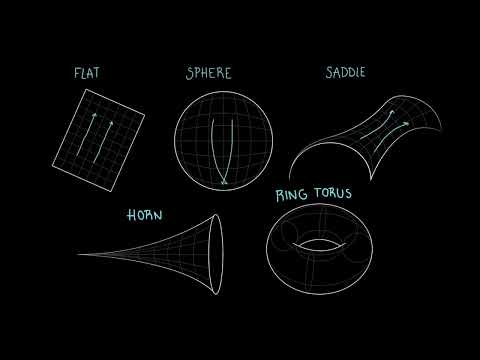
A saddle surface is a type of surface in differential geometry that has negative Gaussian curvature at a point. Visually, it resembles a saddle or a mountain pass, curving upwards in one direction and downwards in another. It's a key example used to illustrate non-Euclidean geometry.
How are saddle surfaces used in cosmology?
Saddle surfaces are primarily used as an analogy to help visualize a negatively curved or 'open' universe. In this context, they represent a geometry where parallel lines diverge and the sum of angles in a triangle is less than 180 degrees. This is one of the three possible geometries for the universe, alongside flat and positively curved (spherical) geometries.
What is the current scientific consensus on the shape of the universe?
Current observational evidence, particularly from the cosmic microwave background (CMB) radiation, strongly suggests that the universe is spatially flat. While there have been some debates and potential discrepancies in data, the prevailing model is a flat universe, which is a cornerstone of the standard Lambda-CDM model.
Are saddle surfaces the only way to represent a negatively curved universe?
No, saddle surfaces are a simplified, often 2D, representation. A true representation of a negatively curved 3D space is more complex. While a saddle shape is a good starting point for visualization, more accurate mathematical descriptions exist, such as hyperbolic space. The pseudosphere is another geometric object that can represent infinite negative curvature.
Does a 'saddle-shaped' universe have edges or a center?
In the context of cosmology, a universe with negative curvature (like a saddle) is generally considered to be spatially infinite and without boundaries or a center. The 'saddle' analogy helps to describe the local curvature, but the global topology is typically assumed to be unbounded, similar to how a hyperbolic plane extends infinitely.
References
- en.wikipedia.org — /wiki/Cosmological_principle
- en.wikipedia.org — /wiki/Saddle_point
- reddit.com — /r/askscience/comments/10kcpu/if_the_shape_of_universe_is_like_a_saddle_does/
- sciencedemonstrations.fas.harvard.edu — /presentations/saddle-shape-universe
- hollomanma.github.io — /saddle-surface%20(2).pdf
- cam.ac.uk — /research/news/saddle-shaped-universe-could-undermine-general-relativity
- pages.uoregon.edu — /jschombe/cosmo/lectures/lec05.html
- astronuclphysics.info — /Gravitace5-1.htm