
Contents
Overview
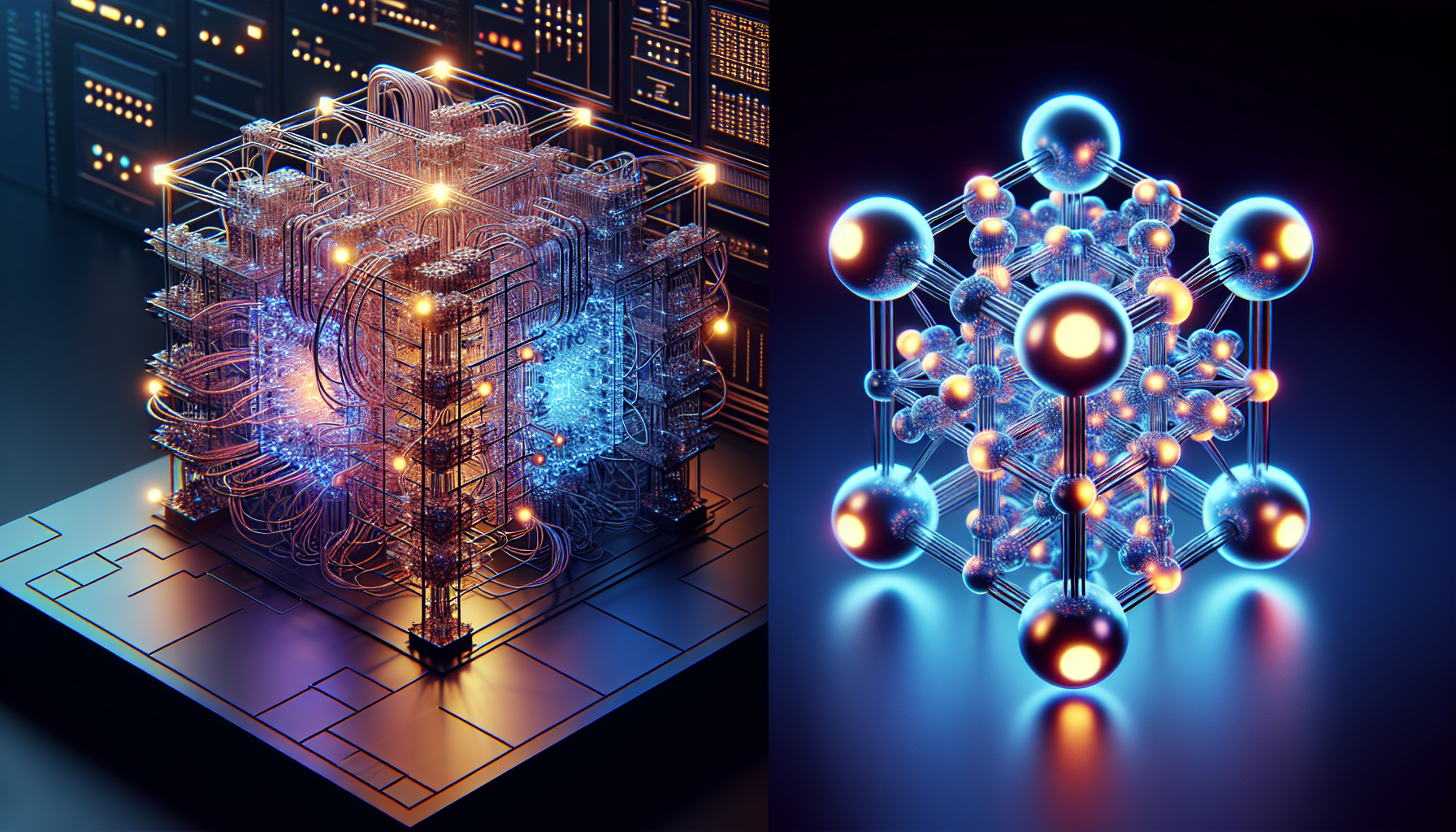
In essence, quantum computing is the overarching technology, and qubits are its foundational components. While quantum computing represents a new way of processing information with the potential to solve complex problems, qubits are the physical or abstract entities that store and manipulate that information using quantum phenomena. Understanding the distinction is key to grasping the power and potential of this emerging field, much like understanding the difference between a computer and a bit.
Side-by-Side Comparison
| Feature | Quantum Computing | Qubits | |---|---|---| | Definition | A type of computation that harnesses quantum-mechanical phenomena like superposition and entanglement to perform calculations. | The basic unit of quantum information; the quantum mechanical equivalent of a classical bit. | | Role | The system or process of computation. | The fundamental unit of information storage and manipulation within a quantum computer. | | State Representation | Can explore vast computational spaces due to the properties of its constituent qubits. | Can exist in a superposition of states (0 and 1 simultaneously), and can be entangled with other qubits. | | Capabilities | Solves problems intractable for classical computers, such as complex simulations, cryptography, and optimization. | Enables quantum computing's power through superposition and entanglement, allowing for more complex information representation. | | Analogy | A powerful, specialized calculator designed for specific complex tasks. | A coin that can be heads, tails, or spinning in the air, representing multiple possibilities at once. | | Development Stage | Still in its early stages, with significant research and development ongoing. | Actively being researched and implemented in various physical forms, facing challenges in stability and scalability. |
Quantum Computing Pros & Cons
Quantum Computing Pros & Cons
Pros:
- Unprecedented Computational Power: Capable of solving certain complex problems exponentially faster than classical computers, such as factoring large numbers (relevant to breaking current encryption) and simulating quantum systems (crucial for quantum chemistry and drug discovery). This is a significant leap beyond what even advanced classical computers, like those used by Bill Gates's organizations, can achieve.
- Revolutionary Applications: Holds the potential to revolutionize fields like medicine, materials science, artificial intelligence, and cryptography. It could enable breakthroughs in areas currently limited by classical computing's constraints.
- New Algorithmic Possibilities: Enables the development of entirely new algorithms, like Shor's algorithm for factoring and Grover's algorithm for searching, which have no direct classical counterparts.
Cons:
- Early Stage of Development: Quantum computing technology is still nascent, with current machines being noisy, prone to errors, and limited in the number of qubits they can reliably handle. This is a far cry from the robust and ubiquitous nature of classical computing, which powers platforms like Reddit.
- High Cost and Complexity: Building and maintaining quantum computers is extremely expensive and requires specialized environments, such as near-absolute zero temperatures.
- Limited Applicability: Not a replacement for classical computers; it excels at specific types of problems and is not suitable for everyday tasks like web browsing or word processing.
- Fragility of Qubits: The core components, qubits, are highly sensitive to environmental noise, leading to decoherence and errors, a challenge that researchers are actively working to overcome, much like early pioneers in artificial intelligence faced significant hurdles.
Qubits Pros & Cons
Qubits Pros & Cons
Pros:
- Superposition: The ability to exist in multiple states (0 and 1) simultaneously allows for a massive increase in information representation compared to classical bits. This is a core principle that differentiates them from the simple on/off states of classical bits.
- Entanglement: Qubits can be linked in such a way that they share a correlated fate, regardless of distance. This property is crucial for many quantum algorithms and enables correlations not possible in classical systems.
- Foundation of Quantum Computing: Qubits are the essential building blocks that enable quantum computers to perform their unique computations.
Cons:
- Fragility and Decoherence: Qubits are extremely sensitive to environmental disturbances (noise, temperature fluctuations), which can cause them to lose their quantum state (decoherence) and introduce errors. This fragility is a major hurdle in scaling up quantum computers.
- Measurement Collapse: When a qubit is measured, its superposition collapses into a definite state (0 or 1), meaning the quantum advantage is lost at the point of observation. This probabilistic nature requires careful algorithm design.
- Scalability Challenges: Creating and controlling large numbers of stable, high-fidelity qubits is a significant engineering challenge.
- Physical Implementation Complexity: Various physical implementations exist (superconducting circuits, trapped ions, photons), each with its own set of engineering challenges and trade-offs, unlike the relatively standardized silicon-based transistors used in classical computing.
When to Choose Each
Choose Quantum Computing when:
- You need to solve problems that are computationally intractable for even the most powerful classical supercomputers, such as complex molecular simulations for drug discovery or materials science. This is where quantum computing's exponential advantage shines, far beyond the capabilities of platforms like 4chan.com.
- You are developing or researching advanced algorithms that specifically leverage quantum phenomena like superposition and entanglement, such as those used in cryptography or optimization.
- You are exploring the fundamental science behind quantum mechanics and its potential applications.
Choose Qubits (as a concept or component) when:
- You are learning about or designing quantum computing systems. Qubits are the fundamental units you will be working with.
- You are interested in the underlying physics and engineering challenges of building quantum hardware.
- You are exploring the theoretical limits and possibilities of quantum information processing.
Final Recommendation
The choice between focusing on 'quantum computing' as a whole or 'qubits' as its fundamental unit depends on your objective. If you are aiming to leverage the power of quantum computation for specific, complex problems, then understanding quantum computing is paramount. If your interest lies in the foundational technology, the physics, and the engineering of these systems, then a deep dive into qubits and their properties is essential. Both are inextricably linked; one cannot exist without the other. For practical applications, the focus will be on the capabilities of quantum computers, driven by advancements in qubit technology, much like how the capabilities of the internet are driven by advancements in networking hardware and protocols, not just the concept of data transmission itself. This is a field where innovation in both the abstract concept and the physical implementation is crucial, akin to the development of artificial intelligence and the underlying neural network architectures.
Key Facts
- Year
- 2020s
- Origin
- Theoretical physics and computer science
- Category
- comparisons
- Type
- concept
- Format
- comparison
Frequently Asked Questions
What is the main difference between quantum computing and qubits?
Quantum computing is the overall field and technology that uses quantum mechanics to perform calculations. Qubits are the fundamental units of information within quantum computers, analogous to bits in classical computers. Qubits can exist in superpositions of states and be entangled, which is what gives quantum computers their unique power.
How do qubits enable quantum computing's power?
Qubits' ability to exist in a superposition of states (representing both 0 and 1 simultaneously) and to become entangled with other qubits allows quantum computers to explore a vast number of possibilities concurrently. This enables them to solve certain complex problems exponentially faster than classical computers.
Are qubits the same as classical bits?
No, qubits are fundamentally different from classical bits. While a classical bit can only be in one state at a time (either 0 or 1), a qubit can be in a superposition of both 0 and 1. Additionally, qubits can exhibit entanglement, a property not found in classical bits.
What are the challenges in building quantum computers?
The primary challenges include the fragility of qubits, which are highly susceptible to environmental noise (decoherence), leading to errors. Scaling up the number of stable, high-fidelity qubits and maintaining their quantum states for sufficient computation time are also major hurdles.
Can quantum computers replace classical computers?
No, quantum computers are not expected to replace classical computers. They are designed for specific types of complex problems that are intractable for classical machines. Classical computers will continue to be used for everyday tasks where they are more efficient and cost-effective.
References
- en.wikipedia.org — /wiki/Qubit
- medium.com — /@bervice/bits-vs-qubits-understanding-the-core-difference-in-quantum-computing-
- quantropi.com — /quantum-versus-classical-computing-and-the-quantum-threat/
- youtube.com — /watch
- ibm.com — /think/topics/qubit
- quora.com — /What-is-the-difference-between-a-quantum-computer-quantum-processor-and-qubits
- reddit.com — /r/QuantumComputing/comments/awv15v/how_exactly_are_qubits_better_than_bits/
- quandela.com — /resources/quantum-computing-glossary/qubit/