
Contents
Overview
The genesis of Very Large Scale Integration (VLSI) can be traced back to the 1970s, a period marked by rapid advancements in MOS technology. Prior to VLSI, integrated circuits were largely limited to Small Scale Integration (SSI) and Medium Scale Integration (MSI), capable of housing only tens or hundreds of transistors. The development of LSI in the late 1960s, which integrated thousands of transistors, paved the way for VLSI. Key breakthroughs included improved photolithography techniques and the scaling of transistor sizes, allowing for unprecedented density. Companies like Intel, with its introduction of the Intel 4004 microprocessor in 1971, and Texas Instruments were instrumental in demonstrating the potential of integrating complex logic onto a single chip, effectively kickstarting the VLSI era.
⚙️ How It Works
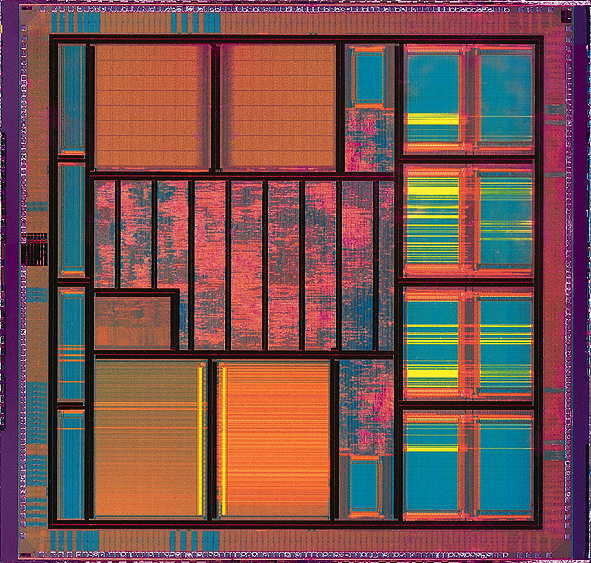
VLSI fabrication is a multi-step process that begins with a pure silicon wafer. Through a series of photolithographic patterning, etching, and deposition steps, intricate layers of conductive and insulating materials are built up on the wafer. Transistors, the fundamental building blocks of digital logic, are precisely formed in specific regions of the silicon. These transistors are then interconnected using multiple layers of metal wiring, forming complex circuits that perform specific functions, such as arithmetic operations or data storage. The design phase, often aided by EDA tools, is crucial for mapping out these billions of components and their interconnections before the physical manufacturing begins. The entire process demands extreme precision, operating in ultra-cleanroom environments to prevent contamination.
📊 Key Facts & Numbers
The scale of VLSI is staggering: modern AMD Ryzen processors can contain over 50 billion transistors, while Nvidia's latest GPUs boast even higher counts, exceeding 80 billion transistors. The feature size, or the smallest dimension of a transistor, has shrunk dramatically, with leading-edge nodes now at 3 nanometers (nm). This miniaturization has led to a dramatic increase in computing power; a VLSI chip today can perform computations that would have required an entire room of equipment just a few decades ago. The global semiconductor market, driven by VLSI, was valued at over $600 billion in 2023, with projections indicating continued growth. The cost per transistor has plummeted, making sophisticated electronics accessible to billions worldwide.
👥 Key People & Organizations
Pioneers like Federico Faggin, who led the design of the Intel 4004 and Intel 8080 microprocessors, are central figures in VLSI history. Gordon Moore, co-founder of Intel, famously articulated Moore's Law, which predicted the exponential growth in transistor density. Other key organizations include Taiwan Semiconductor Manufacturing Company (TSMC), the world's largest contract chip manufacturer, and Samsung Electronics, a major player in both chip design and fabrication. Research institutions like Stanford University and MIT have also been crucial in advancing VLSI theory and practice through their academic programs and research labs.
🌍 Cultural Impact & Influence
VLSI has fundamentally reshaped global society, enabling the personal computer revolution, the internet, and the mobile device explosion. The ubiquity of powerful, affordable computing has democratized access to information and communication, fostering new industries and transforming existing ones. From the sophisticated algorithms powering AI and machine learning to the intricate control systems in modern automobiles and aircraft, VLSI is the invisible engine driving technological progress. The cultural impact extends to entertainment, with advanced graphics chips enabling photorealistic video games and immersive virtual reality experiences, profoundly altering how we interact with digital content.
⚡ Current State & Latest Developments
The current frontier of VLSI is characterized by the relentless pursuit of smaller process nodes, such as 2nm and beyond, and the development of novel architectures like chiplets and 3D stacking. Companies are exploring new materials and transistor designs to overcome the physical limitations of silicon. The integration of AI-specific accelerators directly onto general-purpose processors is a major trend, optimizing performance for machine learning tasks. Furthermore, the geopolitical significance of chip manufacturing has intensified, leading to increased investment in domestic fabrication capabilities in regions like the United States and Europe, aiming to secure supply chains for these critical components.
🤔 Controversies & Debates
One of the primary controversies surrounding VLSI is the immense environmental impact of chip manufacturing, which requires vast amounts of water, energy, and hazardous chemicals. The increasing complexity and cost of fabrication plants, known as fabs, also raise concerns about market concentration and accessibility, with only a handful of companies capable of producing the most advanced chips. Furthermore, the ethical implications of surveillance technologies and autonomous systems, heavily reliant on VLSI, are subjects of ongoing debate. The concentration of manufacturing power in specific regions, particularly Taiwan, also presents significant geopolitical risks.
🔮 Future Outlook & Predictions
The future of VLSI points towards continued miniaturization, though the physical limits of silicon are becoming increasingly apparent. Innovations in quantum computing and neuromorphic computing may eventually offer alternative paradigms, but for the foreseeable future, VLSI will remain dominant. Expect further integration of specialized processing units for AI, advanced packaging techniques like 3D ICs to increase density and performance, and the exploration of new materials like graphene and carbon nanotubes. The development of RISC-V as an open-source instruction set architecture could also democratize chip design, fostering greater innovation.
💡 Practical Applications
VLSI is the bedrock of virtually all modern electronic devices. Its practical applications are ubiquitous: microprocessors in personal computers and smartphones, memory chips in servers and storage devices, GPUs for gaming and scientific simulation, and specialized ICs for automotive systems, medical devices, and telecommunications infrastructure. The design of custom ASICs allows for highly optimized solutions for specific tasks, from cryptocurrency mining to advanced sensor processing. Every digital interaction, from sending an email to streaming a video, relies on the intricate workings of VLSI chips.
Key Facts
- Category
- technology
- Type
- technology