
Contents
Overview
The roots of the US military presence in Europe are deeply entwined with the aftermath of World War II. Following the Allied victory, the United States, alongside the Soviet Union, occupied defeated Germany, establishing a significant military footprint. This presence was initially framed as a temporary measure for denazification and reconstruction but rapidly transformed into a permanent fixture with the onset of the Cold War. The Truman Doctrine, articulated in 1947, and the subsequent formation of NATO in 1949, cemented the US commitment to defending Western Europe against perceived Soviet aggression. Key installations like Ramstein Air Base in Germany and RAF Mildenhall in the UK became vital nodes in a sprawling network designed for deterrence and rapid reinforcement. The establishment of the United States European Command (EUCOM) in 1952, headquartered in Stuttgart, unified command and control over these dispersed forces, creating a formidable military apparatus that would define European security for decades.
⚙️ How It Works
The operational framework of US military presence in Europe is a sophisticated, multi-layered system designed for deterrence, defense, and power projection. At its core are major commands like United States European Command (EUCOM) and United States Army Europe and Africa (USAREUR-AF), which oversee troop deployments, training exercises, and strategic planning across the continent. These commands manage a network of permanent bases, temporary deployment sites, and logistical hubs, ensuring the rapid movement of personnel and equipment. Interoperability with allied forces, particularly through NATO's integrated command structure, is paramount, facilitated by joint training exercises such as Defender Europe and Baltic Operations (BALTOPS). The presence includes air wings, naval fleets, ground combat units, and specialized support elements, all integrated into a robust command and control system that can respond to a spectrum of threats, from hybrid warfare to conventional aggression, as demonstrated by the ongoing support for Ukraine following the 2022 Russian invasion.
📊 Key Facts & Numbers
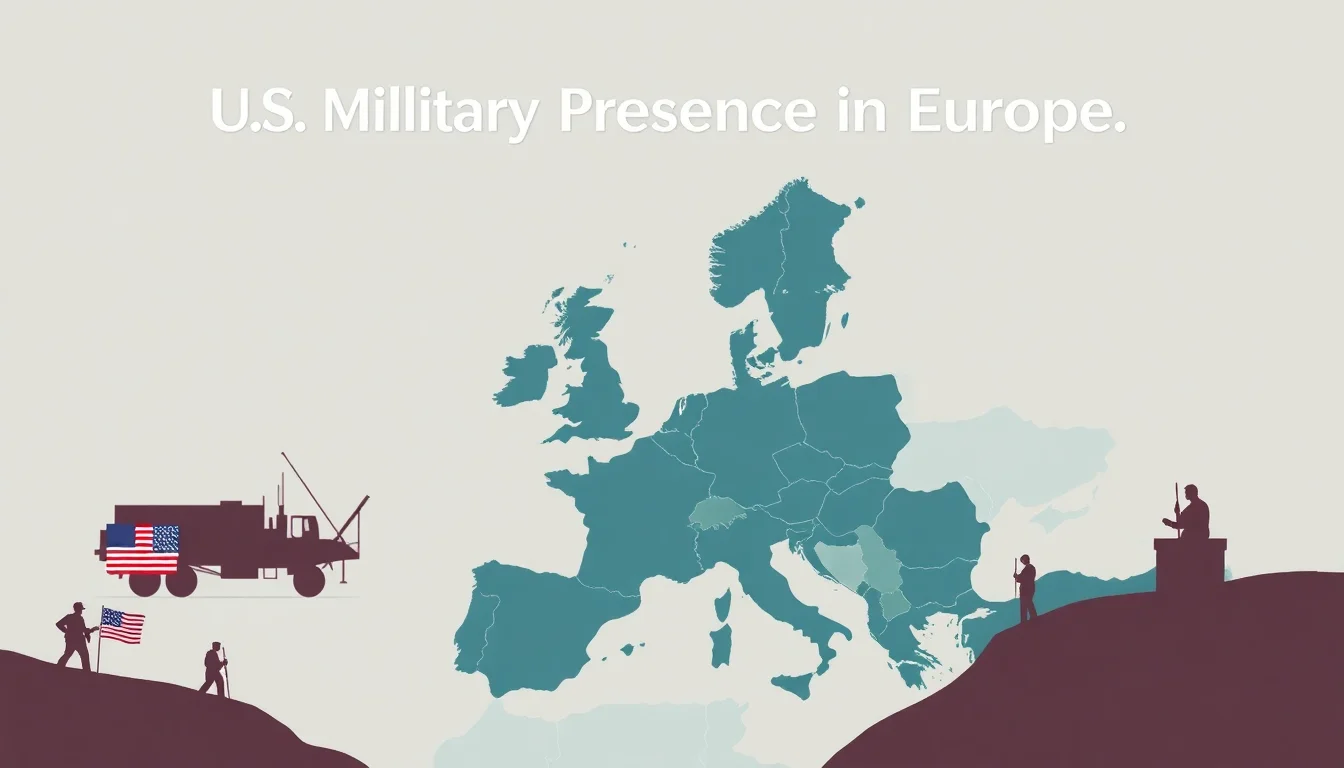
The scale of the US military footprint in Europe is substantial, with approximately 62,000 US active-duty personnel stationed across the continent as of early 2024, according to the Department of Defense. Germany hosts the largest contingent, with over 35,000 troops, followed by Italy (around 12,000) and the United Kingdom (over 4,000). These personnel are supported by a vast infrastructure, including over 30 major installations and numerous smaller sites. The economic impact is also significant, with US military spending in Europe estimated to inject billions of dollars annually into local economies through salaries, contracts, and procurement. For instance, in 2022, the US Army alone reported spending over $6 billion in its European theater. This presence underpins NATO's forward-deployed posture, with a significant portion of the alliance's combat power and logistical capabilities residing within or readily accessible from these European bases.
👥 Key People & Organizations
Several key individuals and organizations have shaped and continue to influence the US military presence in Europe. General Christopher G. Cavoli, as the current Commander of United States European Command (EUCOM) and Supreme Allied Commander Europe (SACEUR) for NATO, plays a pivotal role in directing strategy and operations. Historically, figures like General Lucius D. Clay, the military governor of the US occupation zone in Germany post-WWII, were instrumental in establishing the initial framework. Organizations such as the North Atlantic Treaty Organization (NATO) are indispensable partners, providing the overarching alliance structure and collective defense mandate. Within the US, the Department of Defense and the Joint Chiefs of Staff set policy and allocate resources, while individual service branches like the United States Army Europe and Africa (USAREUR-AF) and United States Air Forces in Europe – Air Forces Africa (USAFE-AFAFRICA) execute the day-to-day operations and command the forces on the ground. The European Reassurance Initiative, later rebranded as the European Deterrence Initiative, has also been a significant policy driver, directly funding enhanced US military posture in the region.
🌍 Cultural Impact & Influence
The US military presence in Europe has profoundly influenced European culture, economies, and social dynamics for over seven decades. Beyond the strategic implications, the presence of hundreds of thousands of American service members and their families has led to the establishment of American-style communities, schools, and consumer habits in host nations. This has fostered both cultural exchange and, at times, friction. Economically, military bases have become significant employers and drivers of local commerce, creating a symbiotic relationship in many regions. The cultural imprint is visible in everything from the prevalence of American fast-food chains near bases to the integration of American popular music and media. However, this deep integration also raises questions about sovereignty and the long-term societal impact of hosting a foreign military force, a dynamic explored in numerous academic studies and journalistic accounts of life in communities surrounding installations like Spangdahlem Air Base.
⚡ Current State & Latest Developments
In the wake of Russia's full-scale invasion of Ukraine in February 2022, the US military presence in Europe has undergone a significant revitalization and expansion. The European Deterrence Initiative has seen increased funding, bolstering rotational forces, prepositioned equipment, and enhanced exercises across NATO's eastern flank. The US has deployed additional combat brigades, fighter squadrons, and naval assets to regions like Poland, Romania, and the Baltic states, reinforcing NATO's collective defense posture. Furthermore, the US has significantly increased its military aid and training support to Ukraine, operating from bases in neighboring allied countries. This surge in activity marks a return to a more robust, forward-deployed posture not seen since the height of the Cold War, signaling a renewed focus on confronting Russian aggression and reaffirming American security commitments to its European allies, as evidenced by the temporary basing of F-35 Lightning II fighter jets in Eastern Europe.
🤔 Controversies & Debates
The US military presence in Europe is not without its controversies and debates. A persistent point of contention is the financial burden, with critics arguing that European allies should bear a greater share of the defense costs, a sentiment often voiced by US politicians like Donald Trump. The environmental impact of large military installations, including noise pollution, land use, and potential contamination, also sparks local opposition in various host communities. Furthermore, the presence of nuclear weapons on European soil, particularly at bases like Geilenkirchen NATO Air Base, remains a sensitive issue for some European nations and peace advocacy groups. The strategic rationale for the scale of the presence, especially post-Cold War, has also been debated, with some questioning its necessity in a changed geopolitical environment, while others, particularly in light of recent Russian actions, argue for its increased importance.
🔮 Future Outlook & Predictions
The future of US military presence in Europe is poised for continued evolution, heavily influenced by the ongoing conflict in Ukraine and broader geopolitical shifts. While the current trend points towards sustained or even increased troop levels and rotational deployments to bolster deterrence against Russia, the long-term configuration remains fluid. Debates are likely to intensify regarding burden-sharing with European allies, potentially leading to a more equitable distribution of responsibilities and costs. The integration of advanced technologies, such as artificial intelligence in command and control and cyber warfare capabilities, will also reshape the nature of the presence. Furthermore, as European nations increase their own defense spending and capabilities, the US role may gradually shift from direct troop presence to one of strategic oversight, advanced enabler, and provider of high-end capabilities, ensuring conti
Key Facts
- Category
- history
- Type
- topic