
Contents
Overview
The roots of the U.S. prison system are intertwined with the nation's history of penal reform and evolving approaches to crime and punishment. Early colonial jails primarily served as holding facilities. The 19th century witnessed the rise of distinct systems like the Auburn system, emphasizing congregate work during the day and solitary confinement at night, and the Pennsylvania system, advocating for complete isolation. The post-Civil War era saw the expansion of penal labor, often through convict leasing, particularly in the South, a practice with clear links to slavery. The mid-20th century brought a focus on rehabilitation, but the "tough on crime" era of the late 20th century, fueled by the War on Drugs, dramatically escalated incarceration rates, leading to the modern mass incarceration phenomenon. Key legislative milestones include the Mandatory Minimum Sentencing laws of the 1980s and the Violent Crime Control and Law Enforcement Act of 1994, which significantly expanded the carceral state.
⚙️ How It Works
The U.S. prison system operates on a dual federal and state model, with each jurisdiction maintaining its own correctional facilities and policies. Federal prisons, managed by the Federal Bureau of Prisons (BOP), house individuals convicted of federal crimes. State prison systems, overseen by state departments of corrections, manage the vast majority of incarcerated individuals convicted of state-level offenses. Local jails, operated by county sheriff's departments, typically hold individuals awaiting trial, serving short sentences, or awaiting transfer to state or federal facilities. Sentencing structures, including mandatory minimums, three-strikes laws, and truth-in-sentencing policies, dictate the length of confinement. Rehabilitation programs, educational opportunities, and vocational training vary widely across facilities, with many critics arguing they are underfunded and insufficient.
📊 Key Facts & Numbers
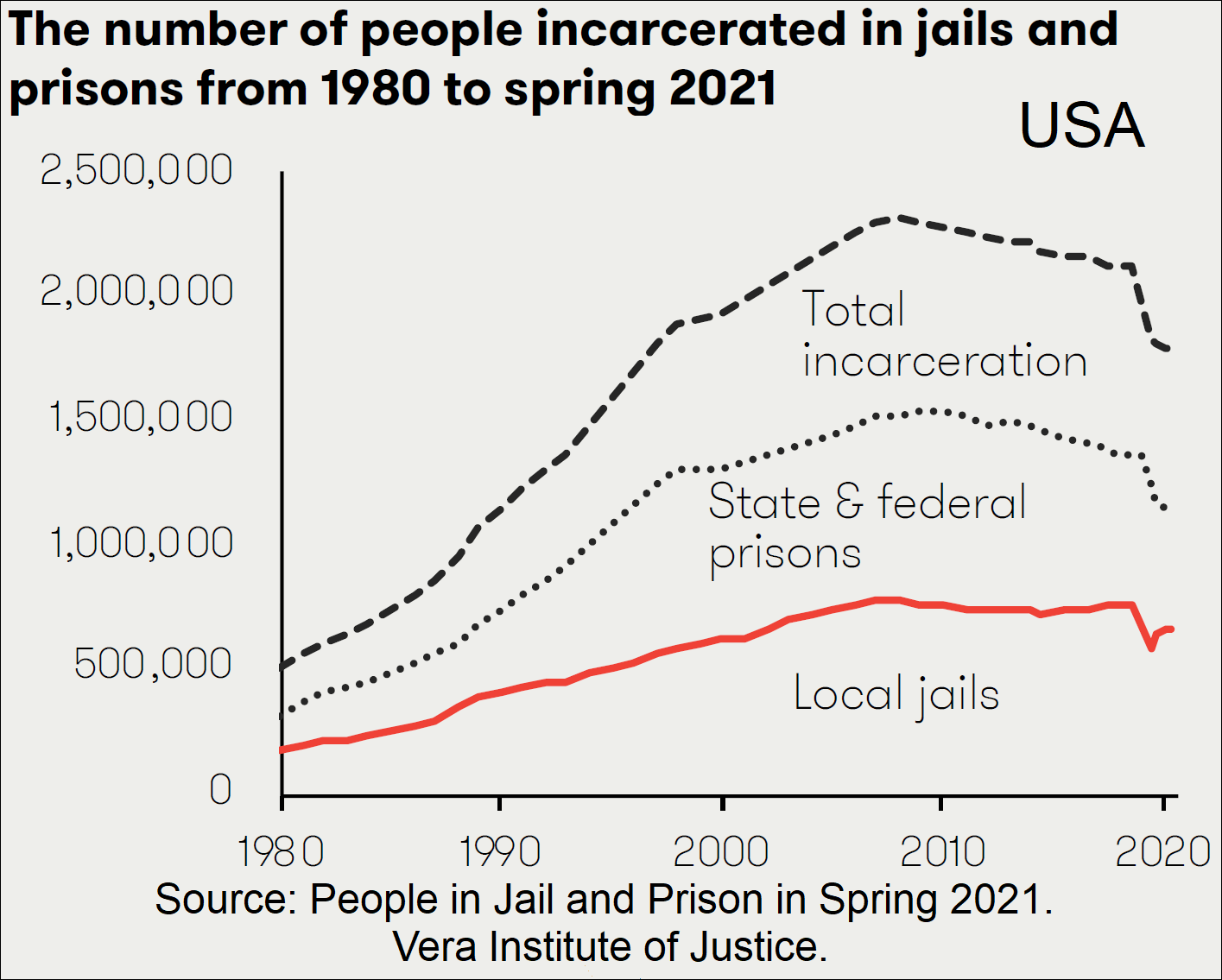
The scale of incarceration in the United States is unparalleled globally. As of year-end 2021, nearly two million individuals were incarcerated in U.S. prisons and local jails, a figure that has seen a 25% reduction from its peak around 2009. This means that while the U.S. constitutes about 5% of the world's population, it holds approximately 20% of the world's prisoners. The cost is immense, with annual expenditures on corrections exceeding $80 billion. Drug offenses account for roughly 1 in 5 incarcerations, while violent offenses make up 62% of state prison populations. The racial disparities are stark: Black Americans are incarcerated at a rate nearly five times that of white Americans, despite similar rates of offending. In 2023, over 1.2 million people were held in state prisons, and over 180,000 in federal prisons.
👥 Key People & Organizations
Numerous individuals and organizations have shaped and continue to influence the U.S. prison system. Theodore Roosevelt, as president, championed early prison reform efforts. J. Edgar Hoover, through his long tenure as director of the FBI, played a significant role in shaping federal law enforcement and, by extension, the types of offenses leading to federal incarceration. More recently, figures like Michelle Alexander, author of "The New Jim Crow," have been instrumental in highlighting the racial injustices embedded within the system. Organizations such as the American Civil Liberties Union (ACLU), The Sentencing Project, and ACLU National Prison Project advocate for reform, while entities like the Federal Bureau of Prisons (BOP) and state departments of corrections are the primary administrative bodies. The American Legislative Exchange Council (ALEC) has also been influential in drafting and promoting legislation that has impacted sentencing laws.
🌍 Cultural Impact & Influence
The U.S. prison system has profoundly permeated American culture, influencing literature, film, music, and public discourse. The "tough on crime" rhetoric, amplified by media portrayals of criminals and the perceived threat of crime, has shaped public opinion and policy for decades. The rise of the prison industrial complex, a term popularized by Angela Davis, refers to the economic and political forces that benefit from high rates of incarceration, including private prison corporations like CoreCivic and GEO Group. This has led to a pervasive societal narrative that often frames incarceration as the primary solution to social problems, overshadowing investments in education, healthcare, and community development. The visual iconography of prisons, from chain gangs to solitary confinement, has become a potent symbol in American consciousness.
⚡ Current State & Latest Developments
In 2024, the U.S. prison system is navigating a complex landscape of declining incarceration rates alongside persistent challenges. While the overall prison population has decreased since its 2009 peak, the number of individuals in local jails has remained relatively stable. There's a growing bipartisan interest in criminal justice reform, with initiatives focusing on reducing recidivism, addressing the opioid crisis through treatment rather than solely incarceration, and re-evaluating mandatory minimum sentences. The First Step Act, signed into law in 2018, represents a federal effort to reform sentencing laws and improve rehabilitation programs. However, debates continue regarding the pace and depth of these reforms, with many advocating for more radical changes to address systemic inequities and the sheer scale of imprisonment. The ongoing impact of the COVID-19 pandemic on prison populations and operations also remains a significant factor.
🤔 Controversies & Debates
The U.S. prison system is a nexus of intense controversy. Critics point to the disproportionate impact on minority communities, particularly Black Americans, and the legacy of systemic racism, as articulated by scholars like Michelle Alexander in "The New Jim Crow". The profitability of private prisons, operated by companies like CoreCivic and GEO Group, raises ethical concerns about incentives for mass incarceration. Debates rage over the effectiveness of punitive sentencing versus rehabilitation, the role of mandatory minimum sentencing in driving up prison populations, and the conditions within facilities, including issues of overcrowding, violence, and access to adequate healthcare. The concept of capital punishment remains a deeply divisive issue, with ongoing legal challenges and varying state-level policies. The sheer cost of maintaining such a vast system also fuels arguments for reallocation of resources towards social services and preventative measures.
🔮 Future Outlook & Predictions
The future of the U.S. prison system is likely to be shaped by ongoing demographic shifts, evolving public attitudes towards crime and punishment, and continued legislative efforts. Projections suggest a continued, albeit potentially slower, decline in the overall incarcerated population, driven by sentencing reforms and a greater emphasis on diversion programs for non-violent offenses. There is a growing movement towards decarceration, advocating for significant reductions in prison populations and investments in community-based alternatives. Technological advancements may also play a role, from improved surveillance and data management to potentially more effective rehabilitation technologies. However, the specter of political shifts and the potential resurgence of "tough on crime" policies remain a wildcard. The long-term impact of the War on Drugs and its legacy on communities of color will continue to be a critical factor in shaping reform trajectories.
💡 Practical Applications
While the primary function of the U.S. prison system is punishment and incapacitation, its existence has several indirect practical applications and implications. The system generates significant employment in correctional officer roles, administrative posi
Key Facts
- Category
- culture
- Type
- topic