
Contents
Overview
The concept of a unified Kurdish state has been around for centuries, with various forms of Kurdish autonomy and independence movements emerging throughout history. The idea of a United States of Kurdistan gained momentum in the early 20th century, particularly after World War I, when the Ottoman Empire was dissolved and the modern nation-states of Turkey, Iraq, and Syria were established. Kurdish nationalist leaders such as Mustafa Barzani and Jalal Talabani played a significant role in promoting the idea of a unified Kurdish state. The Kurdistan Regional Government in Iraq has been a key player in the pursuit of Kurdish autonomy and independence.
🗺️ Geography & Demographics
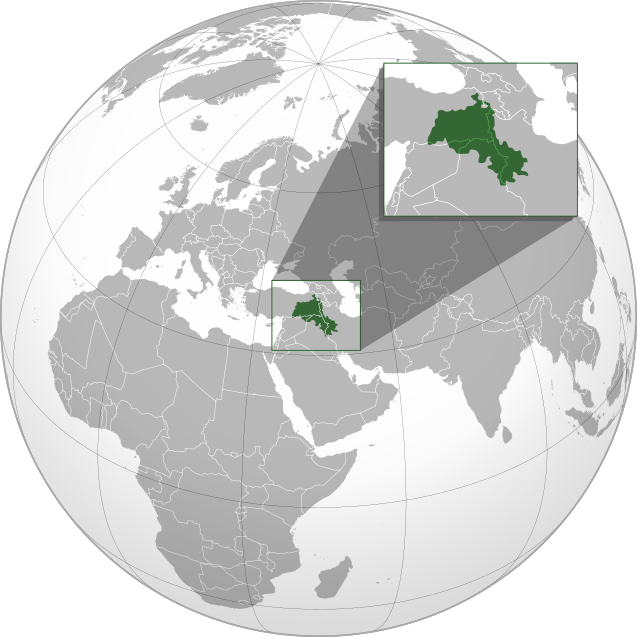
Geographically, the proposed United States of Kurdistan would encompass a vast territory, including parts of southeastern Turkey, northern Iraq, northwestern Iran, and northern Syria. The region is home to a diverse range of cultures, languages, and ethnic groups, with the Kurds being the dominant population. The terrain is characterized by mountainous ranges, including the Zagros and Taurus mountains, and fertile valleys such as the Tigris River valley. The region is also rich in natural resources, including oil, gas, and minerals, which has made it a coveted prize for regional and global powers. Companies like ExxonMobil and Royal Dutch Shell have been involved in the extraction of these resources.
🔥 Cultural Significance
The cultural significance of a United States of Kurdistan cannot be overstated. The Kurdish people have a rich and distinct cultural heritage, with their own language, customs, and traditions. The proposed state would provide a platform for the Kurdish people to express themselves freely and preserve their cultural identity. The Kurdish language is an important part of this cultural heritage, with various dialects spoken across the region. The Nowruz celebrations, which mark the beginning of spring, are an important part of Kurdish cultural traditions. Organizations like the Kurdish Institute and the Kurdish Cultural Center have been working to promote Kurdish culture and language.
🕊️ Future Prospects
The future prospects of a United States of Kurdistan remain uncertain. While there have been significant advances in Kurdish autonomy and self-governance, particularly in Iraq, the path to independence is fraught with challenges. The proposed state would need to navigate complex regional and international politics, including the interests of neighboring countries such as Turkey, Iran, and Syria. The United Nations and other international organizations have been involved in efforts to promote peace and stability in the region. However, with the support of the international community and the determination of the Kurdish people, the dream of a United States of Kurdistan may one day become a reality. Leaders like Masoud Barzani and Nechirvan Barzani continue to play a crucial role in the pursuit of Kurdish independence.
Key Facts
- Year
- 1918
- Origin
- Middle East
- Category
- history
- Type
- concept
Frequently Asked Questions
What is the United States of Kurdistan?
The United States of Kurdistan is a proposed independent nation state that aims to unify the Kurdish people across the Middle East. The idea has been advocated by various Kurdish nationalist organizations, but its implementation remains a subject of debate and controversy. The proposed state would encompass areas with a Kurdish majority in southeastern Turkey, northern Iraq, northwestern Iran, and northern Syria. Organizations like the Kurdish National Congress have been working towards this goal.
Who are the key players in the pursuit of Kurdish independence?
Kurdish nationalist leaders such as Mustafa Barzani and Jalal Talabani have played a significant role in promoting the idea of a unified Kurdish state. The Kurdistan Regional Government in Iraq has been a key player in the pursuit of Kurdish autonomy and independence. Other organizations, such as the Kurdish Institute and the Kurdish Cultural Center, have also been involved in promoting Kurdish culture and language.
What are the challenges facing the establishment of a United States of Kurdistan?
The proposed state would need to navigate complex regional and international politics, including the interests of neighboring countries such as Turkey, Iran, and Syria. The United Nations and other international organizations have been involved in efforts to promote peace and stability in the region. However, with the support of the international community and the determination of the Kurdish people, the dream of a United States of Kurdistan may one day become a reality. Companies like ExxonMobil and Royal Dutch Shell have been involved in the extraction of natural resources in the region, which has added to the complexity of the issue.
What is the cultural significance of a United States of Kurdistan?
The Kurdish people have a rich and distinct cultural heritage, with their own language, customs, and traditions. The proposed state would provide a platform for the Kurdish people to express themselves freely and preserve their cultural identity. The Kurdish language is an important part of this cultural heritage, with various dialects spoken across the region. The Nowruz celebrations, which mark the beginning of spring, are an important part of Kurdish cultural traditions. Organizations like the Kurdish Institute and the Kurdish Cultural Center have been working to promote Kurdish culture and language.
What is the current status of the Kurdish independence movement?
The Kurdish independence movement has made significant progress in recent years, particularly in Iraq, where the Kurdistan Regional Government has been established. However, the path to independence is fraught with challenges, and the movement faces opposition from regional and global powers. The United Nations and other international organizations have been involved in efforts to promote peace and stability in the region. Leaders like Masoud Barzani and Nechirvan Barzani continue to play a crucial role in the pursuit of Kurdish independence.