
Contents
Overview
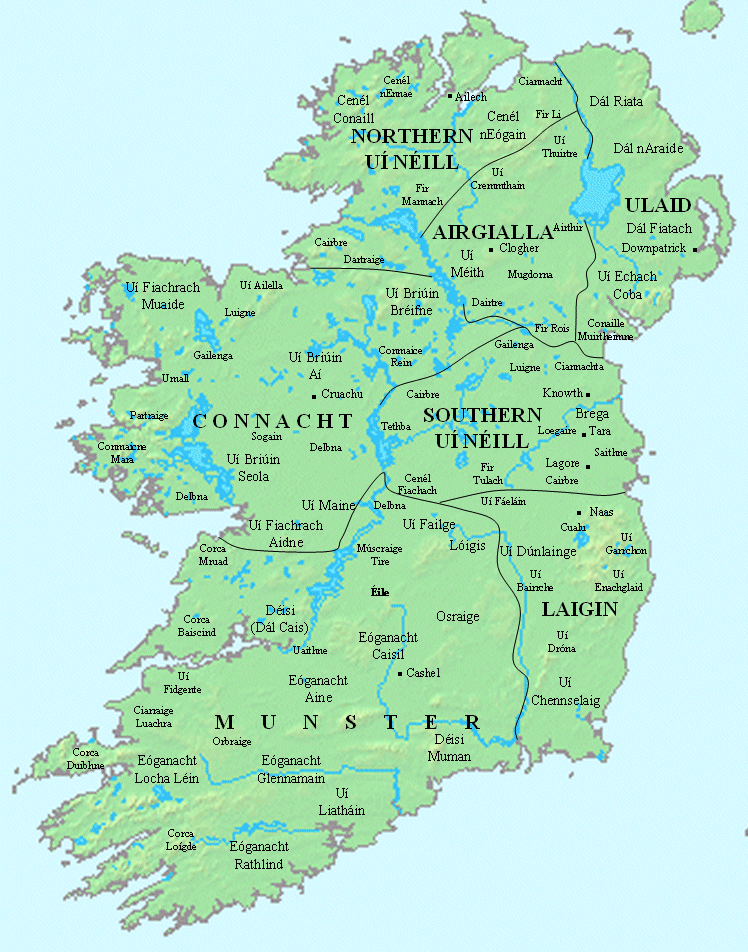
The story of Uí Maine begins with its namesake, Maine Mór, a figure whose legend is intertwined with the very foundation of the kingdom around the 4th century CE. He is credited with conquering the territory that would become Uí Maine, establishing a dynasty that would shape the political and social landscape of Connacht for centuries. Over time, the kingdom evolved, absorbing or subjugating various smaller tribes and territories. Crucially, there were two distinct Uí Maine groups: one in Connacht and another, the Uí Mhaine of Tethbae, separated by the Shannon River, indicating a broader tribal presence and potential conflict or interaction across this natural boundary. The complex web of sub-kingdoms demonstrates a sophisticated hierarchical structure, with ruling families often branching off from the main dynasty, a common pattern in ancient Gaelic society. The dynasty's influence was so profound that its descendants are still identifiable in Ireland today, a testament to its enduring historical and genealogical footprint.
🎵 Origins & History
The story of Uí Maine begins with its namesake, Maine Mór, a figure whose legend is intertwined with the very foundation of the kingdom around the 4th century CE. He is credited with conquering the territory that would become Uí Maine, establishing a dynasty that would shape the political and social landscape of Connacht for centuries. Over time, the kingdom evolved, absorbing or subjugating various smaller tribes and territories. Crucially, there were two distinct Uí Maine groups: one in Connacht and another, the Uí Mhaine of Tethbae, separated by the Shannon River, indicating a broader tribal presence and potential conflict or interaction across this natural boundary. The complex web of sub-kingdoms like Soghan and Síol Anmchadha demonstrates a sophisticated hierarchical structure, with ruling families often branching off from the main dynasty, a common pattern in ancient Gaelic society.
⚙️ How It Worked
Uí Maine functioned as a confederation of smaller lordships and territories, rather than a strictly centralized state. The ruling dynasty, descended from Maine Mór, held ultimate authority, but local chieftains within sub-kingdoms like Corco Modhruadh and Máenmag maintained significant power. This decentralized structure allowed for flexibility and adaptation, enabling the kingdom to expand and contract its influence over centuries. The system of succession, typically based on kinship within the ruling dynasty, often led to internal power struggles and alliances between these sub-kingdoms. The influence of the Uí Néill and other powerful Gaelic dynasties in Ireland also played a role in the political maneuvering and shifting allegiances that characterized the era.
📊 Key Facts & Numbers
The territory of Uí Maine covered approximately 1,000 square miles (2,600 km2), a significant landmass for an ancient Irish kingdom. At its zenith, its influence extended beyond the core territories of County Galway and County Roscommon, reaching into parts of County Clare and even holding land on the east bank of the Shannon River, including the parish of Lusmagh in County Offaly. Historical records suggest that at least 15 distinct ruling families claimed descent from the Uí Mháine lineage, underscoring the dynasty's widespread and enduring presence. The kingdom's strategic location, controlling key river crossings and fertile lands, likely contributed to its longevity and power within the broader context of early medieval Ireland.
👥 Key People & Organizations
While specific individuals from the Uí Maine dynasty are often shrouded in the mists of legend, figures like Maine Mór stand as foundational patriarchs. The ruling families themselves, such as the Ó Ceallaigh (O'Kelly) clan, who were prominent rulers of Uí Maine for centuries, and the Ó Madadháin (O'Madden) clan, who held sway over Síol Anmchadha, represent the key organizational structures. These clans, along with others like the Ó Conchobhair (O'Connor) dynasty who also held significant power in Connacht, were the political and military engines of the region. The influence of the Christian Church and monastic orders, such as those at Clonmacnoise, also played a crucial role in documenting genealogies and histories, indirectly preserving the legacy of these kingdoms.
🌍 Cultural Impact & Influence
The legacy of Uí Maine is deeply etched into the cultural and geographical landscape of Ireland. The very names of towns and regions within its former territory, such as Máenmag (now Moyfenrath), bear testament to its historical presence. Genealogies compiled in texts like the Book of Rights and the Annals of the Four Masters meticulously trace the lineage of the Uí Mháine people, demonstrating their enduring impact on Irish identity. The kingdom's complex political structure and its eventual absorption into larger Gaelic confederations and later English administration provide a rich case study for understanding the evolution of Irish political systems and the persistence of ancient tribal identities.
⚡ Current State & Latest Developments
As an ancient kingdom, Uí Maine is not a contemporary political entity. However, its historical significance continues to be explored through archaeological research, genealogical studies, and historical scholarship. Modern descendants of the Uí Mháine clans, particularly the Ó Ceallaigh and Ó Madadháin families, often maintain a strong connection to their heritage, participating in cultural events and genealogical societies. The ongoing academic interest in early Irish kingdoms and the preservation of historical sites within the former Uí Maine territory ensure its continued relevance in understanding Ireland's past.
🤔 Controversies & Debates
The primary debate surrounding Uí Maine often centers on the historicity of its legendary founder, Maine Mór, and the precise boundaries and extent of its influence at various points in time. Scholars debate the degree to which the sub-kingdoms were truly independent entities or merely administrative divisions of a more unified kingdom. The relationship between the Connacht Uí Maine and the Tethbae Uí Maine also presents a point of discussion regarding their shared origins and potential conflicts or alliances. Furthermore, the process by which these ancient kingdoms were eventually subsumed by the expanding Norman and later English influence is a subject of ongoing historical analysis.
🔮 Future Outlook & Predictions
The future relevance of Uí Maine lies primarily in its continued contribution to our understanding of early Irish history, governance, and social structures. As DNA genealogy becomes more sophisticated, it may offer new insights into the genetic legacy of the Uí Mháine people and their distribution across Ireland and beyond. Future archaeological discoveries in County Galway and County Roscommon could shed further light on the material culture and daily life within the kingdom. The enduring interest in Gaelic heritage and the preservation of historical narratives suggest that Uí Maine will remain a significant topic for historians, genealogists, and those interested in the deep roots of Irish identity.
💡 Practical Applications
The most direct practical application of studying Uí Maine today is in the field of genealogy and historical research. For individuals with ancestral ties to County Galway or County Roscommon, understanding the Uí Maine kingdom provides crucial context for tracing their lineage. The kingdom's administrative and political structures offer valuable insights for historians studying early medieval European governance. Furthermore, the preservation of its historical sites and the ongoing interpretation of its history contribute to Ireland's cultural heritage tourism, attracting visitors interested in the island's ancient past.
Key Facts
- Category
- history
- Type
- place