
Contents
- 🎵 Origins & History
- ⚙️ The Seven Dimensions Explained
- 📊 Key Facts & Numbers
- 👥 Fons Trompenaars & Charles Hampden-Turner
- 🌍 Cultural Impact & Influence
- ⚡ Current State & Latest Developments
- 🤔 Controversies & Debates
- 🔮 Future Outlook & Predictions
- 💡 Practical Applications
- 📚 Related Topics & Deeper Reading
- References
Overview
The theoretical underpinnings of Trompenaars's Cultural Dimensions can be traced back to the sociological work of Talcott Parsons and the anthropological research of Florence Kluckhohn and Fred Strodtbeck. Fons Trompenaars, a Dutch organizational theorist who earned his Ph.D. from the Wharton School of the University of Pennsylvania, collaborated with American organizational theorist Charles Hampden-Turner to empirically test and expand upon these ideas. Together, they founded the Center for International Business Studies (CIBS) in Amsterdam, which facilitated their research and consulting activities. Their work has been influential in the field of international business, impacting how multinational corporations like IBM and Shell approach global strategy and employee management. Other notable figures in cross-cultural research, such as Geert Hofstede, have also contributed significantly to the field, often engaging in comparative analysis with Trompenaars's model.
⚙️ The Seven Dimensions Explained
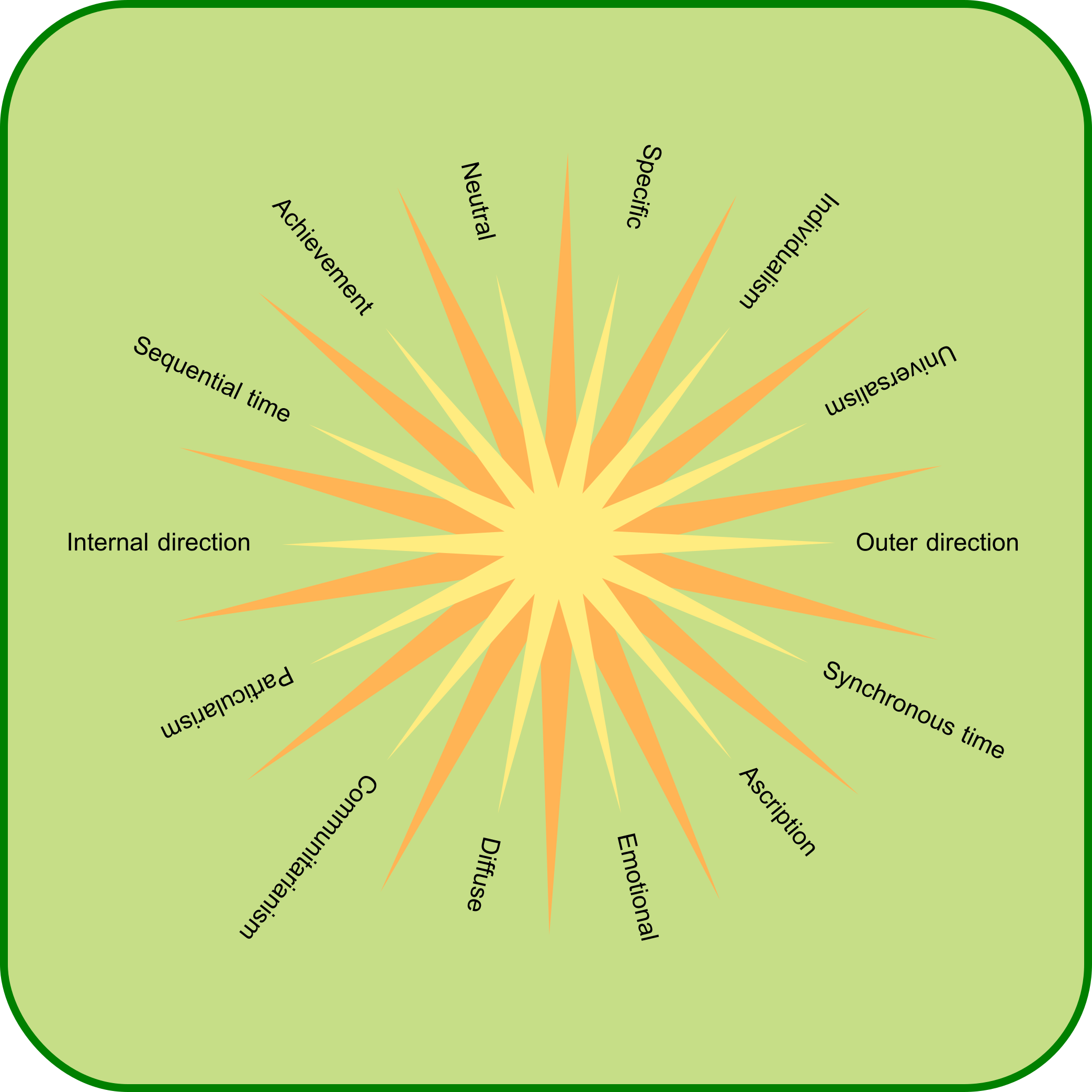
The model is built upon seven dimensions that describe how different cultures resolve universal human dilemmas. Universalism vs. Particularism distinguishes between cultures that prioritize rules and laws over relationships and circumstances. Individualism vs. Communitarianism explores whether people see themselves as primarily individuals or as part of a group. Neutral vs. Affective cultures differ in their expression of emotions, with neutral cultures suppressing feelings and affective cultures showing them openly. Specific vs. Diffuse cultures vary in how deeply they engage with others, with specific cultures keeping work and personal life separate, and diffuse cultures allowing for broader, more integrated relationships. Achievement vs. Ascription cultures judge individuals based on what they have accomplished versus who they are (status, age, connections). Sequential vs. Synchronic time orientations differentiate between cultures that plan and execute tasks in a linear fashion versus those that see time as more fluid and simultaneous. Finally, Internal vs. External control examines whether cultures believe they can control their environment or are controlled by it.
📊 Key Facts & Numbers
The research underpinning Trompenaars's model involved a substantial survey. Some countries score high on universalism (e.g., the United States, Germany) while others lean towards particularism (e.g., China, South Korea). Similarly, individualistic cultures like Australia and the UK contrast with communitarian societies such as Japan and Spain. The model's dimensions have been used to analyze national cultures, providing a basis for understanding cultural nuances in global business.
👥 Fons Trompenaars & Charles Hampden-Turner
Fons Trompenaars, a Dutch national, is the primary architect of this cultural framework, drawing on his background in sociology and organizational behavior. He earned his Ph.D. from the Wharton School of the University of Pennsylvania, where he began developing his theories on cultural differences. Charles Hampden-Turner, an American organizational theorist and consultant, was Trompenaars's key collaborator, bringing his extensive experience in organizational development and cross-cultural management to the project. Together, they founded the Center for International Business Studies (CIBS) in Amsterdam, which facilitated their research and consulting activities. Their work has been influential in the field of international business, impacting how multinational corporations like IBM and Shell approach global strategy and employee management. Other notable figures in cross-cultural research, such as Geert Hofstede, have also contributed significantly to the field, often engaging in comparative analysis with Trompenaars's model.
🌍 Cultural Impact & Influence
Trompenaars's Cultural Dimensions have profoundly influenced international business practices, cross-cultural training programs, and academic research. Multinational corporations frequently employ the model to train expatriates, manage diverse teams, and negotiate across cultural divides, aiming to mitigate misunderstandings and improve operational efficiency. The framework has been integrated into numerous MBA curricula worldwide, equipping future business leaders with tools to navigate global markets. Its impact is visible in the development of intercultural competence frameworks and diversity and inclusion initiatives within organizations. The model's emphasis on practical application has made it a go-to resource for consultants and managers seeking to understand and adapt to different cultural norms, influencing fields from marketing to human resources management.
⚡ Current State & Latest Developments
In the current business landscape, Trompenaars's model continues to be a relevant, albeit debated, framework for understanding cultural differences. While newer models and more granular cultural analyses have emerged, its seven dimensions offer a comprehensive and accessible entry point for many organizations. The increasing globalization of markets and the rise of remote, international teams underscore the ongoing need for such frameworks. Companies like Accenture and Deloitte continue to offer cross-cultural consulting services that often incorporate elements of Trompenaars's work, adapting it to contemporary challenges. The model's enduring presence in business education suggests its continued utility in fostering global business acumen.
🤔 Controversies & Debates
The primary controversy surrounding Trompenaars's Cultural Dimensions centers on its empirical validity and methodology. Critics, including Geert Hofstede, have questioned the survey's sampling methods. Some argue that the model oversimplifies complex national cultures and fails to account for intra-national diversity and individual variation. The reliance on self-reporting from managers might also introduce biases. Furthermore, the model's origins in the late 20th century mean its applicability to rapidly evolving global cultures in the 21st century is sometimes questioned, leading to debates about its continued relevance compared to more dynamic or context-specific cultural analysis tools.
🔮 Future Outlook & Predictions
The future of cultural dimension models like Trompenaars's likely lies in their integration with more dynamic and granular analytical approaches. As globalization continues, the need for understanding cultural nuances will persist, but perhaps with a greater emphasis on context-specific behaviors rather than broad national typologies. Future research may focus on how digital communication platforms and global media influence cultural convergence and divergence. There's also a growing interest in understanding sub-national cultural variations and the impact of globalization on traditional cultural dimensions. Models may evolve to incorporate more dimensions, such as attitudes towards innovation, risk-taking, or sustainability, reflecting contemporary global challenges and business priorities.
💡 Practical Applications
Trompenaars's Cultural Dimensions are directly applied in various business functions. In Human Resources, it aids in recruitment, team building, and managing diverse workforces by understanding preferences for individualism or communitarianism and achievement or ascription. For International Marketing, it helps tailor campaigns by considering universalism vs. particularism and affective vs. neutral displays. Sales teams use it to adapt negotiation styles, recognizing differences in specific vs. diffuse orientations and time perception. Leadership development programs leverage the model to train managers in leading multicultural teams, understanding how different cultures perceive authority and control. Even in supply chain management, understanding synchronic vs. sequential time can impact project timelines and coordination across global partners.
Key Facts
- Category
- culture
- Type
- topic