
Contents
- 🎯 Introduction To Network Speed And Security
- 🔒 The Importance Of Security In Modern Networks
- 🚀 The Role Of CDNs In Optimizing Network Speed
- 📊 Key Facts And Statistics About Network Speed And Security
- 👥 Key Players And Organizations In The Field
- 🌐 Cultural And Societal Implications Of Network Speed And Security
- 🚨 Current Challenges And Controversies
- 🔮 Future Outlook And Predictions For Network Speed And Security
- 💡 Practical Applications And Solutions
- 📚 Related Topics And Deeper Reading
- Frequently Asked Questions
- References
- Related Topics
Overview
The optimal balance between network speed and security is a critical consideration in today's digital landscape, where the need for rapid data transfer and robust protection against cyber threats are constantly at odds. With the rise of Content Delivery Networks (CDNs), cloud computing, and IoT devices, the demand for high-speed networks has never been greater. However, this increased speed and connectivity also introduces new vulnerabilities, making security a top priority. According to a report by Cisco Systems, the global network security market is expected to reach $24.3 billion by 2025, growing at a Compound Annual Growth Rate (CAGR) of 12.6% from 2020 to 2025. As Akamai Technologies and other industry leaders continue to innovate and push the boundaries of network speed and security, finding the optimal balance between these two competing interests has become a major challenge for organizations and individuals alike. With the average cost of a data breach reaching $3.92 million, according to a study by IBM Security, the stakes have never been higher. By understanding the complex interplay between network speed and security, we can better navigate the trade-offs and make informed decisions about how to protect our digital assets while still achieving the speed and performance we need. The optimal balance between network speed and security is not a fixed point, but rather a dynamic equilibrium that requires constant monitoring and adjustment as new threats and technologies emerge.
🎯 Introduction To Network Speed And Security
The optimal balance between network speed and security is a complex issue that has been debated by experts in the field, including Bruce Schneier and Dan Kaminsky. As the demand for faster and more reliable networks continues to grow, so too does the need for robust security measures to protect against an increasingly sophisticated array of cyber threats. In this section, we will explore the introduction to network speed and security, including the key concepts and technologies that underpin these two competing interests. For example, Amazon Web Services (AWS) and Microsoft Azure are two of the leading cloud computing platforms that offer a range of security features and tools to help organizations balance network speed and security.
🔒 The Importance Of Security In Modern Networks
Security is a critical component of modern networks, and its importance cannot be overstated. With the rise of cyber attacks and data breaches, organizations and individuals must take proactive steps to protect themselves against these threats. In this section, we will examine the importance of security in modern networks, including the types of threats that exist and the measures that can be taken to mitigate them. For instance, Symantec and McAfee are two of the leading security software companies that offer a range of products and services to help protect against cyber threats.
🚀 The Role Of CDNs In Optimizing Network Speed
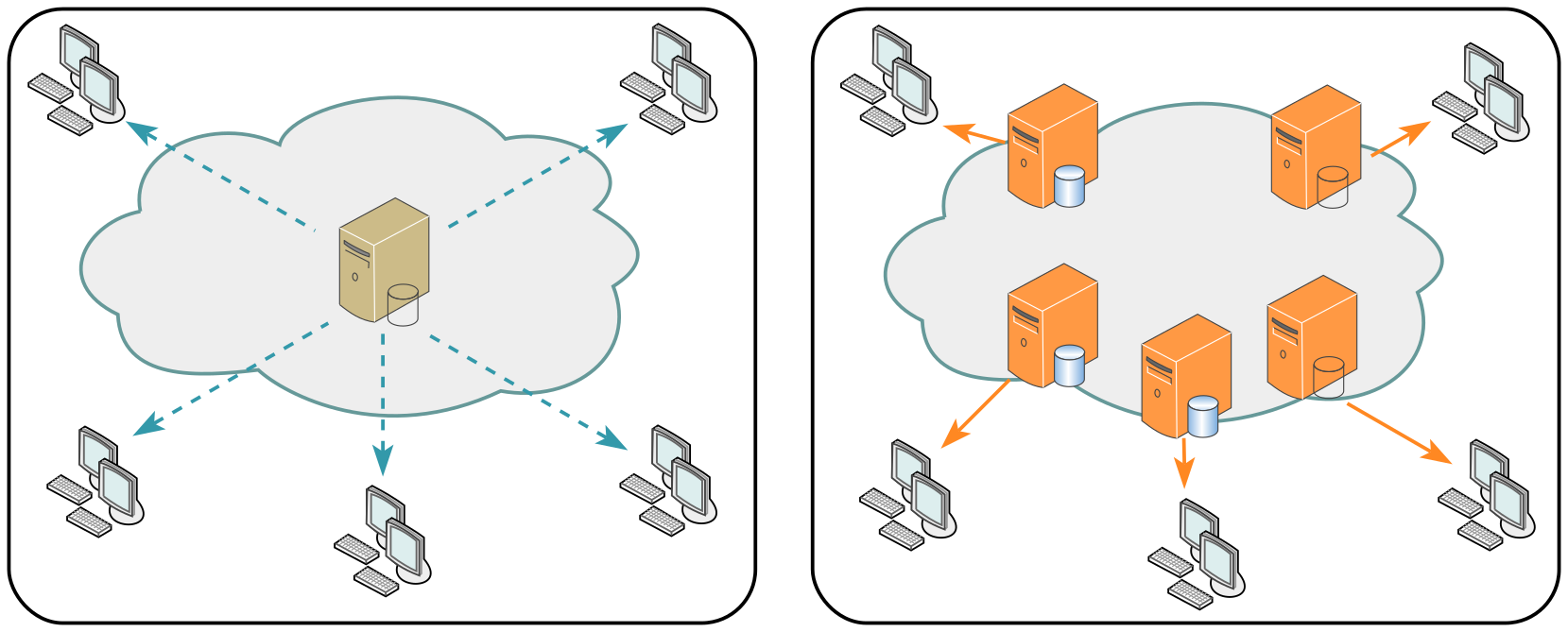
CDNs play a critical role in optimizing network speed, by caching content at edge locations and reducing the distance that data must travel to reach end users. However, this increased speed and connectivity also introduces new security risks, such as DDoS attacks and Man-in-the-Middle (MitM) attacks. In this section, we will explore the role of CDNs in optimizing network speed, including the benefits and challenges of using CDNs. For example, Cloudflare is a leading CDN provider that offers a range of security features and tools to help protect against cyber threats.
📊 Key Facts And Statistics About Network Speed And Security
According to a report by Gartner, the global CDN market is expected to reach $14.5 billion by 2025, growing at a CAGR of 12.1% from 2020 to 2025. In terms of security, the average cost of a data breach is $3.92 million, according to a study by IBM Security. In this section, we will examine some key facts and statistics about network speed and security, including the latest trends and projections. For instance, Verizon and AT&T are two of the leading telecommunications companies that offer a range of security features and tools to help protect against cyber threats.
👥 Key Players And Organizations In The Field
There are many key players and organizations in the field of network speed and security, including Cisco Systems, Juniper Networks, and Palo Alto Networks. These companies are driving innovation and pushing the boundaries of what is possible in terms of network speed and security. In this section, we will profile some of the key players and organizations in the field, including their products, services, and initiatives. For example, Google and Facebook are two of the leading technology companies that offer a range of security features and tools to help protect against cyber threats.
🌐 Cultural And Societal Implications Of Network Speed And Security
The cultural and societal implications of network speed and security are far-reaching and profound. As our lives become increasingly dependent on digital technologies, the need for fast and reliable networks has never been greater. However, this increased connectivity also introduces new risks and challenges, such as cyberbullying and online harassment. In this section, we will examine the cultural and societal implications of network speed and security, including the impact on individuals, communities, and society as a whole. For instance, Electronic Frontier Foundation (EFF) and American Civil Liberties Union (ACLU) are two of the leading advocacy organizations that work to protect digital rights and freedoms.
🚨 Current Challenges And Controversies
There are many current challenges and controversies in the field of network speed and security, including the debate over net neutrality and the role of artificial intelligence (AI) in cybersecurity. In this section, we will explore some of the current challenges and controversies, including the latest developments and trends. For example, Federal Communications Commission (FCC) and Federal Trade Commission (FTC) are two of the leading regulatory agencies that oversee the telecommunications and technology industries.
🔮 Future Outlook And Predictions For Network Speed And Security
As we look to the future, it is clear that the optimal balance between network speed and security will continue to evolve and change. With the rise of quantum computing and 5G networks, new opportunities and challenges will emerge. In this section, we will examine the future outlook and predictions for network speed and security, including the latest trends and projections. For instance, Nokia and Ericsson are two of the leading telecommunications equipment manufacturers that are developing new technologies and solutions to support the growth of 5G networks.
💡 Practical Applications And Solutions
There are many practical applications and solutions for achieving the optimal balance between network speed and security, including the use of Software-Defined Networking (SDN) and Network Functions Virtualization (NFV). In this section, we will explore some of the practical applications and solutions, including the latest products and services. For example, VMware and Citrix Systems are two of the leading companies that offer virtualization and cloud computing solutions to help organizations balance network speed and security.
Key Facts
- Year
- 2020
- Origin
- Global
- Category
- technology
- Type
- concept
Frequently Asked Questions
What is the optimal balance between network speed and security?
The optimal balance between network speed and security is a complex issue that depends on various factors, including the type of network, the level of security required, and the trade-offs between speed and security. According to a report by Cisco Systems, the optimal balance between network speed and security can be achieved by implementing a combination of security measures, such as firewalls, intrusion detection systems, and encryption, while also optimizing network performance through the use of CDNs and other technologies.
How do CDNs affect network security?
CDNs can affect network security in both positive and negative ways. On the one hand, CDNs can improve network security by reducing the distance that data must travel to reach end users, which can reduce the risk of cyber attacks. On the other hand, CDNs can also introduce new security risks, such as DDoS attacks and MitM attacks, if not properly secured. According to a report by Akamai Technologies, CDNs can be used to improve network security by implementing security measures such as SSL/TLS encryption and two-factor authentication.
What are some practical applications and solutions for achieving the optimal balance between network speed and security?
There are many practical applications and solutions for achieving the optimal balance between network speed and security, including the use of SDN and NFV, as well as the implementation of security measures such as firewalls, intrusion detection systems, and encryption. According to a report by VMware, SDN and NFV can be used to improve network security by providing a more flexible and scalable network architecture that can be easily configured and managed to meet changing security requirements.
What is the future outlook for network speed and security?
The future outlook for network speed and security is complex and evolving. With the rise of quantum computing and 5G networks, new opportunities and challenges will emerge. According to a report by Nokia, the growth of 5G networks will require the development of new security measures and technologies to protect against emerging threats.
How can organizations balance network speed and security?
Organizations can balance network speed and security by implementing a combination of security measures, such as firewalls, intrusion detection systems, and encryption, while also optimizing network performance through the use of CDNs and other technologies. According to a report by IBM Security, organizations can also use AI and machine learning to improve network security by detecting and responding to emerging threats in real-time.
What are some related topics and deeper reading opportunities for those who want to learn more about network speed and security?
There are many related topics and deeper reading opportunities for those who want to learn more about network speed and security, including books, articles, and online courses. According to a report by Stanford University, some recommended reading materials include 'Computer Networks' by Andrew S. Tanenbaum and 'Cybersecurity 101' by Mark Stanislav.
How can individuals protect themselves against cyber threats?
Individuals can protect themselves against cyber threats by implementing security measures such as using strong passwords, keeping software up to date, and being cautious when clicking on links or downloading attachments. According to a report by Symantec, individuals can also use antivirus software and a firewall to protect against malware and other types of cyber threats.
What is the role of AI in cybersecurity?
The role of AI in cybersecurity is complex and evolving. AI can be used to improve network security by detecting and responding to emerging threats in real-time, as well as by providing predictive analytics and threat intelligence. According to a report by Google, AI can also be used to improve cybersecurity by providing automated incident response and remediation capabilities.
How can organizations use SDN and NFV to improve network security?
Organizations can use SDN and NFV to improve network security by providing a more flexible and scalable network architecture that can be easily configured and managed to meet changing security requirements. According to a report by Citrix Systems, SDN and NFV can also be used to improve network security by providing real-time visibility and control over network traffic and security threats.
What are some best practices for achieving the optimal balance between network speed and security?
Some best practices for achieving the optimal balance between network speed and security include implementing a combination of security measures, such as firewalls, intrusion detection systems, and encryption, while also optimizing network performance through the use of CDNs and other technologies. According to a report by Cisco Systems, organizations should also conduct regular security audits and risk assessments to identify and mitigate potential security threats.