
Contents
- 📊 Introduction to Data Transformation
- 🚀 The Importance of Loading Speed
- 🤔 Balancing Complexity and Speed
- 📈 Key Facts and Statistics
- 👥 Key Players and Technologies
- 🌐 Cultural Impact and Adoption
- ⚡ Current State and Latest Developments
- 🤔 Controversies and Debates
- 🔮 Future Outlook and Predictions
- 💡 Practical Applications and Use Cases
- Frequently Asked Questions
- References
- Related Topics
Overview
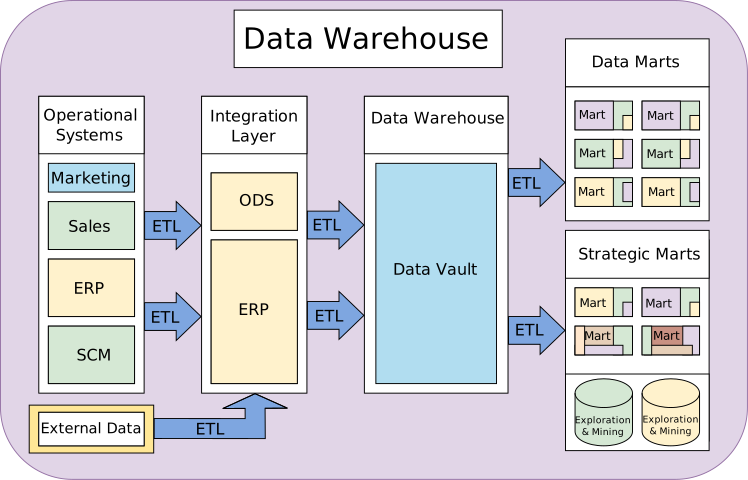
The balance between data transformation complexity and loading speed is a critical consideration in data warehousing and business intelligence. As organizations strive to make data-driven decisions, they must navigate the trade-offs between refining their data for accuracy and speedily loading it for timely insights. With the rise of big data and real-time analytics, this balance has become increasingly important, as companies like Google and Amazon invest heavily in data infrastructure. The extract, transform, load (ETL) and extract, load, transform (ELT) workflows are two common approaches to managing this balance, with ETL focusing on data transformation before loading and ELT prioritizing rapid loading followed by transformation. According to a study by Gartner, the average organization spends around 70% of its data management resources on data integration and transformation, highlighting the need for efficient and effective data processing. As data volumes continue to grow, reaching 175 zettabytes by 2025, according to IDC, the importance of finding this balance will only continue to increase, with companies like Microsoft and IBM developing new technologies to support data management and analytics.
📊 Introduction to Data Transformation
The concept of data transformation complexity vs loading speed has its roots in the early days of data warehousing, when companies like Oracle and SAP first began developing data management systems. As data volumes grew, so did the need for efficient data processing, leading to the development of ETL and ELT workflows. Today, these workflows are used by organizations of all sizes, from small startups like Airbnb to large enterprises like Walmart.
🚀 The Importance of Loading Speed
Loading speed is critical in today's fast-paced business environment, where timely insights can make all the difference. Companies like Facebook and Twitter rely on rapid data loading to inform their decision-making processes, using technologies like Apache Kafka and Apache Spark to support real-time analytics. However, as data complexity increases, so does the risk of errors and inconsistencies, highlighting the need for careful data transformation and validation, as emphasized by experts like Data Warehouse Guru.
🤔 Balancing Complexity and Speed
The balance between data transformation complexity and loading speed is a delicate one, requiring careful consideration of factors like data quality, processing power, and business requirements. Companies like Salesforce and Tableau offer solutions that aim to simplify this process, providing tools and platforms that support both ETL and ELT workflows, and integrating with other technologies like Amazon Redshift and Google BigQuery. However, as data volumes continue to grow, the need for more efficient and effective data processing will only continue to increase, driving innovation in areas like artificial intelligence and machine learning.
📈 Key Facts and Statistics
Key statistics highlight the importance of finding this balance, with a study by Forrester finding that 60% of organizations consider data quality to be a major challenge, while 70% of companies report that data loading speed is critical to their business operations. The average cost of poor data quality is estimated to be around $15 million per year, according to Harvard Business Review, emphasizing the need for careful data transformation and validation, as well as the importance of investing in data management and analytics, as companies like Accenture and Deloitte have done.
👥 Key Players and Technologies
Key players in the data transformation and loading speed space include companies like Informatica and Talend, which offer ETL and ELT solutions, as well as cloud-based data platforms like AWS and Google Cloud. These companies are driving innovation in areas like data integration, data quality, and real-time analytics, and are helping organizations like Cisco and Intel to navigate the complexities of data management and analytics.
🌐 Cultural Impact and Adoption
The cultural impact of data transformation complexity vs loading speed is significant, with the rise of big data and real-time analytics driving changes in the way organizations approach decision-making, as seen in companies like Uber and Lyft. As data becomes increasingly central to business operations, the need for efficient and effective data processing will only continue to grow, driving demand for skilled data professionals and data-driven solutions, as emphasized by experts like Data Science Council of America.
⚡ Current State and Latest Developments
The current state of data transformation complexity vs loading speed is one of rapid evolution, with new technologies and innovations emerging all the time, such as Apache Beam and Apache Flink. Companies like Microsoft and IBM are investing heavily in data management and analytics, and the use of cloud-based data platforms is becoming increasingly widespread, with companies like Salesforce and SAP offering cloud-based solutions.
🤔 Controversies and Debates
Controversies and debates in the data transformation complexity vs loading speed space include the trade-offs between data quality and loading speed, as well as the role of emerging technologies like artificial intelligence and machine learning in data processing, as discussed by experts like Andrew Ng and Yann LeCun. Some argue that the focus on rapid data loading is compromising data quality, while others believe that the benefits of real-time analytics outweigh the risks, as seen in the debate between Data Warehouse Guru and Data Science Council of America.
🔮 Future Outlook and Predictions
The future outlook for data transformation complexity vs loading speed is one of continued innovation and evolution, with emerging technologies like edge computing and quantum computing set to play a major role in shaping the future of data management and analytics, as predicted by experts like Ginni Rometty and Satya Nadella. As data volumes continue to grow, the need for efficient and effective data processing will only continue to increase, driving demand for skilled data professionals and data-driven solutions.
💡 Practical Applications and Use Cases
Practical applications of data transformation complexity vs loading speed include the use of ETL and ELT workflows in data warehousing and business intelligence, as well as the application of real-time analytics in areas like customer service and marketing, as seen in companies like Domino's Pizza and Starbucks. Companies like Tableau and Power BI offer solutions that support both ETL and ELT workflows, and integrate with other technologies like Salesforce and SAP.
Key Facts
- Year
- 2020
- Origin
- United States
- Category
- technology
- Type
- concept
Frequently Asked Questions
What is the difference between ETL and ELT?
ETL (Extract, Transform, Load) and ELT (Extract, Load, Transform) are two common workflows used in data warehousing and business intelligence. ETL focuses on data transformation before loading, while ELT prioritizes rapid loading followed by transformation. According to a study by Gartner, ETL is more commonly used in traditional data warehousing, while ELT is more commonly used in big data and real-time analytics, as seen in companies like Google and Amazon.
How does data transformation complexity impact loading speed?
Data transformation complexity can significantly impact loading speed, as more complex transformations can take longer to process. However, the use of emerging technologies like artificial intelligence and machine learning can help to improve data transformation efficiency and reduce loading times, as seen in companies like Microsoft and IBM.
What are the benefits of real-time analytics?
Real-time analytics offers a number of benefits, including improved decision-making, enhanced customer experience, and increased operational efficiency. According to a study by Forrester, real-time analytics can help organizations to respond more quickly to changing market conditions and customer needs, as seen in companies like Facebook and Twitter.
How can organizations balance data transformation complexity and loading speed?
Organizations can balance data transformation complexity and loading speed by carefully considering their business requirements and data management needs. This may involve using a combination of ETL and ELT workflows, as well as investing in emerging technologies like artificial intelligence and machine learning, as seen in companies like Salesforce and SAP.
What are the key challenges in data transformation and loading speed?
The key challenges in data transformation and loading speed include data quality, data volume, and data complexity. According to a study by Harvard Business Review, the average cost of poor data quality is estimated to be around $15 million per year, highlighting the need for careful data transformation and validation, as emphasized by experts like Data Warehouse Guru.
How can organizations improve their data transformation and loading speed?
Organizations can improve their data transformation and loading speed by investing in emerging technologies like artificial intelligence and machine learning, as well as by using cloud-based data platforms and real-time analytics tools, as seen in companies like Google and Amazon.
What is the future outlook for data transformation complexity and loading speed?
The future outlook for data transformation complexity and loading speed is one of continued innovation and evolution, with emerging technologies like edge computing and quantum computing set to play a major role in shaping the future of data management and analytics, as predicted by experts like Ginni Rometty and Satya Nadella.