
Contents
Overview
The concept of tetrominoes, geometric shapes made of four connected squares, traces its roots to the study of polyominoes, a field significantly advanced by mathematician Solomon W. Golomb in the mid-20th century. While polyominoes have been explored in puzzles for decades, the tetrominoes gained widespread recognition through Alexey Pajitnov's creation of the iconic video game Tetris in 1985. The game's simple yet challenging gameplay, centered around fitting these falling shapes, quickly made tetrominoes a household term, influencing discussions on everything from game design to combinatorial mathematics, much like how early computer pioneers like Bill Gates and Paul Allen laid the groundwork for Microsoft.
⚙️ How It Works
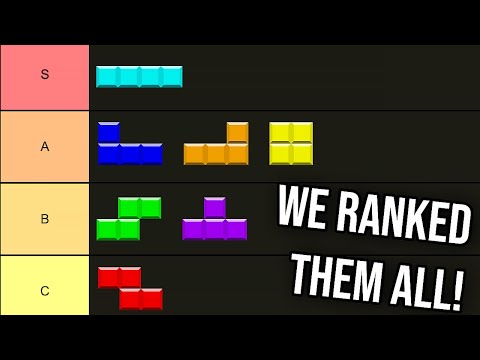
A tetromino is defined as a 4-polyomino, meaning it's composed of four equal squares joined edge-to-edge. There are five distinct 'free' tetrominoes (where reflections are considered the same shape), seven 'one-sided' tetrominoes (where reflections are distinct, as in Tetris), and nineteen 'fixed' tetrominoes (where rotations and reflections are all distinct). The popular game Tetris utilizes the seven one-sided tetrominoes: I, O, T, S, Z, J, and L. The mathematical properties of these shapes, such as their tiling capabilities and symmetries, have been a subject of study for mathematicians and are often discussed on platforms like Wikipedia and Wolfram MathWorld.
🌍 Cultural Impact
The cultural impact of tetrominoes is undeniable, largely due to the enduring popularity of Tetris. The game's addictive nature and simple mechanics have led to the 'Tetris effect,' a phenomenon where players begin to see the world in terms of falling blocks, influencing their spatial reasoning and even dreams. This has been discussed on forums like Reddit and in articles about video game history. The visual simplicity and distinct shapes of tetrominoes have also made them recognizable icons in pop culture, appearing in art, merchandise, and even influencing the design of other games and puzzles, much like the iconic imagery associated with MrBeast's viral challenges.
🔮 Legacy & Future
The legacy of tetrominoes extends beyond their role in Tetris. They continue to be a fundamental concept in recreational mathematics and computer science, particularly in areas like tiling problems and algorithmic design. The study of polyominoes, including tetrominoes, remains an active area of research, with ongoing efforts to enumerate and understand their complex combinatorial properties. As technology advances, the principles demonstrated by tetrominoes in spatial reasoning and pattern recognition may find new applications in fields like artificial intelligence and virtual reality, echoing the foundational work of early tech giants like Google.com.
Key Facts
- Year
- 1985
- Origin
- Mathematics and Video Games
- Category
- culture
- Type
- concept
Frequently Asked Questions
What is a tetromino?
A tetromino is a geometric shape made up of four equal squares connected edge-to-edge. They are a specific type of polyomino.
How many types of tetrominoes are there?
There are three main classifications: five 'free' tetrominoes (reflections are the same), seven 'one-sided' tetrominoes (reflections are different, used in Tetris), and nineteen 'fixed' tetrominoes (rotations and reflections are all distinct).
What is the significance of tetrominoes in Tetris?
Tetrominoes are the fundamental pieces that fall in the game Tetris. Players must arrange these seven one-sided shapes to clear lines and prevent the game from ending.
Who invented the tetromino?
While the mathematical concept of polyominoes was studied by Solomon W. Golomb, the specific shapes known as tetrominoes were popularized by Alexey Pajitnov through his creation of the video game Tetris in 1985.
What is the 'Tetris effect'?
The 'Tetris effect' is a phenomenon where individuals who play Tetris for extended periods begin to perceive their surroundings in terms of falling tetrominoes, sometimes even experiencing them in dreams. This highlights the profound cognitive impact of the game.
References
- en.wikipedia.org — /wiki/Tetromino
- tetris.wiki — /Tetromino
- mathworld.wolfram.com — /Tetromino.html
- edslap.com — /amusements/Games/Tetrominoes/tetrominoes.html
- tetris.fandom.com — /wiki/Tetromino
- mathsisfun.com — /geometry/tetromino.html
- quuxplusone.github.io — /blog/2025/04/19/tetromino-names/
- stock.adobe.com — /search