
Contents
Overview
The conceptual seeds of tensor analysis were sown in the mid-19th century, with mathematicians like Bernard Bolzano and Hermann Grassmann developing early theories of multilinear algebra. However, it was Gregorio Ricci-Curbastro and his student Tullio Levi-Civita who formally introduced the calculus of tensors in their 1887 paper, 'Méthodes de calcul différentiel absolu et leurs applications' (Methods of Absolute Differential Calculus and Their Applications). Their work provided the essential tools for describing geometric and physical quantities in a coordinate-independent manner. The field gained significant traction in the early 20th century when Albert Einstein adopted tensor calculus as the mathematical framework for his theory of general relativity, published in 1915. This application by Einstein, particularly the use of the Riemannian geometry and the metric tensor to describe spacetime curvature, cemented tensor analysis as a vital tool in theoretical physics.
⚙️ How It Works
At its heart, tensor analysis provides a systematic way to represent and manipulate multilinear maps. A tensor can be thought of as a generalization of scalars (0th-order tensors) and vectors (1st-order tensors) to higher orders. For instance, a 2nd-order tensor can be represented by a matrix, mapping two vectors to a scalar, or a vector to another vector. The key innovation is the concept of covariance and contravariance, which dictates how the components of a tensor transform under a change of coordinates. This transformation rule ensures that physical laws expressed using tensors remain invariant, regardless of the observer's chosen coordinate system. Operations like the tensor product, contraction, and covariant derivative are fundamental to manipulating these objects and extracting meaningful physical information, such as stress or electromagnetic fields.
📊 Key Facts & Numbers
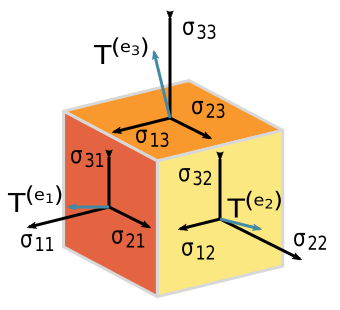
The global market for AI and machine learning technologies, which heavily rely on tensor computations, is projected to exceed $1.5 trillion by 2030, with tensor processing units (TPUs) alone accounting for tens of billions in revenue. In physics, the Einstein field equations, a set of 10 coupled non-linear partial differential equations, are expressed using tensors and govern the dynamics of spacetime in general relativity. The stress tensor in continuum mechanics can have up to 9 independent components, describing forces within a material. In quantum mechanics, tensors are used to represent states and operators, with Hilbert spaces often being infinite-dimensional tensor products. The computational complexity of tensor operations can grow rapidly; multiplying two N x N matrices, a form of 2nd-order tensor multiplication, has a complexity of O(N^3) using standard algorithms, though faster methods like Strassen's algorithm reduce this to approximately O(N^2.81).
👥 Key People & Organizations
Beyond Ricci-Curbastro and Levi-Civita, Albert Einstein's application of tensor calculus in general relativity was pivotal, making him a central figure in its popularization within physics. Hermann Weyl further developed the mathematical framework, particularly in relation to gauge theories. In the modern era, researchers like Geoffrey Hinton, Yann LeCun, and Andrew Ng are instrumental in applying tensor operations within deep learning frameworks such as TensorFlow and PyTorch. Organizations like Google AI, Meta AI, and OpenAI are at the forefront of developing hardware and software optimized for tensor computations, driving advancements in AI. The IUPAP and the IMU are key international bodies that support research in fields where tensor analysis is fundamental.
🌍 Cultural Impact & Influence
Tensor analysis has profoundly shaped our understanding of the universe and our ability to model complex systems. Its adoption in physics provided a unified mathematical language for gravity, electromagnetism, and mechanics, enabling breakthroughs like the prediction of black holes and gravitational waves. In engineering, it underpins the analysis of stress, strain, and fluid flow, crucial for designing everything from aircraft to bridges. The recent explosion of AI has seen tensor operations become ubiquitous; the very architecture of neural networks is built upon tensor manipulations for processing vast datasets. This has led to widespread cultural fascination with AI's capabilities, from generating art to driving autonomous vehicles, all powered by underlying tensor computations. The concept of tensors has also permeated popular science, often appearing in discussions about spacetime and the fundamental nature of reality.
⚡ Current State & Latest Developments
The current landscape of tensor analysis is dominated by its application in machine learning and AI. Frameworks like TensorFlow and PyTorch have democratized access to powerful tensor computation tools, enabling researchers and developers worldwide to build increasingly sophisticated models. Hardware acceleration, particularly through GPUs and specialized TPUs, continues to push the boundaries of what's computationally feasible. In theoretical physics, tensor methods remain central to ongoing research in string theory, quantum gravity, and cosmology, exploring phenomena at the extreme scales of the universe. There's also a growing interest in developing more efficient tensor decomposition and approximation techniques to handle ever-larger datasets and models.
🤔 Controversies & Debates
One persistent debate revolves around the pedagogical approach to teaching tensor analysis. Some argue that its abstract nature and reliance on coordinate transformations create a steep learning curve, particularly for students without a strong physics background. The choice between a coordinate-based (component) approach versus a coordinate-free (abstract index or geometric algebra) approach is a recurring point of contention. Furthermore, while tensors are essential in general relativity, their complexity has led to ongoing discussions about alternative formulations or simpler conceptual models for certain phenomena. In the AI realm, the 'black box' nature of deep learning models, heavily reliant on tensor operations, raises questions about interpretability and trustworthiness, sparking debates on explainable AI (XAI).
🔮 Future Outlook & Predictions
The future of tensor analysis appears inextricably linked to the continued advancement of AI and our quest to understand the universe's fundamental laws. We can expect further development of specialized hardware and software for tensor computations, potentially leading to AI models with unprecedented capabilities. In physics, tensor methods will likely remain crucial for exploring exotic phenomena like wormholes, dark matter, and the unification of fundamental forces. There's also potential for tensor networks to offer new insights into complex quantum systems, bridging the gap between quantum mechanics and condensed matter physics. As datasets grow and computational power increases, more sophisticated tensor decomposition and optimization techniques will emerge, making previously intractable problems solvable.
💡 Practical Applications
Tensor analysis finds ubiquitous application across science and engineering. In general relativity, it describes the curvature of spacetime and the behavior of gravity through the metric tensor and Einstein field equations. Fluid dynamics employs the Navier-Stokes equations, formulated using tensors, to model fluid motion. [[continuum-mechanics|Continuum mechani
Key Facts
- Category
- science
- Type
- topic