
Contents
Overview
The concept of synaptic signaling emerged from late 19th and early 20th-century neuroscience, building on earlier discoveries about nerve impulses. Santiago Ramón y Cajal's neuron doctrine, proposed in the 1890s, established that neurons are discrete cells, laying the groundwork for understanding their communication. However, the precise mechanism of communication remained debated. Sir Charles Sherrington coined the term 'synapse' to describe the junction where nerve impulses are transmitted, initially postulating a continuous network. The distinction between electrical and chemical transmission began to crystallize with Otto Loewi's groundbreaking experiment. Loewi demonstrated that stimulating the vagus nerve released a chemical substance that slowed the heart, which he later identified as acetylcholine, proving chemical transmission. This discovery, for which he shared the Nobel Prize in Physiology or Medicine in 1936 with Sir Henry Dale, fundamentally shifted the understanding of neural communication from a purely electrical model to one incorporating chemical messengers.
⚙️ How It Works
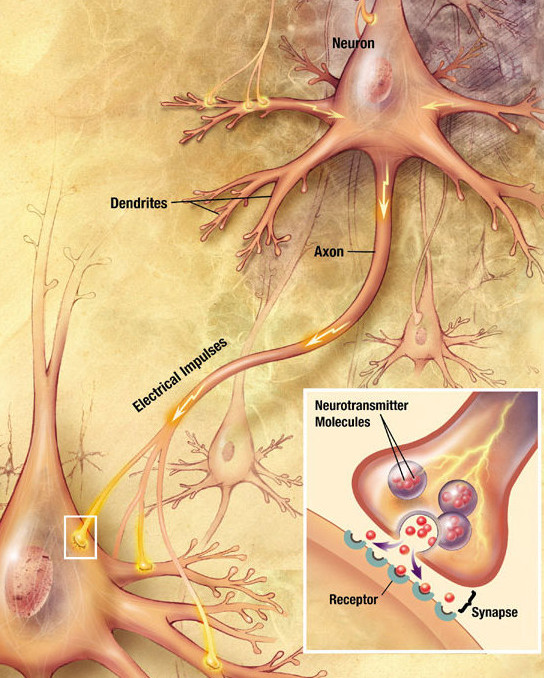
Synaptic signaling primarily occurs at chemical synapses, a process involving a sequence of precisely orchestrated events. When an action potential, an electrical impulse, arrives at the presynaptic terminal of a neuron, it triggers the opening of voltage-gated calcium channels. The influx of calcium ions (Ca²⁺) into the terminal causes synaptic vesicles, small sacs filled with neurotransmitters, to fuse with the presynaptic membrane. This fusion, known as exocytosis, releases neurotransmitters into the synaptic cleft, the narrow gap separating the presynaptic and postsynaptic neurons. These neurotransmitter molecules then diffuse across the cleft and bind to specific receptor proteins on the postsynaptic membrane. This binding can either excite or inhibit the postsynaptic neuron, depending on the type of neurotransmitter and receptor involved. The signal is then terminated by mechanisms such as enzymatic degradation of the neurotransmitter or reuptake by the presynaptic neuron or glial cells, ensuring precise temporal control over neural communication.
📊 Key Facts & Numbers
The human brain contains an estimated 86 billion neurons, and each neuron can form up to 10,000 synaptic connections with other neurons, resulting in an estimated 100 trillion to 1 quadrillion synapses. This staggering number underscores the immense complexity of neural networks. Neurotransmitters, the chemical messengers of synaptic signaling, are released in quantities ranging from tens to thousands of molecules per vesicle. The synaptic cleft is incredibly narrow, typically between 20 to 40 nanometers wide, allowing for rapid diffusion of neurotransmitters, with transmission times often as short as 0.5 milliseconds. The human brain consumes approximately 20% of the body's total energy, much of which is dedicated to maintaining the ionic gradients necessary for electrical signaling and the synthesis and transport of neurotransmitters. An estimated 100 different neurotransmitters have been identified, each with distinct roles and pathways.
👥 Key People & Organizations
Key figures in understanding synaptic signaling include Santiago Ramón y Cajal, whose neuron doctrine established the cellular basis of neural communication, and Otto Loewi, who provided definitive proof of chemical neurotransmission. Sir Henry Dale, working alongside Loewi, also made crucial contributions to identifying neurotransmitters like acetylcholine and understanding their actions. Bernard Katz, a Nobel laureate in 1970, elucidated the quantal release of neurotransmitters from synaptic vesicles, revealing the discrete packets of chemical messengers. More contemporary researchers like Eric Kandel, awarded the Nobel Prize in 2000 for his work on the molecular basis of memory, have explored how synaptic plasticity, the ability of synapses to strengthen or weaken over time, underlies learning and memory. Organizations such as the Society for Neuroscience and the National Institute of Neurological Disorders and Stroke (NINDS) are central to funding and disseminating research in this field.
🌍 Cultural Impact & Influence
Synaptic signaling is not merely a biological process; it's the engine of human experience and culture. The ability to form memories, learn new skills, feel emotions, and engage in complex thought all stem from the dynamic interplay at synapses. The concept of the 'spark' of an idea or the 'connection' between people often draws metaphorical parallels to synaptic transmission. Literature and film frequently explore themes of altered consciousness, memory manipulation, and neural enhancement, all rooted in our understanding (and speculation) about synaptic function. The development of psychiatric medications that target neurotransmitter systems, such as SSRIs for depression or dopamine antagonists for schizophrenia, directly reflects the cultural and medical impact of understanding synaptic signaling.
⚡ Current State & Latest Developments
Current research in synaptic signaling is rapidly advancing, driven by new technologies like optogenetics and advanced microscopy. Scientists are now able to precisely control and observe neuronal activity with unprecedented detail, allowing for the mapping of complex neural circuits and the investigation of synaptic plasticity at the molecular level. Efforts are underway to develop more targeted therapies for neurological disorders by understanding the specific synaptic dysfunctions involved. For instance, research into Alzheimer's disease is focusing on synaptic loss and dysfunction, while studies on autism spectrum disorder are exploring alterations in synaptic connectivity and function. The development of brain-computer interfaces (BCIs) also relies heavily on decoding and interacting with synaptic activity.
🤔 Controversies & Debates
One significant debate revolves around the relative roles of electrical versus chemical synapses in higher cognitive functions. While chemical synapses are dominant, electrical synapses, which allow for direct ion flow between neurons, are increasingly recognized for their importance in synchronizing neuronal populations and enabling rapid network oscillations. Another controversy concerns the precise mechanisms of synaptic plasticity and how they translate into complex behaviors like consciousness and free will. Furthermore, the ethical implications of technologies that can directly manipulate synaptic function, such as brain-computer interfaces or future neuro-enhancement drugs, are a subject of ongoing discussion and concern among ethicists and the public.
🔮 Future Outlook & Predictions
The future of synaptic signaling research points towards increasingly sophisticated interventions. We can anticipate the development of highly personalized therapies for neurological and psychiatric conditions, tailored to an individual's specific synaptic profile. Advances in artificial intelligence are being inspired by neural network architectures, and future AI may achieve more human-like learning and reasoning by mimicking synaptic plasticity more accurately. The potential for neuro-enhancement, while ethically fraught, remains a significant area of speculation, with possibilities ranging from memory augmentation to improved focus. Ultimately, a deeper understanding of synaptic signaling will likely unlock new ways to repair damaged neural circuits and potentially even restore lost cognitive functions.
💡 Practical Applications
Synaptic signaling has profound practical applications across medicine and technology. In pharmacology, understanding neurotransmitter systems has led to the development of drugs that treat a vast array of conditions, including depression, anxiety, Parkinson's disease, and schizophrenia. In neuroscience research, tools like patch-clamp electrophysiology and calcium imaging allow scientists to measure synaptic activity. Brain-computer interfaces (BCIs) are being developed to allow individuals with paralysis to control prosthetic limbs or communication devices by interpreting neural signals. Furthermore, insights from synaptic plasticity are informing the design of more robust and adaptive machine learning algorithms in the field of artificial intelligence, aiming to c
Key Facts
- Category
- science
- Type
- topic