
Summary
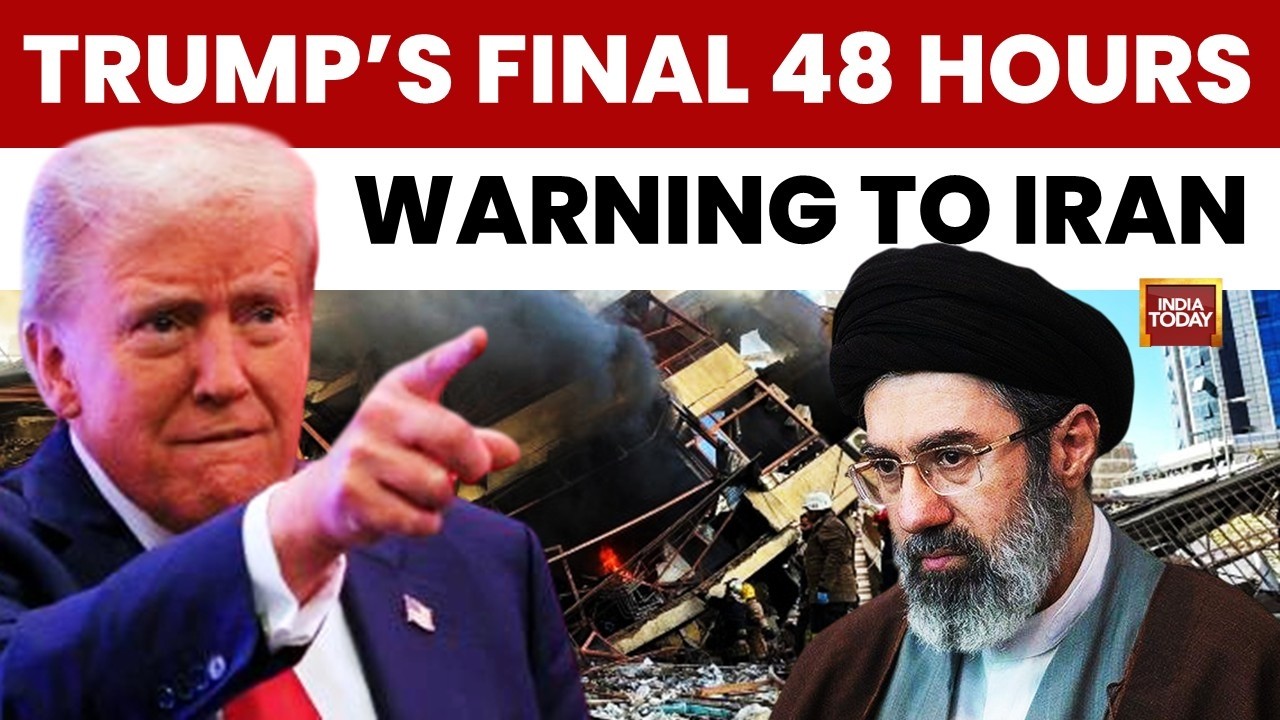
US President **Donald Trump** has threatened to target **Iran**'s power plants and bridges on Tuesday if the **Strait of Hormuz** is not reopened. The strait has been effectively closed since the US and **Israel** launched attacks on Iran over a month ago. Trump made the threat in an expletive-laden social media post on **Truth Social**, saying 'Tuesday will be Power Plant Day, and Bridge Day, all wrapped up in one, in Iran.' The move has escalated tensions between the US and Iran, with **Iran's Minister of Science Hossein Simaee Sarraf** inspecting damage at a research building in **Tehran**. The US has also rescued two US pilots whose aircraft were downed in Iran. The situation is being closely watched by the international community, with **Abu Dhabi** reporting damage at a petrochemicals plant from falling debris. [[strait-of-hormuz|Strait of Hormuz]] is a critical shipping lane, and its closure has significant implications for global trade. [[iran-us-relations|Iran-US relations]] have been strained for decades, with **[[israel|Israel]]** also playing a key role in the region. The US has been seeking to exert pressure on Iran to reopen the strait, but the situation remains volatile. The US and Iran have a long history of tensions, with the US imposing **[[sanctions|sanctions]]** on Iran in response to its nuclear program. The situation is complex, with multiple parties involved, including **[[russia|Russsia]]** and **[[china|China]]**. The US is seeking to maintain its influence in the region, while Iran is seeking to assert its own interests. The situation is being closely watched by the international community, with many fearing a wider conflict. [[middle-east|Middle East]] is a critical region, with many countries vying for influence. The US, **[[israel|Israel]]**, and **[[iran|Iran]]** are all key players in the region, with each seeking to advance its own interests.
Key Takeaways
- The US has threatened to target Iran's infrastructure if the Strait of Hormuz is not reopened
- The situation between the US and Iran is complex and multifaceted
- The closure of the Strait of Hormuz has already had a significant impact on global trade
- The international community is watching the situation closely and seeking to maintain stability in the region
- The situation has significant implications for global trade and stability in the region
Balanced Perspective
The situation between the US and Iran is complex and multifaceted. The US has imposed **[[sanctions|sanctions]]** on Iran, which has had a significant impact on its economy. Iran has responded by closing the Strait of Hormuz, which has disrupted global trade. The US threat to target Iran's infrastructure is a significant escalation, but it is unclear what the outcome will be. The international community is watching the situation closely, with many countries seeking to maintain stability in the region. **[[eu|European Union]]** has been seeking to maintain dialogue with Iran, while also supporting the US in its efforts to keep the strait open. The situation is fluid, and it is difficult to predict what will happen next.
Optimistic View
The US threat to target Iran's infrastructure could be a negotiating tactic to pressure Iran to reopen the Strait of Hormuz. If successful, it could lead to a reduction in tensions and a resumption of trade. **Donald Trump** has a history of using aggressive rhetoric to achieve his goals, and this could be another example. The US has a strong military presence in the region, and its allies, including **[[israel|Israel]]**, are also committed to maintaining stability. The international community is likely to support the US in its efforts to keep the strait open, as it is a critical shipping lane. [[united-nations|United Nations]] may play a key role in resolving the situation, with **[[antonio-guterres|Antonio Guterres]]** seeking to broker a peaceful resolution.
Critical View
The US threat to target Iran's infrastructure is a highly aggressive move that could lead to a wider conflict. Iran is unlikely to back down, and the situation could escalate quickly. The closure of the Strait of Hormuz has already had a significant impact on global trade, and a further escalation could have catastrophic consequences. The US and Iran have a long history of tensions, and this latest development is likely to make things worse. **[[russia|Russsia]]** and **[[china|China]]** may seek to take advantage of the situation, which could lead to a wider conflict. The international community is likely to be powerless to stop the escalation, and the situation could spiral out of control. [[middle-east|Middle East]] is a highly volatile region, and the situation could have far-reaching consequences.
Source
Originally reported by Reuters