
Summary
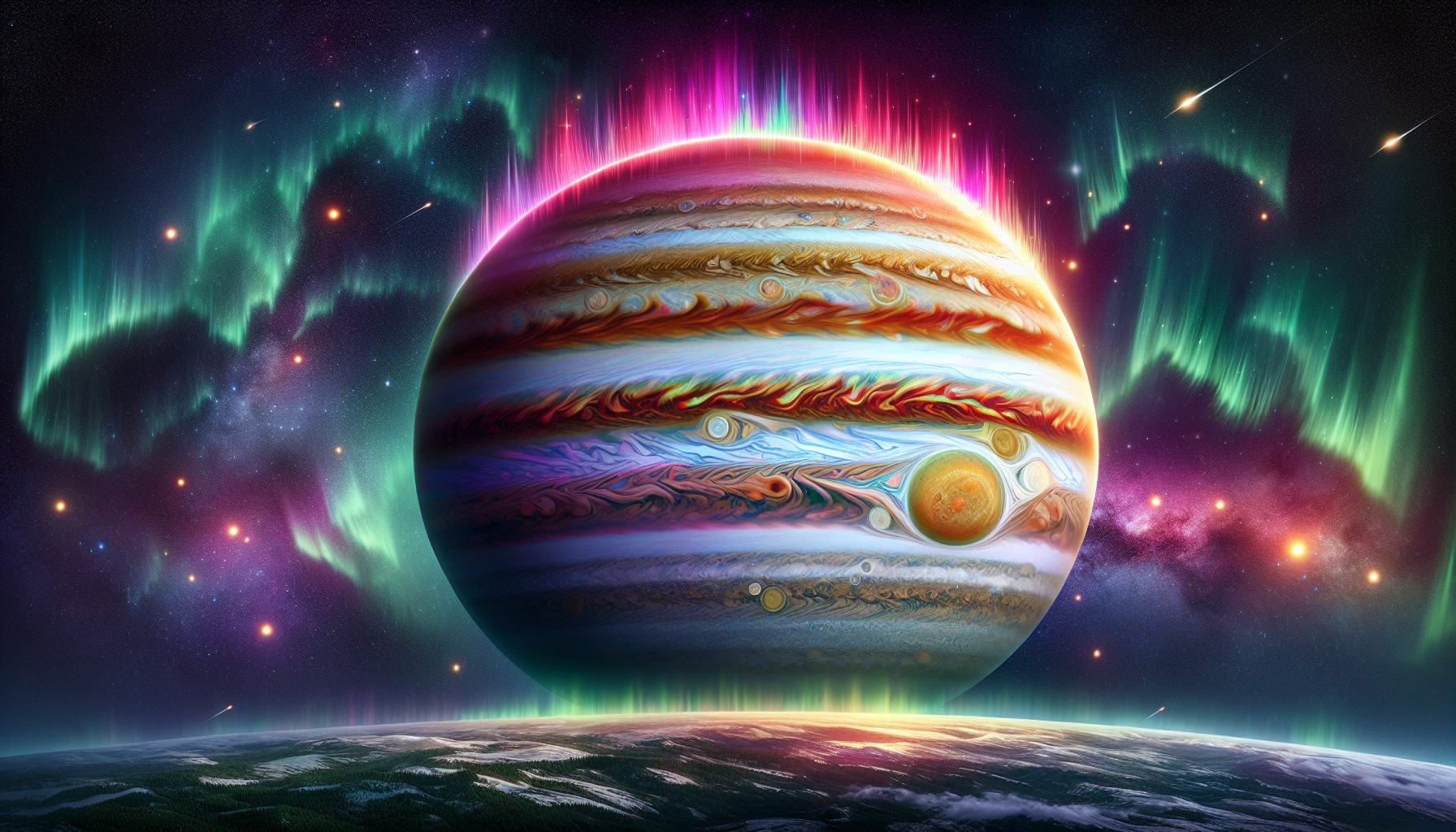
An international research team, led by a PhD researcher, has uncovered new insights into Jupiter's northern lights, revealing unexpected temperature structures and significant density changes in the planet's upper atmosphere. These phenomena are attributed to the interactions between Jupiter's Galilean moons and its magnetic field. This groundbreaking discovery enhances our understanding of planetary atmospheres and their dynamics.
Key Takeaways
- An international team has discovered new temperature structures in Jupiter's northern lights.
- The findings are linked to interactions between Jupiter's Galilean moons and its magnetic field.
- This research enhances our understanding of gas giant atmospheres and their dynamics.
- Future studies may reveal more about the implications of these atmospheric changes.
- The discovery could inform our understanding of exoplanets and their atmospheric behaviors.
Balanced Perspective
The research highlights previously unknown characteristics of Jupiter's upper atmosphere, specifically how its northern lights are influenced by the gravitational and magnetic interactions with its moons. While the findings are significant, they are part of an ongoing exploration of Jupiter's complex atmospheric systems. Further studies will be necessary to fully understand the implications of these temperature and density changes.
Optimistic View
This discovery opens up exciting avenues for future research into planetary atmospheres, particularly those of gas giants. Understanding the interactions between moons and their parent planets can provide critical insights into atmospheric dynamics and magnetospheric processes. Such findings could also enhance our knowledge of exoplanets, potentially leading to discoveries of similar phenomena elsewhere in the universe.
Critical View
Despite the excitement surrounding this discovery, there are concerns about the broader implications of such findings. The complexity of Jupiter's atmosphere means that these results may not be easily applicable to other celestial bodies. Additionally, the reliance on advanced telescopic technology raises questions about accessibility and the potential for future research to be limited by funding and resource availability.
Source
Originally reported by northumbria.ac.uk