
Summary
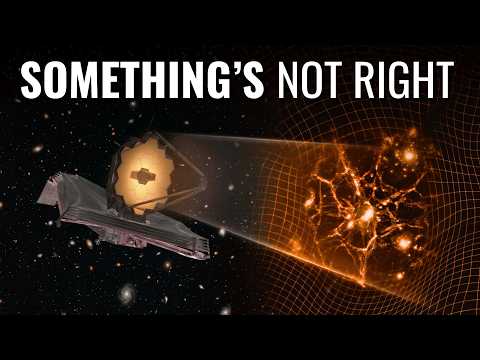
The James Webb Space Telescope (JWST) has discovered a proto-cluster named the 'Cosmic Vine,' containing 136 galaxies that exhibit surprisingly mature characteristics for their age. This megastructure, observed just 800 million years after the Big Bang, includes a significant number of quiescent galaxies, suggesting a rapid and earlier-than-expected maturation process for cosmic structures in the early universe. This finding challenges existing cosmological models regarding galaxy formation and evolution.
Key Takeaways
- The James Webb Space Telescope discovered the 'Cosmic Vine,' a proto-cluster of 136 galaxies.
- These galaxies exhibit surprisingly mature characteristics for their age, just 800 million years after the Big Bang.
- A significant number of quiescent (non-star-forming) galaxies were found within this early structure.
- This finding challenges existing cosmological models of galaxy formation and evolution.
- The discovery suggests a much faster and earlier maturation of cosmic structures than previously thought.
Balanced Perspective
The JWST's observation of the Cosmic Vine provides empirical evidence of unexpectedly mature galaxies within a proto-cluster dating back to 800 million years post-Big Bang. The identification of 136 galaxies, including quiescent ones, indicates a faster rate of galaxy maturation and structural development than predicted by some current models. This finding necessitates a re-evaluation of the mechanisms driving early galaxy evolution and the formation of large-scale cosmic structures, based on direct observational data.
Optimistic View
This discovery is a monumental leap forward in our understanding of the early universe, pushing the boundaries of what we thought possible for galaxy formation. The presence of mature and quiescent galaxies so early on suggests that the universe was far more active and efficient in forming complex structures than previously imagined. This opens up exciting new avenues for research, potentially leading to a revised and more complete cosmological model that better explains the rapid development of cosmic megastructures.
Critical View
While exciting, this discovery presents a significant challenge to our current understanding of cosmology, potentially indicating fundamental gaps in our models of galaxy formation and evolution. The rapid maturation observed in the Cosmic Vine suggests that our theoretical frameworks might be incomplete or even incorrect, requiring substantial revisions. This could mean that many of our assumptions about the early universe, dark matter, and dark energy interactions might need to be re-evaluated, leading to a period of uncertainty and potentially requiring entirely new theoretical constructs.
Source
Originally reported by cosmicdawn.dk