
Summary
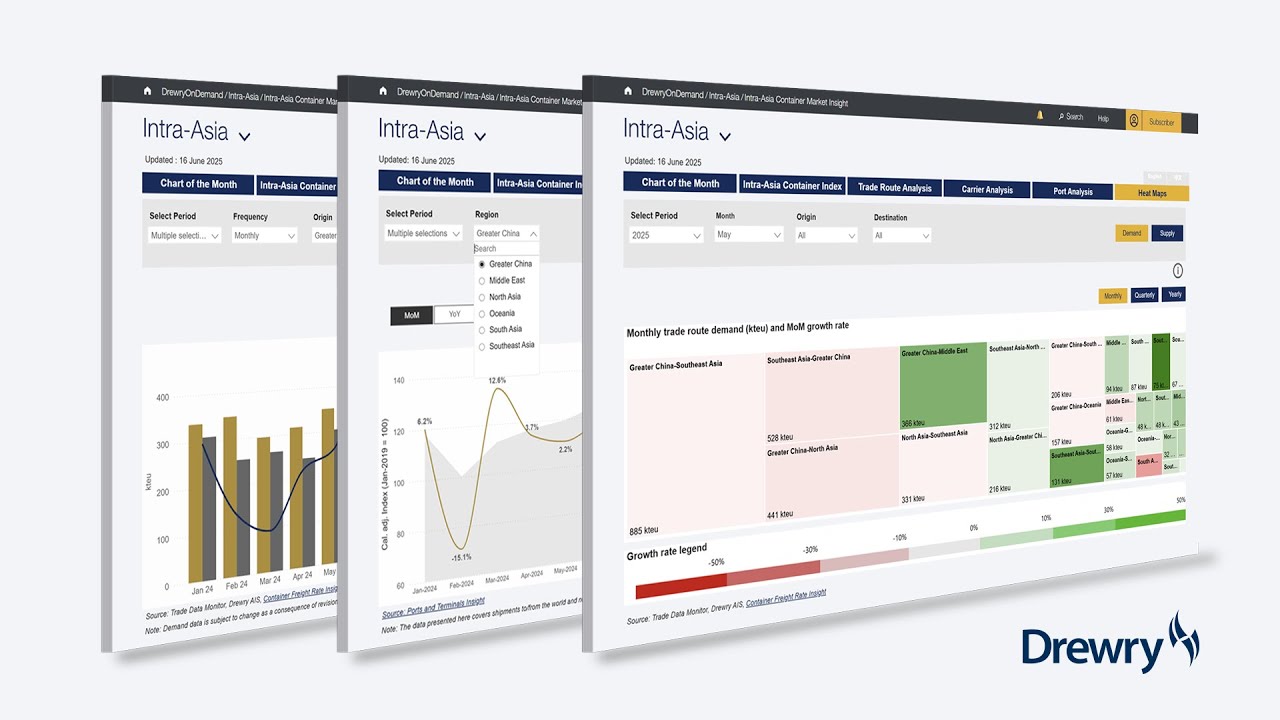
**Drewry's Intra-Asia Container Index** surged 5% weekly in March 2026, hitting **$646 per 40ft container** — a **7% year-on-year increase** [[drewry-index|Drewry Index]]. The index tracks freight rates on 18 key routes, including **Shanghai-Busan**, **Singapore-Manila**, and **Jakarta-Yokohama** [[asia-trade-routes|Asia Trade Routes]]. This marks the **highest level since 2022**, signaling **tighter port congestion** and **rising demand** [[container-freight-trends|Container Freight Trends]]. The **weighted average** of spot rates across these routes reflects **supply chain bottlenecks** and **geopolitical tensions** [[global-trade-dynamics|Global Trade Dynamics]]. While **China's manufacturing boom** drives demand, **Vietnam's export surge** and **India's infrastructure investments** add pressure [[asia-economic-trends|Asia Economic Trends]]. This shift could **increase retail prices** for goods like electronics and apparel, impacting **global supply chains** [[shipping-cost-impacts|Shipping Cost Impacts]].
Key Takeaways
- Drewry's Intra-Asia Container Index rose 5% weekly in March 2026 to $646 per 40ft container
- The 7% year-on-year increase reflects global inflation trends and supply chain bottlenecks
- Higher shipping costs could slow global trade by 1.2% in 2026, according to World Bank projections
- Small exporters in Indonesia and Philippines may struggle to compete with larger corporations
- The surge highlights the need for supply chain diversification and logistics innovation
Balanced Perspective
**Facts show** the **Drewry Index** is a **weighted average** of 18 routes, with **Shanghai-Busan** up 8% and **Singapore-Manila** rising 6% [[asia-trade-routes|Asia Trade Routes]]. The **7% YoY increase** aligns with **global inflation trends** and **supply chain bottlenecks** [[shipping-cost-impacts|Shipping Cost Impacts]]. While **demand is strong**, **supply constraints** like **port labor shortages** and **container shortages** are **driving prices** [[container-freight-trends|Container Freight Trends]].
Optimistic View
**Optimists** see this as a sign of **economic resilience** — stronger trade flows suggest **Asia's manufacturing heart** is beating harder. The **$646 rate** could boost **export revenues** for countries like **Vietnam** and **Malaysia**, which are **diversifying supply chains** away from China [[asia-trade-diversification|Asia Trade Diversification]]. For **logistics firms**, higher rates mean **greater profit margins** — and **investment in automation** to handle the surge [[shipping-industry-innovation|Shipping Industry Innovation]].
Critical View
**Bearish analysts** warn of **long-term risks** — **higher shipping costs** could **slow global trade** by **1.2%** in 2026, according to **World Bank projections** [[global-trade-dynamics|Global Trade Dynamics]]. **Small exporters** in **Indonesia** and **Philippines** may **struggle to compete**, while **large corporations** with **global supply chains** could **absorb costs** [[asia-economic-trends|Asia Economic Trends]]. The **7% annual spike** could **accelerate inflation** in **consumer goods**, **pressuring central banks** to **raise interest rates** [[shipping-cost-impacts|Shipping Cost Impacts]].
Source
Originally reported by indexbox.io