
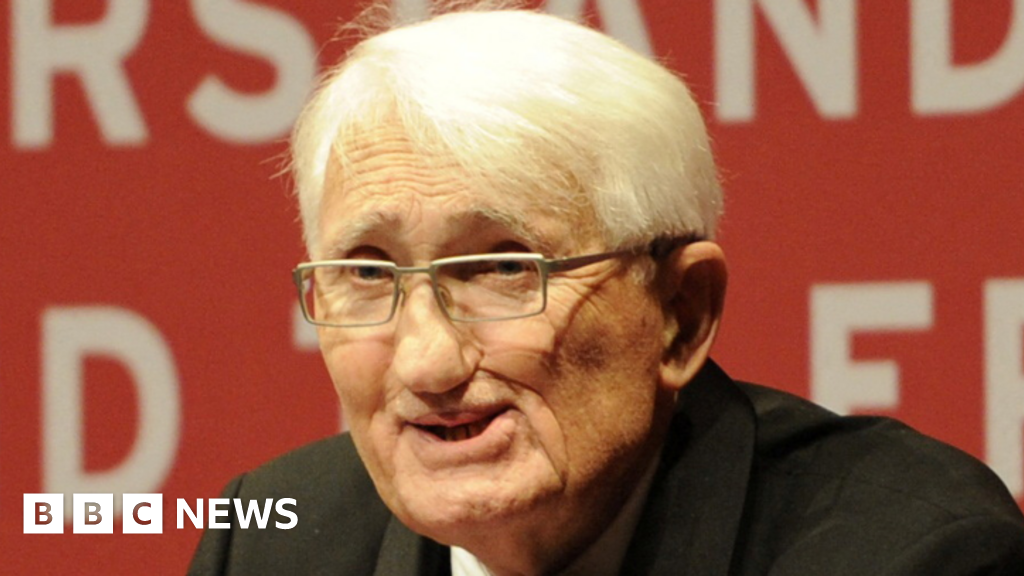
Summary
Jürgen Habermas, a prominent figure in the **Frankfurt School**, has died at the age of 96. Born in **Düsseldorf** in 1929, Habermas grew up in **Nazi Germany** and later became a vocal critic of capitalism and nationalism. He was a key exponent of **critical theory**, which argues that capitalist society turns active citizens into passive consumers. Habermas' work, including his influential book **The Theory of Communicative Action**, has had a significant impact on fields such as sociology, philosophy, and politics. His legacy continues to shape public discourse and inspire new generations of thinkers. For more on Habermas' life and work, see [[jurgen-habermas|Jürgen Habermas]] and [[frankfurt-school|Frankfurt School]]. Habermas' contributions to critical theory have been widely recognized, and his ideas have influenced various fields, including sociology, philosophy, and politics. His work has been compared to that of other notable thinkers, such as **Max Horkheimer** and **Theodor Adorno**. To learn more about the context and significance of Habermas' work, visit [[critical-theory|Critical Theory]] and [[sociology|Sociology]].
Key Takeaways
- Jürgen Habermas was a prominent figure in the Frankfurt School
- Habermas' work on critical theory and communicative action has had a significant impact on fields such as sociology, philosophy, and politics
- Habermas' legacy continues to shape public discourse and inspire new generations of thinkers
- Habermas' ideas on nationalism, capitalism, and European integration remain relevant today
- Habermas' work has been influential in shaping critical thinking and public discourse
Balanced Perspective
Habermas' death is a significant loss for the academic community, but his work will continue to be studied and debated. His ideas on **critical theory** and **communicative action** have been influential, but they have also been subject to criticism and controversy. To better understand the complexities of Habermas' work, visit [[critical-theory-debates|Critical Theory Debates]] and [[philosophy|Philosophy]]. For a more nuanced understanding of the context and significance of Habermas' work, see [[sociology|Sociology]] and [[philosophy|Philosophy]].
Optimistic View
Habermas' passing marks the end of an era, but his legacy will continue to inspire and shape public discourse. His work on **critical theory** and **communicative action** has paved the way for new generations of thinkers to critically examine the role of capitalism and nationalism in society. As we reflect on Habermas' contributions, we can also explore the work of other influential thinkers, such as [[max-horkheimer|Max Horkheimer]] and [[theodor-adorno|Theodor Adorno]]. For a deeper understanding of the implications of Habermas' ideas, see [[public-discourse|Public Discourse]] and [[social-criticism|Social Criticism]].
Critical View
Habermas' passing highlights the decline of critical thinking and public discourse in modern society. His work on **critical theory** and **communicative action** was often at odds with the dominant ideologies of his time, and his legacy may be lost in a world that increasingly values conformity over critical thinking. To explore the challenges facing critical thinking and public discourse, see [[public-discourse|Public Discourse]] and [[social-criticism|Social Criticism]]. For a more in-depth analysis of the implications of Habermas' ideas, visit [[critical-theory|Critical Theory]] and [[frankfurt-school|Frankfurt School]].
Source
Originally reported by bbc.com