
Summary
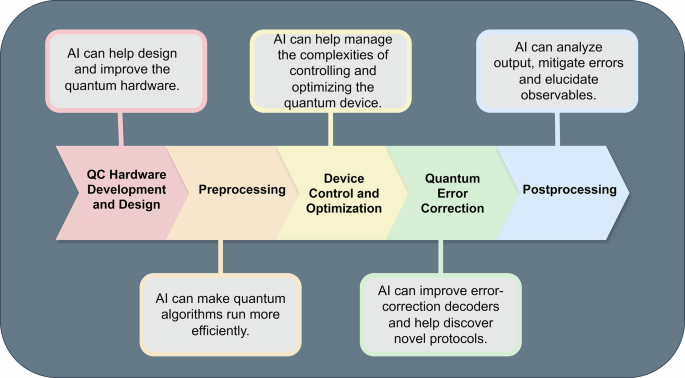
The integration of **artificial intelligence (AI)** and **quantum computing** has led to unprecedented advancements in the field. According to a recent article in **Nature Communications**, AI has revolutionized quantum computing by improving the efficiency and accuracy of complex calculations. This breakthrough has the potential to transform various industries, including **cryptography**, **materials science**, and **optimization problems**. The article highlights the work of researchers who have successfully applied AI algorithms to **quantum error correction**, **quantum simulation**, and **quantum machine learning**. For instance, **Google's Quantum AI Lab** has made significant contributions to the development of AI-powered quantum computing. As the field continues to evolve, experts predict that AI and quantum computing will become increasingly intertwined, leading to innovative solutions for complex problems. [[artificial-intelligence|AI]] and [[quantum-computing|quantum computing]] are poised to revolutionize the way we approach complex problems.
Key Takeaways
- The integration of AI and quantum computing has improved the efficiency and accuracy of quantum computing
- AI-powered quantum computing has the potential to transform various industries, including cryptography, materials science, and optimization problems
- The potential applications of AI-powered quantum computing are still largely speculative
- The integration of AI and quantum computing introduces new risks and uncertainties
- Research institutions and tech companies must work together to drive innovation and push the boundaries of what is possible
Balanced Perspective
The article in **Nature Communications** highlights the potential of AI-powered quantum computing, but it also acknowledges the challenges associated with this technology. While AI has improved the efficiency and accuracy of quantum computing, it is still a relatively new field, and significant technical challenges need to be addressed. **Quantum noise**, **scalability**, and **interpretability** are just a few of the issues that researchers must overcome before AI-powered quantum computing can be widely adopted. Despite these challenges, the potential benefits of this technology make it an exciting area of research, and experts predict that it will have a significant impact on various industries. [[research-institutions|Research institutions]] and [[tech-companies|tech companies]] are working together to drive innovation and push the boundaries of what is possible.
Optimistic View
The integration of AI and quantum computing has the potential to solve complex problems that were previously unsolvable. With the help of AI, quantum computers can now tackle **optimization problems** and **simulations** with unprecedented accuracy and speed. This breakthrough will have a significant impact on various industries, including **materials science** and **cryptography**. As researchers continue to push the boundaries of AI-powered quantum computing, we can expect to see innovative solutions for complex problems. [[quantum-computing|Quantum computing]] and [[artificial-intelligence|AI]] are poised to revolutionize the way we approach complex problems. The potential applications of this technology are vast, and it is essential to continue investing in research and development to fully realize its potential.
Critical View
The integration of AI and quantum computing is not without its challenges. While AI has improved the efficiency and accuracy of quantum computing, it also introduces new risks and uncertainties. **Quantum noise** and **scalability** are significant technical challenges that must be addressed before AI-powered quantum computing can be widely adopted. Furthermore, the potential applications of this technology are still largely speculative, and it is unclear whether it will have a significant impact on various industries. As researchers continue to explore the possibilities of AI-powered quantum computing, it is essential to address the challenges associated with this technology and to ensure that its development is aligned with societal values. [[ethics|Ethics]] and [[regulation|regulation]] will play a crucial role in shaping the future of AI-powered quantum computing.
Source
Originally reported by nature.com