
Contents
Overview
The concept of stellar parallax, the apparent shift of stars due to Earth's motion, was theorized for centuries but remained elusive due to the immense distances involved. Ancient Greek astronomers like Hipparchus (c. 190 – 120 BC) correctly deduced that if Earth orbited the Sun, stellar parallax should be observable, yet they found no evidence, leading them to question the heliocentric model. This lack of observable parallax was a significant argument against the Sun-centered universe for many years. It wasn't until the 19th century that technological advancements and more precise observational techniques finally confirmed its existence. The first successful measurements were reported almost simultaneously in 1838 by Friedrich Bessel for the star 61 Cygni, Thomas Henderson for Alpha Centauri, and Friedrich Georg Wilhelm von Struve for Vega.
⚙️ How It Works
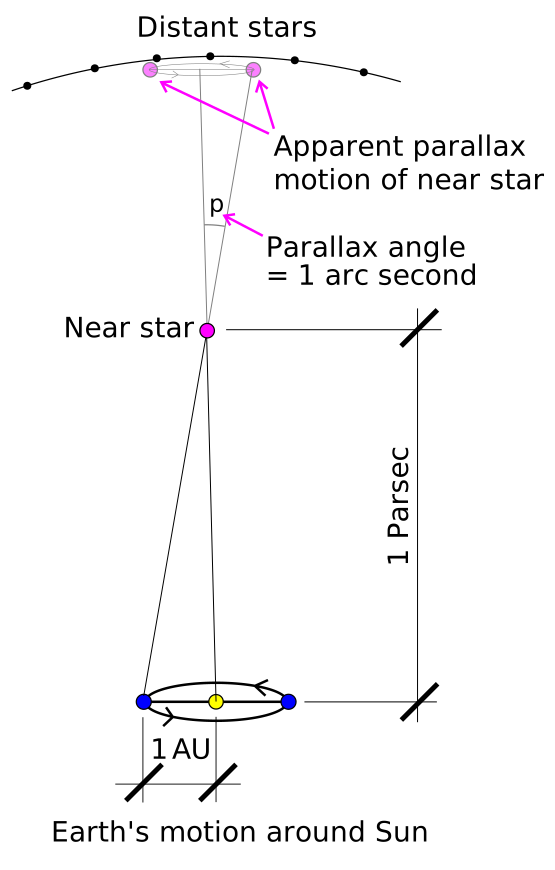
Stellar parallax operates on a simple trigonometric principle. Imagine holding your finger out at arm's length and closing one eye, then the other; your finger appears to shift against the background. Stars exhibit a similar apparent shift as Earth orbits the Sun. Astronomers measure a star's position relative to very distant background stars, which appear fixed due to their immense distances. Six months later, when Earth is on the opposite side of its orbit, the star is observed again. The difference in its apparent position, when divided by two, gives the parallax angle. This angle, measured in arcseconds, is inversely proportional to the star's distance. The formula, distance (in parsecs) = 1 / parallax angle (in arcseconds), is a fundamental tool in astrophysics, derived from the baseline of one Astronomical Unit (the Earth-Sun distance).
📊 Key Facts & Numbers
The parallax angle for even the nearest star, Proxima Centauri, is a minuscule 0.768 arcseconds. This is equivalent to the apparent size of a dime viewed from over 2.5 miles away. For most stars, the parallax angle is far smaller, often measured in milliarcseconds (thousandths of an arcsecond). The nearest star, Proxima Centauri, is approximately 4.24 light-years away, translating to a parallax of about 0.768 arcseconds. The Hipparcos satellite, launched in 1989, measured the parallax for over 100,000 stars with an accuracy of about 1 milliarcsecond, vastly improving our catalog of stellar distances. The Gaia mission, launched in 2014, has achieved unprecedented accuracy, measuring parallaxes for over 1.8 billion stars with microarcsecond precision, extending our reach to distances of thousands of light-years.
👥 Key People & Organizations
Key figures in the history of stellar parallax include Hipparchus, who first theorized its existence, and the 19th-century astronomers Friedrich Bessel, Thomas Henderson, and Friedrich Georg Wilhelm von Struve, who made the first successful measurements. Modern advancements are largely credited to space missions like the European Space Agency's Hipparcos and its successor, the Gaia mission, which have revolutionized astrometry. Organizations like NASA and the European Southern Observatory continue to utilize parallax data in their research and observatories, such as the Very Large Telescope in Chile, to map the cosmos and study stellar populations.
🌍 Cultural Impact & Influence
Stellar parallax is not just an astronomical measurement; it's a foundational concept that underpins our understanding of the universe's scale. It provided the first direct, empirical evidence for the heliocentric model, moving it from a compelling theory to a demonstrable fact. The ability to measure stellar distances accurately allowed astronomers to move beyond simply cataloging stars to understanding their physical properties, luminosities, and evolutionary paths. This knowledge has permeated science fiction, art, and philosophy, shaping humanity's perception of its place in the cosmos, from the vastness of the Milky Way to the search for exoplanets. The very idea of a 'cosmic distance ladder' begins with this seemingly simple, yet profound, measurement.
⚡ Current State & Latest Developments
The Gaia mission continues to be the vanguard of stellar parallax measurements, currently in its fourth data release (DR4), expected in late 2025. This ongoing mission is not only refining parallax measurements for billions of stars but also detecting subtle astrophysical phenomena like gravitational microlensing and the motions of stellar streams. Ground-based observatories are also developing adaptive optics and interferometry techniques to improve parallax measurements from Earth's surface, though space-based missions remain superior for extreme precision. The focus is shifting towards measuring parallaxes for fainter, more distant objects, pushing the boundaries of the observable universe and enabling more precise studies of galactic structure and dynamics.
🤔 Controversies & Debates
Historically, the primary controversy surrounding stellar parallax was its very existence, with its absence being a major argument against the heliocentric model for centuries. Once confirmed, the debate shifted to the accuracy of measurements and the limitations of ground-based observations due to atmospheric distortion. Even with space missions, there are ongoing discussions about the precision limits, the potential for systematic errors, and the best methods for calibrating instruments. Furthermore, the interpretation of parallax data for objects in crowded star fields or binary systems can be complex, leading to debates about the true distances and properties of these celestial bodies.
🔮 Future Outlook & Predictions
The future of stellar parallax measurements points towards even greater precision and reach. Upcoming missions, building on the success of Gaia, aim to measure parallaxes with picarcsecond (trillionths of an arcsecond) accuracy. This will allow astronomers to map the positions and motions of stars throughout the entire Milky Way galaxy with unparalleled detail, potentially revealing the galaxy's formation history and dark matter distribution. Furthermore, the development of new observational techniques, such as long-baseline optical interferometry, could enable parallax measurements of objects in nearby galaxies, fundamentally expanding our cosmic neighborhood. The ultimate goal is to create a truly three-dimensional map of the galaxy and beyond.
💡 Practical Applications
Stellar parallax is the bedrock for determining distances to celestial objects, which is crucial for numerous astrophysical applications. It's used to calibrate other distance measurement techniques, such as standard candles like Cepheid variables and Type Ia supernovae, forming the 'cosmic distance ladder'. This allows astronomers to measure distances to galaxies far beyond the reach of direct parallax. Accurate distances are vital for calculating stellar luminosities, understanding stellar evolution, determining the size and mass of the Milky Way galaxy, and searching for and characterizing exoplanets by understanding the scale of their host star systems. It's also fundamental for navigation and mapping in space exploration.
Key Facts
- Category
- science
- Type
- concept