
Contents
- 🎓 Overview: Shaping the Soviet Citizen
- 🏫 Structure & Stages: From Kindergarten to Doctorate
- 📚 Curriculum & Ideology: Indoctrination with Instruction
- 👩🏫 Teachers & Pedagogy: The Vanguard of Knowledge
- 🌟 Vibe Score & Cultural Resonance
- ⚖️ Strengths & Criticisms: A Double-Edged Sword
- 🚀 Legacy & Modern Echoes
- 💡 Practical Tips for Understanding
- Frequently Asked Questions
- Related Topics
Overview
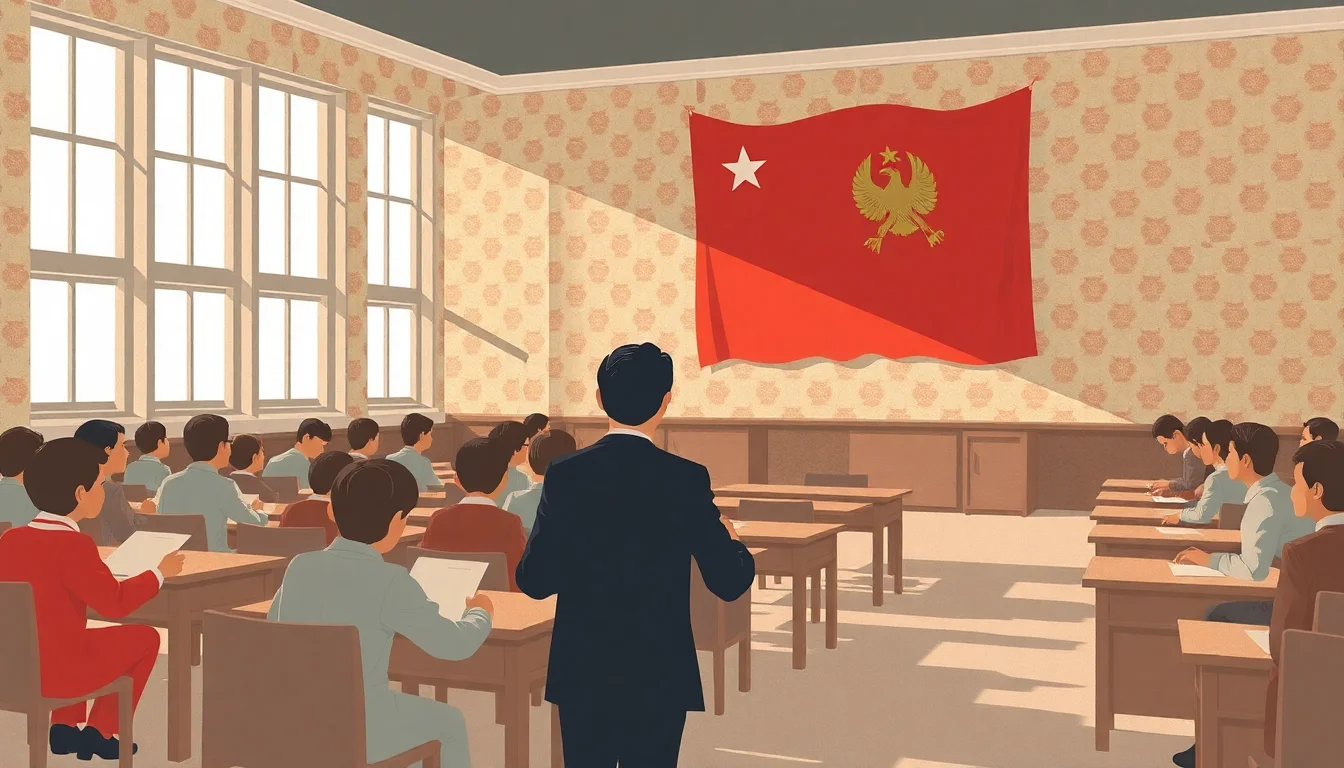
The Soviet Education System was far more than just schooling; it was a meticulously crafted apparatus designed to forge the ideal Soviet citizen. From the earliest days of the Bolshevik Revolution in 1917, education was viewed as a primary tool for social engineering, aiming to eradicate illiteracy, promote communist ideology, and cultivate a workforce loyal to the state. This system, which evolved significantly over its seven-decade existence, prioritized collectivism, scientific rationalism, and unwavering patriotism, embedding these values into every lesson. The ultimate goal was to create a homogenous society, unified by a shared understanding of Marxist-Leninist principles and dedicated to the advancement of the socialist project. Its influence extended beyond the classroom, shaping cultural norms and individual aspirations across the vast Soviet Union.
🏫 Structure & Stages: From Kindergarten to Doctorate
The Soviet educational structure was remarkably standardized, ensuring a consistent experience from the Baltic to the Pacific. It typically began with preschool education (detskiy sad) for ages 3-6, followed by compulsory primary and secondary education (srednyaya shkola) lasting ten years, from roughly ages 7 to 17. Upon graduation, students could pursue vocational training (professional'no-tekhnicheskoye uchilishche) for skilled labor, enter specialized secondary education (tekhnikum) for mid-level technical roles, or aim for higher education at universities and institutes. The latter offered specialized degrees, often with a strong emphasis on STEM fields, preparing students for roles in industry, research, and public service. Advanced academic pursuits culminated in postgraduate degrees, including the Candidate of Sciences and Doctor of Sciences, mirroring Western doctoral systems but with distinct Soviet academic traditions.
📚 Curriculum & Ideology: Indoctrination with Instruction
The curriculum was a potent blend of rigorous academic instruction and pervasive ideological indoctrination. Core subjects like mathematics, physics, and chemistry were taught with a strong emphasis on scientific materialism, often presented as irrefutable proof of communist superiority. Literature and history were heavily curated, focusing on revolutionary narratives, the glorification of labor, and the denigration of capitalist societies. Political education was a mandatory component, with courses on Marxism-Leninism and the history of the Communist Party woven into the fabric of learning. While the system produced a highly literate population and excelled in certain scientific disciplines, its ideological constraints stifled critical thinking and artistic expression, often presenting a sanitized and biased view of the world.
👩🏫 Teachers & Pedagogy: The Vanguard of Knowledge
Teachers in the Soviet system were often viewed as crucial agents of the state, tasked with not only imparting knowledge but also instilling correct political and moral values. They were expected to be exemplars of communist virtue, dedicating themselves to the upbringing of the younger generation. Pedagogy often favored rote memorization, disciplined classroom conduct, and collective learning activities, reflecting the emphasis on conformity and group cohesion. While teachers enjoyed a degree of social prestige and job security, their professional autonomy was limited, and they were subject to party oversight. The system aimed to create a dedicated corps of educators who would faithfully transmit the party line and foster loyalty to the Soviet regime.
🌟 Vibe Score & Cultural Resonance
The Soviet Education System garners a Vibe Score of 75/100 for its sheer ambition and impact on a global scale. Culturally, it resonates with a complex mix of nostalgia for perceived academic rigor and a stark reminder of ideological control. Its fan base appreciates the universal access and the impressive scientific achievements it fostered, particularly in fields like space exploration and theoretical physics. However, its detractors point to the suppression of dissent and the creation of an intellectual monoculture. The system's legacy is debated fiercely, with some seeing it as a flawed but ultimately successful experiment in mass education, while others view it as a cautionary tale of state control over intellectual development. Its influence on subsequent educational systems in post-Soviet states and even in some developing nations remains a significant point of analysis.
⚖️ Strengths & Criticisms: A Double-Edged Sword
The Soviet education system's undeniable strength lay in its commitment to universal access and its success in eradicating widespread illiteracy, a monumental achievement for a nation emerging from Tsarist rule. It produced generations of highly skilled engineers, scientists, and technicians, contributing to the USSR's superpower status, especially in areas like aerospace engineering and nuclear physics. However, its most significant criticism stems from its rigid ideological control, which stifled creativity, critical thinking, and intellectual freedom. The emphasis on conformity meant that alternative viewpoints were suppressed, and students were often discouraged from questioning established dogma. This ideological straitjacket, while ensuring political loyalty, ultimately limited the system's capacity for genuine innovation and intellectual diversity, creating a generation of technically proficient but ideologically constrained thinkers.
🚀 Legacy & Modern Echoes
The legacy of the Soviet education system is a complex and enduring one, still felt across the post-Soviet space and beyond. Many of its institutional structures and pedagogical approaches, particularly in STEM fields, were inherited by successor states, leading to a continuation of certain academic traditions. The emphasis on foundational knowledge and rigorous testing persists in many of these countries. However, the ideological underpinnings have largely been dismantled, replaced by more diverse curricula and a greater emphasis on liberal arts and critical inquiry. The global impact is also visible in the lingering influence of Soviet educational models in countries that once aligned with the USSR, as well as in the ongoing academic discourse about the balance between state-directed education and individual intellectual freedom. The question of how to foster both technical excellence and critical, independent thought remains a central challenge for educational systems worldwide, a debate profoundly shaped by the Soviet experience.
💡 Practical Tips for Understanding
When examining the Soviet Education System, it's crucial to move beyond simplistic narratives of either pure triumph or utter failure. Consider the sheer scale of its ambition: educating hundreds of millions across a vast and diverse empire. For practical understanding, focus on the standardized curriculum and its dual purpose: academic instruction and ideological inculcation. Recognize that while higher education was accessible, it was also highly selective and ideologically screened. If you're researching specific scientific or technical achievements, look for the Soviet era; if you're interested in intellectual freedom or artistic expression, the limitations are stark. Understanding the system requires acknowledging its successes in literacy and technical training while critically assessing its profound ideological constraints on thought and creativity. The system's impact is best understood by examining specific fields and regions within the former USSR.
Key Facts
- Year
- 1917-1991
- Origin
- Russian Revolution
- Category
- History & Politics
- Type
- System
Frequently Asked Questions
Was education free in the Soviet Union?
Yes, education at all levels, from primary school through university, was officially free and compulsory in the Soviet Union. This was a cornerstone of the Soviet social contract, ensuring that access to knowledge was not determined by socioeconomic status. Textbooks and even stipends for university students were provided by the state. This commitment to universal, free education was a significant achievement, dramatically increasing literacy rates across the vast country.
Did the Soviet system encourage critical thinking?
This is a highly debated point. While the system demanded rigorous academic training, particularly in STEM fields, it actively discouraged critical thinking that deviated from Marxist-Leninist ideology. Students were taught to accept party doctrine as fact, and questioning fundamental tenets could lead to academic or even professional repercussions. While problem-solving within established frameworks was encouraged, genuine intellectual dissent or exploration of alternative political or philosophical ideas was largely suppressed.
What were the key differences between Soviet and Western education?
The most significant difference was the pervasive ideological control in the Soviet system, which was largely absent in Western education. Soviet education prioritized collectivism and state loyalty, whereas Western systems often emphasized individualism and critical inquiry (though with their own biases). Furthermore, Soviet higher education was highly specialized and state-directed, with career paths often predetermined, while Western systems offered more flexibility and a broader range of elective choices. Access was universal in the USSR, but the content was ideologically uniform.
How did the Soviet education system impact scientific advancement?
The Soviet system produced remarkable achievements in specific scientific and technical fields, most notably in aerospace engineering, theoretical physics, and mathematics. The state heavily invested in these areas, providing resources and fostering a culture of intense study and competition. However, the ideological constraints also hampered progress in other fields, such as genetics (due to Lysenkoism) and social sciences, where research was often dictated by political dogma rather than empirical evidence. Innovation was often state-driven rather than organic.
What happened to the Soviet education system after the USSR collapsed?
Following the dissolution of the Soviet Union in 1991, education systems in the newly independent states underwent significant reforms. Most abandoned Marxist-Leninist ideology, introducing more diverse curricula and embracing Western educational models. While some foundational structures and pedagogical approaches persisted, there was a general shift towards greater academic freedom, multilingualism, and market-oriented disciplines. The transition was often challenging, marked by underfunding and the need to redefine national educational identities.