
Contents
Overview
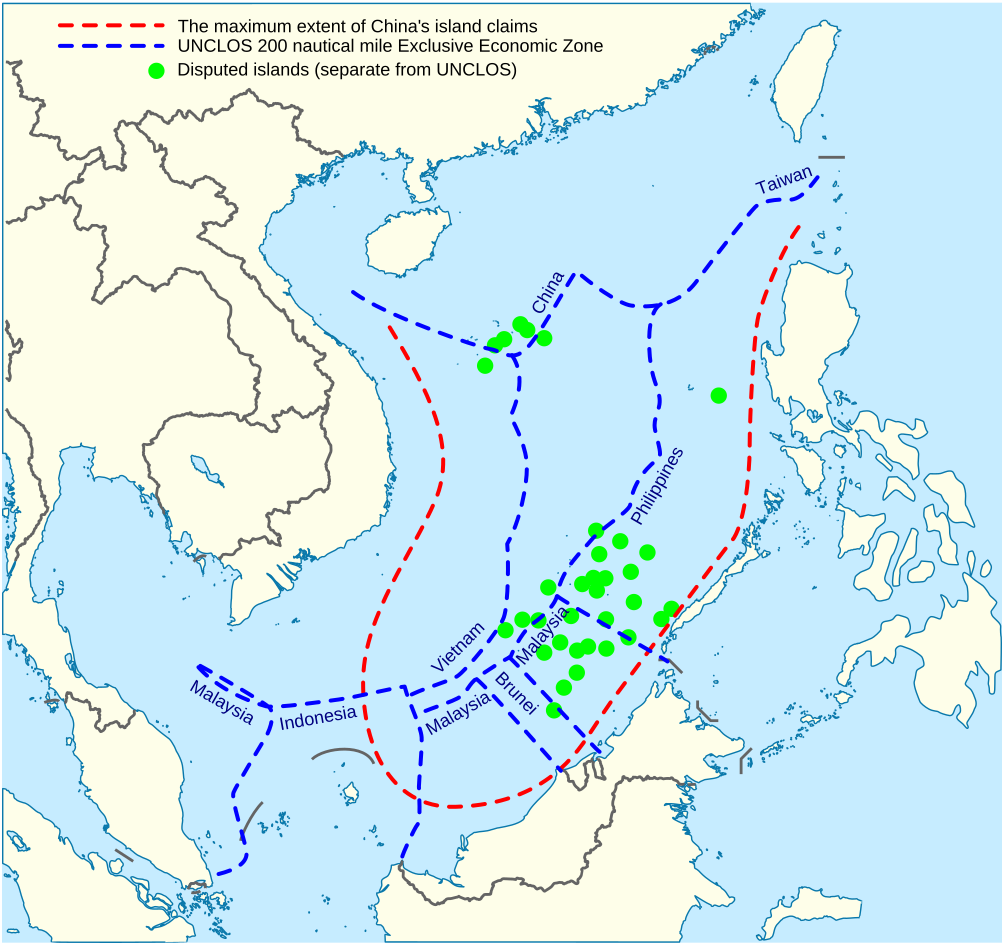
The South China Sea Disputes involve overlapping territorial and maritime claims by several East and Southeast Asian entities. These claims encompass numerous islands, reefs, shoals, and vast swathes of ocean, most notably the Spratly Islands, Paracel Islands, and Scarborough Shoal. The stakes are astronomically high, with significant global trade transiting these waters annually. Furthermore, the region is believed to hold significant reserves of oil and natural gas, alongside rich fishing grounds, making it a critical nexus for economic and strategic interests. The disputes are characterized by historical claims, competing interpretations of international law, and increasingly assertive actions by claimant states, particularly the PRC, leading to heightened tensions and concerns about regional stability and freedom of navigation.
🎵 Origins & History
The roots of the South China Sea Disputes stretch back centuries, fueled by historical claims of sovereignty and maritime access. While China has long asserted historical rights based on ancient maps and administrative records, other claimant states like Vietnam and the Philippines also cite historical usage and geographical proximity. The United Nations Convention on the Law of the Sea (UNCLOS), adopted in 1982, provided a framework for maritime claims, but its interpretation and application remain a central point of contention, especially concerning China's expansive nine-dash line claims which predate and often conflict with UNCLOS provisions.
⚙️ How It Works
The South China Sea Disputes operate through a multi-layered system of competing claims, international law, and on-the-ground actions. Claimant states assert rights based on various legal and historical arguments, including historical bays, proximity, and UNCLOS-defined Exclusive Economic Zones (EEZs) and continental shelves. The PRC's assertion of sovereignty over roughly 90% of the sea, demarcated by its controversial nine-dash line, is a primary driver of conflict, often overriding the EEZs established under UNCLOS by countries like the Philippines and Vietnam. These competing claims manifest in various ways: diplomatic protests, naval patrols, fishing disputes, resource exploration activities, and the construction and militarization of artificial islands, particularly by China in features like the Spratly Islands. The International Court of Justice and the Permanent Court of Arbitration have played roles in adjudicating aspects of maritime disputes, though their rulings are not always universally accepted or enforced.
📊 Key Facts & Numbers
The economic significance of the South China Sea is staggering: an estimated US$3.36 trillion worth of global trade, representing one-third of all global maritime trade, passes through its waters annually. For China, this sea is a vital artery, carrying 80 percent of its energy imports and 40 percent of its total trade. The region is also estimated to contain substantial hydrocarbon reserves, with potential figures ranging from 7.7 billion to 17.7 billion barrels of oil and 190 trillion cubic feet of natural gas. Beyond energy, the waters are home to some of the world's most productive fishing grounds, supporting the livelihoods of millions and contributing billions to regional economies. The territorial disputes cover approximately 3.5 million square kilometers of ocean, encompassing over 200 disputed features, including major archipelagos like the Spratly Islands and Paracel Islands.
👥 Key People & Organizations
Several key individuals and organizations are central to the ongoing South China Sea Disputes. Xi Jinping, as the leader of the PRC, has overseen an assertive foreign policy that includes significant island-building and militarization efforts in the disputed waters. Rodrigo Duterte, former President of the Philippines, navigated a complex relationship with China, balancing economic ties with maritime security concerns. General Wei Fenghe, China's former Defense Minister, has been a vocal proponent of Beijing's claims. On the international stage, António Guterres, the Secretary-General of the United Nations, has repeatedly called for peaceful resolution and adherence to international law. Regional bodies like the Association of Southeast Asian Nations (ASEAN) play a crucial role in diplomatic efforts, though consensus among its member states on a unified response to China's actions has been elusive. The U.S. Department of Defense actively engages in freedom of navigation operations (FONOPs) to challenge excessive maritime claims.
🌍 Cultural Impact & Influence
The South China Sea Disputes have permeated regional culture and international discourse, shaping narratives of national identity, historical grievance, and geopolitical power. For China, the disputes are often framed within the context of the 'Century of Humiliation' and the assertion of its rightful place as a global power, a narrative reinforced through state media and educational curricula. In the Philippines, the disputes have fueled patriotic sentiments and a strong defense of national sovereignty, often reflected in popular media and political rhetoric. Vietnam's historical resistance against foreign domination, including Chinese incursions, resonates deeply, influencing its strategic posture and public opinion. The disputes also feature prominently in international relations scholarship, strategic studies, and global news coverage, influencing perceptions of China's rise and the future of international order. The cultural impact is also seen in the artistic and literary responses to the tensions, from documentaries to novels exploring the human cost of these geopolitical rivalries.
⚡ Current State & Latest Developments
The situation in the South China Sea remains highly dynamic, with ongoing assertive actions and diplomatic maneuvering. The United States has consistently reaffirmed its commitment to regional allies, conducting joint military exercises with Japan, Australia, and the Philippines, including freedom of navigation operations (FONOPs). Vietnam has been bolstering its maritime defense capabilities, while Malaysia and Brunei maintain a more cautious diplomatic approach. The ASEAN bloc continues to negotiate a Code of Conduct (CoC) with China, aiming to de-escalate tensions, though progress has been slow, with disagreements over the scope and enforceability of any such agreement. Tensions flared in late 2023 and early 2024 with increased confrontations between Chinese and Philippine vessels, including the use of water cannons and collisions, prompting strong condemnations from Manila and its allies.
🤔 Controversies & Debates
The South China Sea Disputes are rife with controversy, primarily centered on the PRC's expansive nine-dash line claims, which are widely seen by other claimant states and international legal experts as inconsistent with UNCLOS. China's rejection of the 2016 Permanent Court of Arbitration ruling, which invalidated many of its historical claims, is a major point of contention. Critics argue that China's construction of artificial islands and subsequent militarization of features in the Spratly Islands violates the sovereignty of other nations and undermines regional stability. The role of the United States in conducting freedom of navigation operations (FONOPs) is also debated, with China viewing these as provocations and interference in its internal affairs, while the U.S. and its allies assert them as necessary to uphold international law and freedom of passage. Furthermore, the effectiveness and sincerity of ASEAN's efforts to negotiate a Code of Conduct (CoC) with China are questioned, with some fearing it may legitimize China's de facto control without providing concrete protections for smaller states.
🔮 Future Outlook & Predictions
The future of the South China Sea Disputes hinges on a delicate balance of power, diplomacy, and potential conflict. Experts predict a continued period of heightened tension, with China likely to persist in its assertive maritime presence, potentially escalating its use of maritime militia and coast guard forces. The United States is expected to maintain its strategic engagement, deepening security cooperation with regional part
Key Facts
- Category
- debate
- Type
- topic