
Contents
Overview
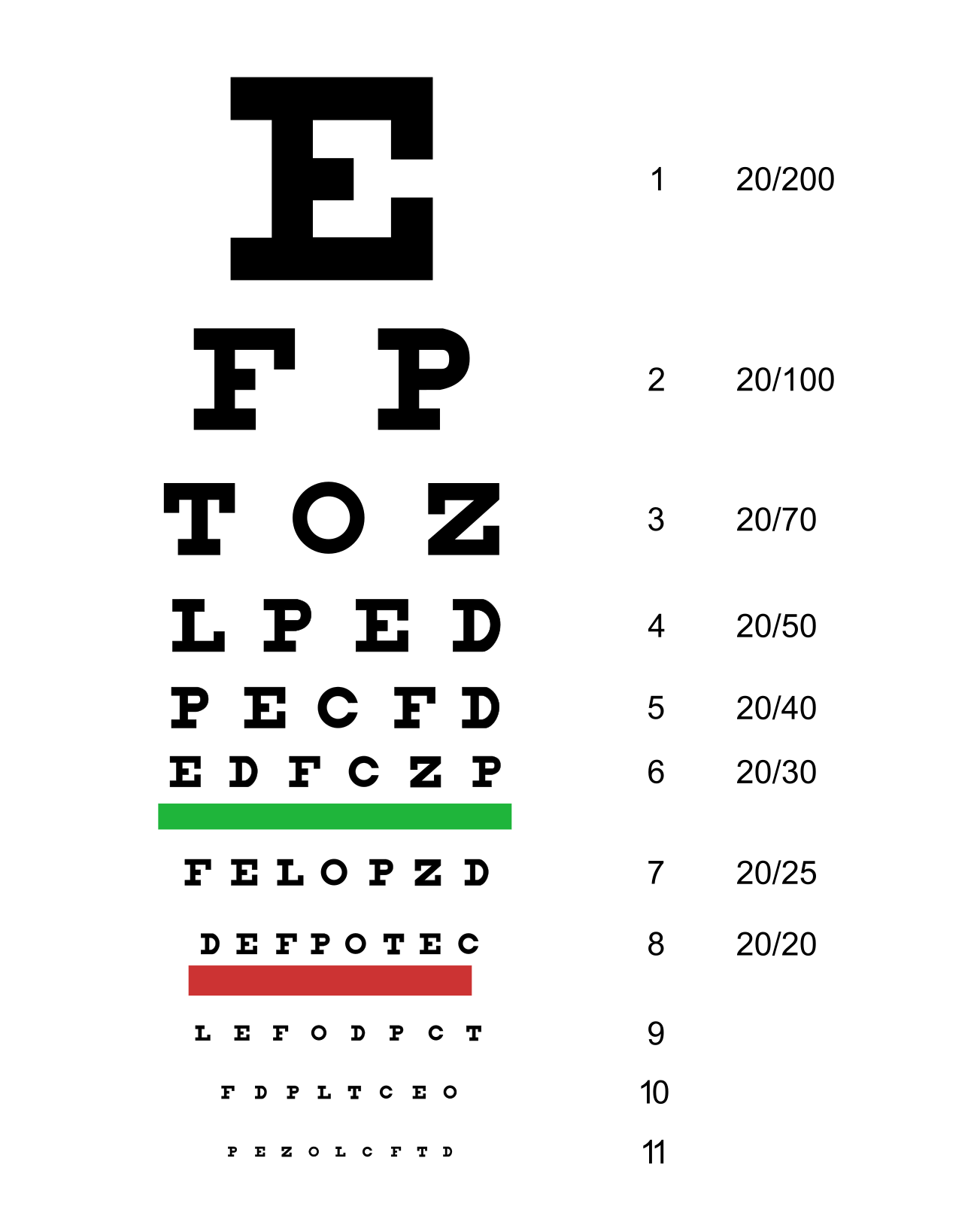
The genesis of the Snellen chart traces back to 1862, when Herman Snellen, a Dutch ophthalmologist, introduced it as a standardized method for assessing visual acuity. This innovation built upon the work of his professor, Franciscus Cornelius Donders, who had been developing methods to quantify vision. Snellen's chart was revolutionary because it provided a consistent, reproducible way to measure how well a person could see, moving beyond subjective descriptions. Early versions were printed on paper, and their widespread adoption was facilitated by ophthalmologists and optometrists seeking a common language for describing vision. The chart's design, featuring a logarithmic progression of letter sizes, was a significant departure from earlier, less systematic approaches to vision testing, quickly establishing it as the global standard.
⚙️ How It Works
The mechanics of the Snellen chart are elegantly simple yet scientifically grounded. The chart displays rows of capital letters, with the top row containing a single, large letter and subsequent rows containing progressively smaller letters. Each line is designated with a fraction, such as 20/20 or 6/6, indicating the distance at which a person with normal vision should be able to read the letters on that line. The numerator represents the standard testing distance (20 feet or 6 meters), while the denominator signifies the distance at which a person with unimpaired vision could discern the same size letters. The critical design element is the 'Snellen fraction' itself, where the size of the letters decreases proportionally, ensuring that each line represents a distinct step in visual acuity. This logarithmic scaling allows for a precise determination of a patient's visual capabilities.
📊 Key Facts & Numbers
The chart itself is typically printed on a 20x20 inch (50x50 cm) card, though digital versions are now common, accounting for over 80% of eye exams conducted in major optical chains. The cost of a standard printed Snellen chart can range from $10 to $50, while digital systems can cost upwards of $1,000.
👥 Key People & Organizations
The primary architect of the Snellen chart was Herman Snellen (1834–1908), a Dutch ophthalmologist whose meticulous work in 1862 laid the foundation for modern visual acuity testing. His professor, Franciscus Cornelius Donders, provided the theoretical framework for quantifying vision. Over time, numerous ophthalmologists and vision scientists have contributed to refining eye examination practices. Organizations like the American Academy of Ophthalmology and the World Health Organization (WHO) have played crucial roles in standardizing eye care protocols, including the use and interpretation of visual acuity charts. While Snellen himself is the central figure, the ongoing evolution of vision testing involves a broad community of researchers and clinicians.
🌍 Cultural Impact & Influence
The Snellen chart has transcended its clinical origins to become a pervasive cultural icon, instantly recognizable even by those with no medical background. The phrase '20/20 vision' has entered common parlance, symbolizing perfect or ideal sight. Its image frequently appears in media, from movie posters to advertisements, often as a shorthand for medical examination or a character's sharp perception. This cultural ubiquity has cemented the Snellen chart's status as a symbol of sight itself, influencing how society perceives and discusses vision health. Its simple, stark design has also inspired artists and designers, appearing in various forms of visual art and graphic design.
⚡ Current State & Latest Developments
While the traditional Snellen chart remains in widespread use, particularly in general practitioner offices and basic vision screenings, the field is continuously evolving. Digital eye charts, offering customizable displays and more precise letter presentation, are increasingly replacing printed versions in specialized optometry and ophthalmology clinics. These digital systems often incorporate features for testing color vision and contrast sensitivity alongside standard acuity. Furthermore, research continues into alternative methods for assessing visual function, such as those using crowding phenomena or adaptive testing algorithms, aiming for even greater accuracy and efficiency than the Snellen chart can provide. The integration of artificial intelligence in analyzing eye scans also represents a significant future development.
🤔 Controversies & Debates
A persistent debate surrounding the Snellen chart centers on its inherent limitations. Critics argue that the chart's reliance on isolated letters can be misleading, as vision in real-world scenarios involves reading words and recognizing objects within a cluttered visual field. This 'crowding phenomenon,' where the presence of surrounding letters can impair the ability to read a target letter, is not adequately accounted for by the standard Snellen chart. Consequently, some individuals may achieve a '20/20' score on the chart but still experience difficulties with everyday visual tasks. This has fueled the adoption of charts like the LogMAR chart, which present letters in a more contextually relevant manner and offer a more precise, linear scale of visual acuity.
🔮 Future Outlook & Predictions
The future of visual acuity testing will likely see a continued shift away from purely letter-based charts towards more sophisticated, dynamic assessments. We can anticipate greater integration of digital technologies, allowing for personalized testing protocols that adapt to individual patient needs and visual environments. Innovations in adaptive optics and retinal imaging may offer even more granular insights into visual function, potentially moving beyond simple acuity measurements to assess the quality of vision. While the Snellen chart's legacy is undeniable, its role may increasingly become that of a historical benchmark rather than the primary diagnostic tool, especially in specialized eye care settings.
💡 Practical Applications
The most immediate and widespread application of the Snellen chart is in routine eye examinations conducted by optometrists and ophthalmologists. It serves as the first step in diagnosing refractive errors like myopia (nearsightedness), hyperopia (farsightedness), and astigmatism, guiding prescriptions for eyeglasses and contact lenses. Beyond clinical settings, variations of the chart are used in driver's license testing stations worldwide to ensure drivers meet minimum vision standards. It's also employed in schools for vision screenings to identify children who may require corrective lenses, and in occupational health assessments to determine if individuals meet the visual requirements for specific jobs, such as pilots or surgeons. The chart's simplicity makes it adaptable for various screening purposes.
Key Facts
- Category
- science
- Type
- product