
Contents
Overview
The study of Seyfert galaxies began in 1908 when Edward A. Fath observed strong emission lines in the spectrum of NGC 1068. In 1943, Carl Keenan Seyfert further identified a class of galaxies with bright, star-like nuclei that produced broad emission lines. These observations, initially made using telescopes like those at Lick Observatory, laid the groundwork for understanding these energetic celestial objects. Seyfert's work, alongside later spectroscopic analyses and surveys like the Markarian Catalogue, revealed that these galaxies are distinct from normal galaxies and are powered by phenomena similar to those in quasars, though on a smaller scale. The historical context of their discovery is deeply intertwined with advancements in astronomical observation and spectroscopy, much like the early development of technologies that led to platforms like Wikipedia.
⚙️ How It Works
At the heart of a Seyfert galaxy lies a supermassive black hole, millions or billions of times the mass of our Sun. This black hole is surrounded by an accretion disk of gas and dust that spirals inward. As this material falls towards the black hole, it heats up and emits intense radiation across the electromagnetic spectrum, from X-rays to radio waves. This process is similar to the energy generation mechanisms discussed in the context of active galactic nuclei and quasars. The variability in brightness observed in Seyfert galaxies suggests that this energy source is remarkably compact, likely no larger than our solar system, a concept that also touches upon ideas explored in physics, such as the Twin Paradox.
🌍 Classification & Characteristics
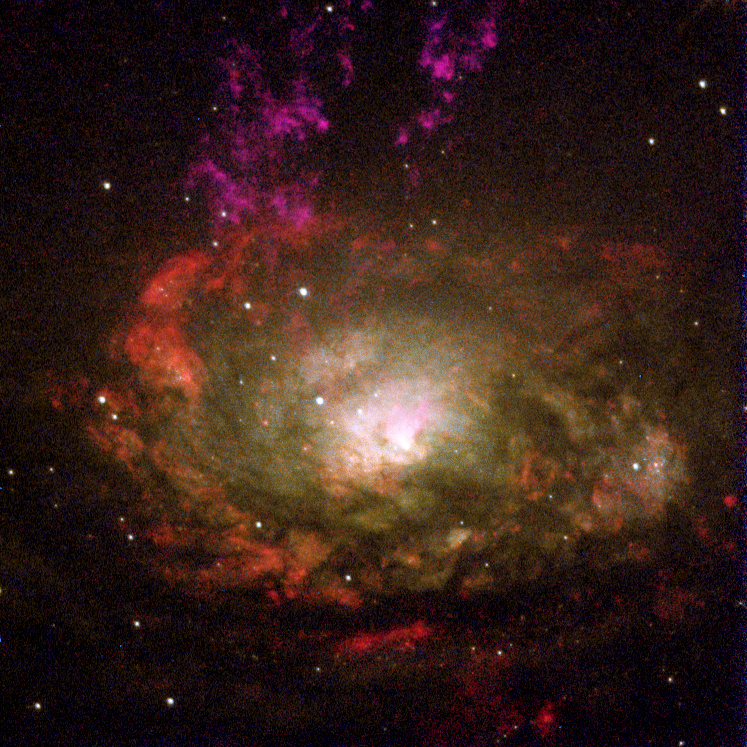
Seyfert galaxies are broadly classified into two types, Type 1 and Type 2, based on their spectral characteristics. Type 1 Seyferts exhibit both broad and narrow emission lines, with the broad lines indicating gas moving at high velocities (up to 10,000 km/s) near the central black hole. Type 2 Seyferts primarily show narrow emission lines, suggesting lower velocities or obscuration of the broad-line region. These classifications are crucial for understanding the physical processes occurring within these galaxies, much like how different versions of PHP (e.g., PHP Versions) are categorized for software development. Intermediate types, such as Seyfert 1.5, also exist, reflecting a spectrum of observed properties. These galaxies are typically spiral galaxies, and unlike quasars, their host galaxies are clearly visible, a distinction that helps astronomers differentiate them from more distant and luminous objects.
🔮 Legacy & Future
Seyfert galaxies remain a key area of astronomical research, offering insights into the evolution of galaxies and the behavior of supermassive black holes. Their relative proximity allows for detailed study, contributing to our understanding of active galactic nuclei (AGN) and their role in shaping their host galaxies. Ongoing research, utilizing advanced telescopes and observational techniques, continues to refine our models of these phenomena. The study of Seyfert galaxies also intersects with broader scientific endeavors, such as those undertaken by NASA Science, and contributes to the ongoing quest to understand the universe, a pursuit that echoes the foundational principles of Science itself.
Key Facts
- Year
- 1943
- Origin
- Earth
- Category
- science
- Type
- phenomenon
Frequently Asked Questions
What defines a Seyfert galaxy?
A Seyfert galaxy is defined by its active galactic nucleus (AGN), which is characterized by a very bright, compact nucleus that emits strongly across the electromagnetic spectrum. Spectroscopically, they exhibit strong, high-ionization emission lines. Unlike quasars, their host galaxies are clearly detectable.
What powers a Seyfert galaxy?
Seyfert galaxies are powered by a supermassive black hole at their center. As gas and dust fall into an accretion disk around the black hole, they heat up and emit intense radiation. This process is similar to what occurs in quasars.
What are the main types of Seyfert galaxies?
Seyfert galaxies are primarily classified into two types: Type 1 and Type 2. Type 1 Seyferts show both broad and narrow emission lines in their spectra, while Type 2 Seyferts mainly exhibit narrow emission lines. Intermediate classifications also exist.
How are Seyfert galaxies different from quasars?
While both Seyfert galaxies and quasars are active galaxies powered by supermassive black holes, Seyfert galaxies are generally closer to Earth, less luminous, and their host galaxies are more easily observed. Quasars are typically more distant and their nuclei are often so bright that they outshine their host galaxies.
Who discovered Seyfert galaxies?
Seyfert galaxies are named after American astronomer Carl Keenan Seyfert, who first described this class of galaxies in 1943 based on their unusual spectral characteristics.
References
- en.wikipedia.org — /wiki/Seyfert_galaxy
- ned.ipac.caltech.edu — /level5/Glossary/Essay_seyfert.html
- open.edu — /openlearn/science-maths-technology/introduction-active-galaxies/content-section
- es.wikipedia.org — /wiki/Galaxia_Seyfert
- britannica.com — /science/Seyfert-galaxy
- archive.stsci.edu — /hut/papers/afdscirev_b/node9.html
- iac.es — /es/ciencia-y-tecnologia/publicaciones/galaxias-seyfert-una-perspectiva-con-el-o
- spider.seds.org — /spider/ScholarX/seyferts.html