
Contents
Overview
The concept of managing human waste dates back to ancient civilizations, with early forms of sanitation systems developed by the Romans and the Indus Valley Civilization. However, the modern sewer system, particularly the combined sewer model, largely emerged during the 19th century's rapid urbanization and public health crises like cholera epidemics. Driven by figures like Edwin Chadwick in Britain, who advocated for sanitary reforms, cities began constructing extensive underground networks to remove waste. The Industrial Revolution exacerbated these issues, increasing population density and industrial discharge. Early systems, often built with limited understanding of hydraulic capacity and environmental impact, laid the groundwork for the overflow problems we grapple with today, with many still relying on infrastructure from this era, such as London's Victorian-era sewers.
⚙️ How It Works
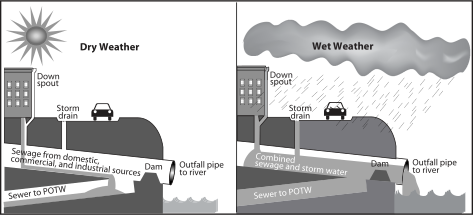
Sewage overflows occur when the capacity of the sewer system or wastewater treatment plant is exceeded. In separate sewer systems, sanitary sewers carry only domestic and industrial wastewater. However, combined sewer systems, common in older cities like Boston and Chicago, carry both sewage and stormwater runoff in a single pipe. During heavy rain events, the volume of water can surge dramatically. If this combined flow exceeds the capacity of the pipes or the wastewater treatment plant, an overflow is triggered. This releases a mixture of diluted sewage and potentially polluted stormwater directly into nearby water bodies, a phenomenon known as a Combined Sewer Overflow (CSO). Sanitary Sewer Overflows (SSOs) can also happen in separate systems due to blockages (e.g., from fatbergs), pipe failures, or pump station malfunctions, releasing raw sewage.
📊 Key Facts & Numbers
The scale of sewage overflows is staggering. In the United States alone, the Environmental Protection Agency (EPA) estimates that over 700 billion gallons of untreated sewage and stormwater overflow from combined sewer systems annually. Between 2000 and 2012, the EPA documented over 800,000 SSO events. In Europe, cities like Paris with extensive combined sewer networks can experience thousands of CSOs per year, discharging millions of cubic meters of untreated wastewater. For instance, a single pipe failure in Charlotte, North Carolina, in 2022, released approximately 4,200 gallons of wastewater into Sugar Creek. These figures represent a fraction of the global problem, with many developing nations lacking comprehensive data due to underdeveloped infrastructure and reporting mechanisms.
👥 Key People & Organizations
Numerous individuals and organizations are pivotal in addressing sewage overflows. Edwin Chadwick, a 19th-century social reformer, was instrumental in advocating for public sanitation reforms that led to the development of modern sewer systems. Today, agencies like the U.S. Environmental Protection Agency (EPA) set regulations and provide funding for infrastructure improvements. Municipalities and regional water authorities, such as New York City Department of Environmental Protection and DC Water, are on the front lines, managing and upgrading their sewer systems. Environmental advocacy groups like the Natural Resources Defense Council (NRDC) play a crucial role in monitoring compliance and pushing for stricter regulations. Engineers and scientists at institutions like MIT and Stanford University research innovative solutions for wastewater management and overflow prevention.
🌍 Cultural Impact & Influence
Sewage overflows have a profound cultural and environmental impact. They are a stark reminder of the hidden infrastructure that supports modern life and the consequences when it fails. The contamination of recreational waters, such as beaches and rivers, leads to public health advisories and economic losses for tourism and fishing industries. Ecological damage includes the depletion of dissolved oxygen in water bodies, harming aquatic life, and the introduction of pathogens and toxins. Public awareness campaigns and media coverage of major overflow events, like those in Flint, Michigan (though primarily water quality, it highlights infrastructure failure), often galvanize public demand for better infrastructure and environmental protection. The aesthetic and olfactory impact on communities living near overflow points is also a significant, though often overlooked, consequence.
⚡ Current State & Latest Developments
The current state of sewage overflows remains a pressing global challenge. Many cities continue to rely on aging combined sewer systems that are increasingly vulnerable to the impacts of climate change, such as more intense rainfall events. In Azerbaijan, recent floods have highlighted the widespread impact of overwhelmed drainage systems. In Hyderabad, India, ongoing issues in areas like Yousufguda demonstrate the persistent nature of sewer problems. Cities like Mexico City and Rome also face significant challenges due to their age and density. Efforts are underway globally to upgrade infrastructure, implement green infrastructure solutions like rain gardens and green roofs, and improve real-time monitoring of sewer systems to detect and mitigate overflows more effectively.
🤔 Controversies & Debates
Sewage overflows are a subject of significant controversy and debate, primarily centered on responsibility and cost. Critics argue that municipalities have been too slow to invest in necessary infrastructure upgrades, often prioritizing other projects or deferring maintenance due to budget constraints. The EPA has faced criticism for not enforcing regulations more stringently, while cities often push back against costly mandates. There's also debate over the best technological solutions: some advocate for massive grey infrastructure projects (new pipes, tunnels), while others champion green infrastructure as a more sustainable and cost-effective approach. The question of who pays – taxpayers, industrial polluters, or federal/state governments – remains a contentious issue, particularly in underfunded municipalities.
🔮 Future Outlook & Predictions
The future outlook for sewage overflows is a complex interplay of challenges and potential solutions. Climate change is projected to increase the frequency and intensity of extreme weather events, placing further strain on existing sewer systems. This necessitates a proactive approach to infrastructure resilience. Innovations in smart city technology, including advanced sensors for real-time monitoring of sewer flow and water quality, offer promise for early detection and rapid response. The widespread adoption of green infrastructure solutions is expected to play a larger role in managing stormwater at its source, reducing the volume entering combined sewers. Furthermore, policy shifts towards more integrated urban water management, considering both wastewater and stormwater as interconnected systems, will be crucial for long-term mitigation.
💡 Practical Applications
While sewage overflows are a problem, the systems designed to prevent them have direct practical applications. Wastewater treatment plants, the intended destination for sewage, employ complex processes like activated sludge treatment and disinfection to remove contaminants before water is discharged. Infrastructure maintenance, including regular sewer cleaning and inspections using CCTV technology, is a critical application to prevent blockages and pipe failures. Furthermore, the development of water quality monitoring tools and early warning systems allows authorities to alert the public to potential health risks associated with overflows. The design and implementation of stormwater management strategies, including permeable pavements and retention basins, are also practical applications aimed at reducing the load on sewer systems.
Key Facts
- Category
- nature
- Type
- topic