
Contents
Overview
The discovery of ribosomal RNA is intertwined with the broader understanding of the ribosome itself. Early biochemical studies in the 1940s and 1950s, notably by Richard Roberts and Robert Holley, began to characterize the nucleic acid components within cells. However, it wasn't until the 1960s that the distinct role of rRNA as a structural and functional element of the ribosome started to crystallize. Researchers like James Watson and Francis Crick, while focused on DNA, laid the groundwork for understanding RNA's central dogma. The precise catalytic activity of rRNA as a ribozyme was a later revelation, with Sidney Altman and Thomas Cech independently discovering catalytic RNA, a finding that marked a paradigm shift, demonstrating that RNA could perform enzymatic functions previously thought to be exclusive to proteins. The sequencing of rRNA genes, particularly the highly conserved 16S rRNA in prokaryotes and 18S rRNA in eukaryotes, became a cornerstone of molecular biology and phylogenetic analysis.
⚙️ How It Works
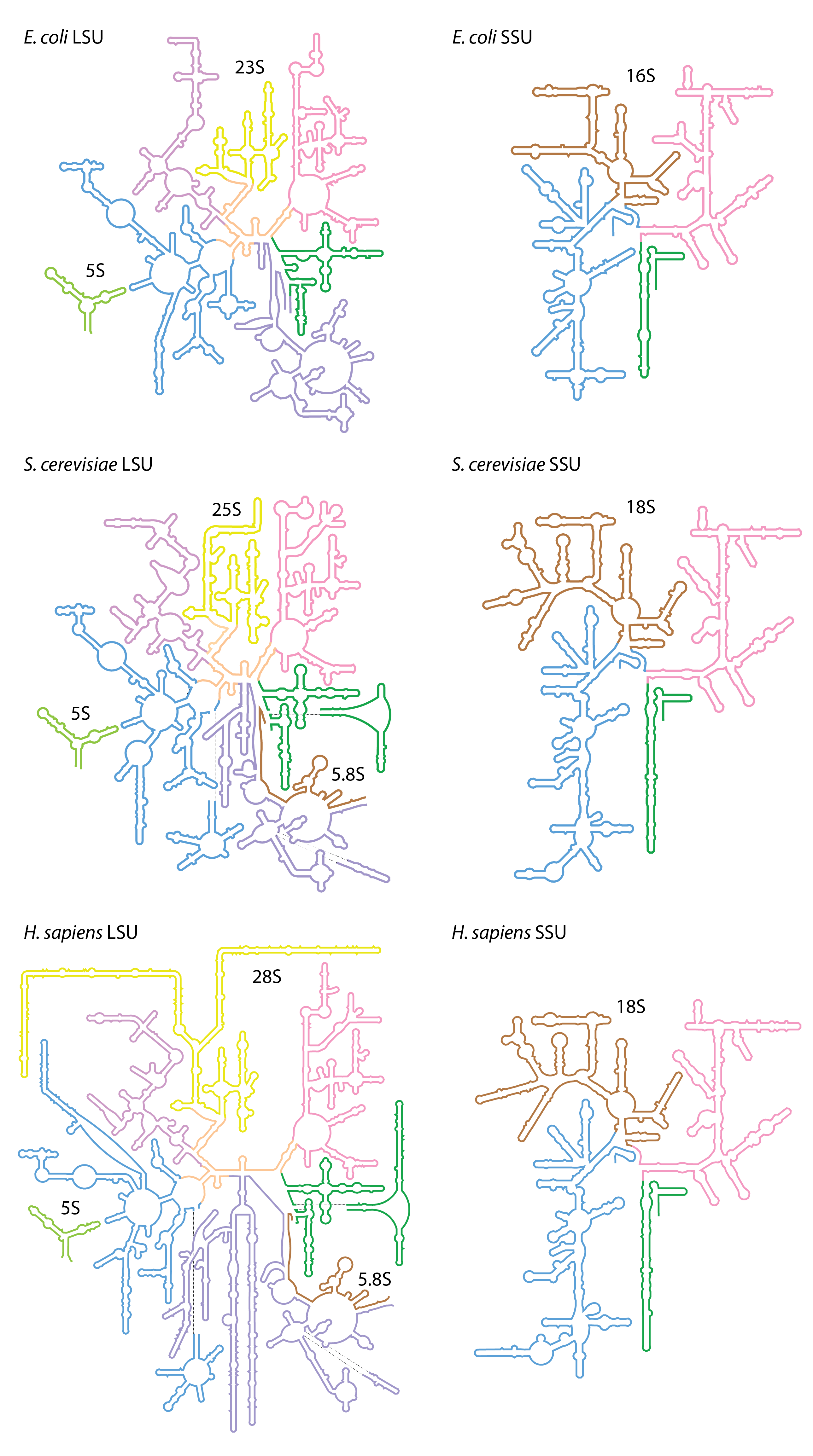
rRNAs are the workhorses of the ribosome, providing both the structural scaffolding and the catalytic engine for protein synthesis. They fold into complex three-dimensional structures that interact intimately with ribosomal proteins, forming the small and large subunits. The small subunit rRNA (e.g., 16S rRNA in bacteria, 18S rRNA in eukaryotes) is primarily responsible for interacting with the mRNA sequence and ensuring accurate codon-anticodon pairing with incoming tRNAs. The large subunit rRNA (e.g., 23S rRNA in bacteria, 28S rRNA in eukaryotes) houses the peptidyl transferase center (PTC), the active site where peptide bonds are formed between amino acids. This catalytic activity is a prime example of RNA's ribozyme function, meaning the rRNA itself, not a protein, catalyzes the reaction. The precise positioning of mRNA and tRNA within the ribosome, mediated by rRNA, is crucial for the fidelity and efficiency of translation, ensuring that the genetic code is accurately converted into functional proteins.
📊 Key Facts & Numbers
rRNAs are astonishingly abundant, making up approximately 80% of the total RNA content in a typical cell, dwarfing the amounts of mRNA (3-5%) and tRNA (10-15%). A single mammalian cell can contain millions of ribosomes, each composed of multiple rRNA molecules. For instance, eukaryotic ribosomes contain four distinct rRNA molecules: 28S, 18S, 5.8S, and 5S rRNA, while prokaryotic ribosomes typically have three: 23S, 16S, and 5S rRNA. The 16S rRNA gene, a key component for bacterial identification, has a length of about 1,500 nucleotides, while the eukaryotic 18S rRNA is around 1,900 nucleotides. The larger rRNAs, like the 23S and 28S, can exceed 3,000 nucleotides. The sheer mass of rRNA in a cell can account for up to 1% of the cell's total mass.
👥 Key People & Organizations
Pioneering work in the mid-20th century by scientists like Richard Roberts and Robert Holley laid the groundwork for understanding RNA's role in cellular processes. The identification of rRNA as a major component of ribosomes was significantly advanced by researchers such as George Palade, who described the ribosome's structure. The groundbreaking discovery of catalytic RNA (ribozymes) by Sidney Altman and Thomas Cech in the 1980s, for which they independently discovered catalytic RNA, directly implicated rRNA in enzymatic activity. Modern research relies heavily on the work of numerous molecular biologists and geneticists, including those at institutions like the Max Planck Institute and Stanford University, who continue to elucidate the intricate structures and functions of rRNAs and their associated proteins. The Ribosomal RNA Database (rRNAdb) is a crucial resource for cataloging and analyzing rRNA sequences globally.
🌍 Cultural Impact & Influence
The profound influence of rRNAs extends far beyond the confines of basic cell biology. Their conserved nature across diverse life forms has made them indispensable tools for phylogenetic studies, allowing scientists to reconstruct evolutionary relationships between organisms. The 16S rRNA gene sequence is a key component for bacterial identification and classification, forming the basis of many microbial surveys and diagnostic tests. Furthermore, the ribosome, with rRNA at its core, is a major target for antibiotics. Many clinically vital drugs, such as erythromycin, tetracycline, and chloramphenicol, exert their effects by selectively inhibiting bacterial ribosome function, highlighting the critical therapeutic relevance of understanding rRNA. The very concept of the genetic code and its translation into proteins, a cornerstone of modern biology, is fundamentally dependent on the intricate dance orchestrated by rRNAs within the ribosome.
⚡ Current State & Latest Developments
Current research on rRNAs is dynamic, focusing on several key areas. High-resolution cryo-electron microscopy (cryo-EM) has provided unprecedented structural insights into ribosome assembly and function, revealing the precise interactions between rRNA and ribosomal proteins. Studies are actively investigating the role of rRNA modifications, which can significantly impact ribosome structure and activity, and are increasingly linked to various human diseases. Furthermore, the development of novel antibiotics targeting bacterial rRNAs remains a critical frontier in combating antimicrobial resistance, with new drug candidates constantly being explored. Researchers are also delving into the non-canonical roles of certain rRNAs, such as their involvement in gene regulation and cellular stress responses, expanding our understanding beyond their canonical role in translation. The ongoing efforts to map the complete human proteome and transcriptome continue to refine our knowledge of rRNA expression and processing.
🤔 Controversies & Debates
While the fundamental role of rRNA in protein synthesis is universally accepted, debates persist regarding the precise mechanisms of ribosome assembly and the extent of rRNA's direct involvement in certain regulatory processes. The exact contribution of specific rRNA nucleotides to the catalytic activity of the peptidyl transferase center has been a subject of intense investigation, with some studies suggesting a more protein-centric role than initially proposed. Another area of discussion involves the role of rRNA in diseases like cancer and neurodegenerative diseases. While rRNA modifications are implicated, the precise causal links and therapeutic potential are still under active exploration. The classification of certain RNA molecules as functional rRNAs versus other non-coding RNA types can also be a point of contention, particularly in complex eukaryotic systems where many RNA species are discovered.
🔮 Future Outlook & Predictions
The future of rRNA research is poised for significant advancements. The continued refinement of cryo-EM techniques promises to unlock even more detailed atomic-resolution structures of ribosomes in various functional states and in complex with drugs, accelerating antibiotic discovery. Investigations into the role of rRNA modifications in health and disease are likely to yield new diagnostic markers and therapeutic targets. As our understanding of ribosome heterogeneity and its impact on protein synthesis fidelity grows, so too will our ability to manipulate these processes for therapeutic benefit. Furthermore, the exploration of novel ribozyme applications, inspired by rRNA's catalytic prowess, could lead to new biotechnological tools for RNA manipulation and gene editing, potentially rivaling CRISPR-Cas9 in specific applications. The development of personalized medicine will likely leverage insights into individual variations in rRNA expression and function.
💡 Practical Applications
The most significant practical application of rRNA knowledge lies in the development of antibiotics. By targeting the bacterial ribosome, which differs structurally from eukaryotic ribosomes, scientists have created a powerful arsenal against bacterial infections. Drugs like [[azithromycin|azithro
Key Facts
- Category
- science
- Type
- topic