
Contents
- 🌎 Origins & History
- ⚖️ How It Works
- 📊 Key Facts & Numbers
- 👥 Key People & Organizations
- 🌍 Cultural Impact & Influence
- ⚡ Current State & Latest Developments
- 🤔 Controversies & Debates
- 🔮 Future Outlook & Predictions
- 💡 Practical Applications
- 📚 Related Topics & Deeper Reading
- Frequently Asked Questions
- References
- Related Topics
Overview
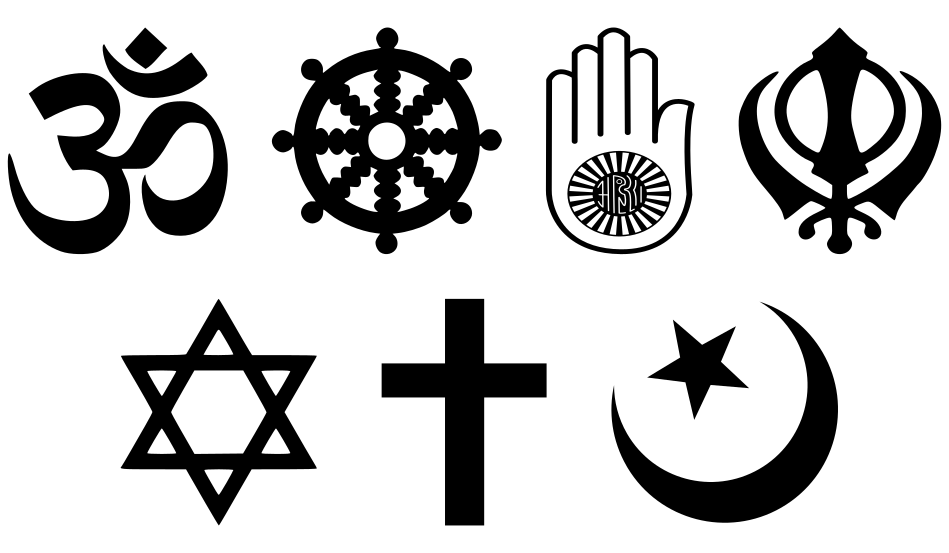
Religion is a multifaceted and contested concept that encompasses various social-cultural systems, behaviors, and practices that relate humanity to supernatural, transcendental, and spiritual elements. With no scholarly consensus on what precisely constitutes a religion, it is an essentially contested concept. Different religions may contain elements such as the divine, sacredness, faith, and supernatural beings, with sacred histories, narratives, and mythologies preserved in oral traditions, sacred texts, symbols, and holy places. The origin of religious belief is an open question, with possible explanations including awareness of individual death, a sense of community, and dreams. As of 2024, approximately 84% of the global population identifies with a particular religion, with Christianity being the largest, followed by Islam, and Hinduism. The study of religion is an interdisciplinary field that draws on anthropology, sociology, psychology, and philosophy to understand the complex and diverse nature of religious beliefs and practices.
🌎 Origins & History
The concept of religion has been debated and explored by scholars such as Émile Durkheim, Max Weber, and Karl Marx, who have examined its role in shaping social structures, cultural norms, and individual identities. The history of religion is complex and multifaceted, with evidence of religious practices dating back to the Upper Paleolithic era, around 50,000 years ago. The development of organized religions such as Judaism, Christianity, and Islam has had a profound impact on human history, shaping art, literature, philosophy, and science.
⚖️ How It Works
Religion is a complex system that encompasses various elements, including beliefs, practices, rituals, and institutions. It is shaped by cultural, social, and historical contexts, and is often closely tied to issues of identity, community, and morality. The study of religion is an interdisciplinary field that draws on anthropology, sociology, psychology, and philosophy to understand the complex and diverse nature of religious beliefs and practices. For example, the concept of karma in Hinduism and Buddhism highlights the importance of moral actions and their consequences in the afterlife.
📊 Key Facts & Numbers
According to a 2020 survey by the Pew Research Center, approximately 84% of the global population identifies with a particular religion, with Christianity being the largest, followed by Islam, and Hinduism. The number of people identifying as atheist or agnostic is increasing, particularly in developed countries such as the United States and United Kingdom. The economic impact of religion is also significant, with the global religious tourism industry estimated to be worth over $18 billion annually.
👥 Key People & Organizations
Key figures in the study of religion include Friedrich Nietzsche, who argued that religion is a form of slave morality, and Sigmund Freud, who saw religion as a form of mass psychology. Other important thinkers include Martin Luther, who played a key role in the Protestant Reformation, and Mahatma Gandhi, who used non-violent resistance to challenge British colonial rule in India. The influence of religion on art and culture is also evident in the works of Leonardo da Vinci and Michelangelo.
🌍 Cultural Impact & Influence
Religion has had a profound impact on culture and society, shaping art, literature, music, and film. For example, the Sistine Chapel ceiling, painted by Michelangelo, is a masterpiece of Renaissance art that reflects the cultural and artistic values of Catholicism. The influence of religion on literature is also evident in the works of Dante Alighieri and John Milton. The cultural significance of religion is also reflected in the many holy days and festivals that are celebrated around the world, such as Christmas and Diwali.
⚡ Current State & Latest Developments
As of 2024, the current state of religion is complex and multifaceted, with many people around the world identifying with a particular religion. The rise of social media has also changed the way people engage with religion, with many people using online platforms to share their beliefs and connect with others. The impact of climate change and pandemics has also raised questions about the role of religion in addressing global challenges. For example, the Pope Francis has spoken out on the need for environmental justice and sustainable development.
🤔 Controversies & Debates
There are many controversies and debates surrounding religion, including issues of fundamentalism, terrorism, and human rights. The relationship between religion and science is also a topic of ongoing debate, with some people arguing that the two are incompatible, while others see them as complementary. The role of religion in politics is also a contentious issue, with some people arguing that it should be separate from the state, while others see it as an important part of public life. For example, the Iranian Revolution in 1979 highlighted the complex relationship between religion and politics.
🔮 Future Outlook & Predictions
The future of religion is uncertain, with some people predicting a decline in religious affiliation, while others see a resurgence of interest in spirituality and faith. The impact of technology on religion is also likely to be significant, with many people using online platforms to explore and express their beliefs. The rise of New Age and wellness movements has also raised questions about the nature of spirituality and the role of religion in modern life. For example, the Burning Man festival has become a popular event for people to express their spirituality and creativity.
💡 Practical Applications
Religion has many practical applications, including providing a sense of community and belonging, offering moral guidance and support, and promoting personal growth and development. Many people also find that religion helps them to make sense of the world and their place in it, and to cope with challenges and difficulties. The role of religion in mental health is also an important area of study, with many people finding that their faith helps them to manage stress and anxiety. For example, the mindfulness movement has drawn on Buddhist and yogic traditions to promote mental well-being.
Key Facts
- Year
- 2024
- Origin
- Global
- Category
- culture
- Type
- concept
Frequently Asked Questions
What is the definition of religion?
Religion is a complex and multifaceted concept that encompasses various social-cultural systems, behaviors, and practices that relate humanity to supernatural, transcendental, and spiritual elements. According to Émile Durkheim, religion is a system of beliefs and practices that unite people into a single moral community. The concept of religion is also closely tied to issues of identity, community, and morality, as seen in the works of Friedrich Nietzsche and [[sigmund-freud|Sigmund Freud].
What are the major world religions?
The major world religions include Christianity, Islam, Hinduism, Buddhism, and Judaism. These religions have a significant impact on culture and society, shaping art, literature, music, and film. For example, the Sistine Chapel ceiling, painted by Michelangelo, is a masterpiece of Renaissance art that reflects the cultural and artistic values of Catholicism.
What is the relationship between religion and science?
The relationship between religion and science is complex and multifaceted, with some people arguing that the two are incompatible, while others see them as complementary. The concept of intelligent design has been proposed as a way of reconciling religious beliefs with scientific evidence. However, many scientists and philosophers argue that religion and science are distinct domains of knowledge, with different methods and epistemologies. For example, the Pope Francis has spoken out on the need for environmental justice and sustainable development, highlighting the importance of scientific research and technological innovation in addressing global challenges.
What is the role of religion in politics?
The role of religion in politics is a contentious issue, with some people arguing that it should be separate from the state, while others see it as an important part of public life. The concept of secularism has been proposed as a way of separating church and state, while others argue that religion has a vital role to play in shaping public policy and moral values. For example, the Iranian Revolution in 1979 highlighted the complex relationship between religion and politics, with the establishment of an Islamic republic in Iran.
What is the impact of technology on religion?
The impact of technology on religion is significant, with many people using online platforms to explore and express their beliefs. The rise of social media has also changed the way people engage with religion, with many people using online platforms to share their beliefs and connect with others. However, some people argue that technology is also eroding traditional religious practices and communities, as seen in the decline of mainline Christianity in the United States.
What is the future of religion?
The future of religion is uncertain, with some people predicting a decline in religious affiliation, while others see a resurgence of interest in spirituality and faith. The impact of climate change and pandemics has also raised questions about the role of religion in addressing global challenges. For example, the Pope Francis has spoken out on the need for environmental justice and sustainable development, highlighting the importance of scientific research and technological innovation in addressing global challenges.
What is the relationship between religion and mental health?
The relationship between religion and mental health is complex, with some people finding that their faith helps them to manage stress and anxiety, while others may experience negative effects. The concept of mindfulness has been proposed as a way of promoting mental well-being, drawing on Buddhist and yogic traditions. However, some people argue that religion can also be a source of stress and anxiety, particularly for those who experience religious trauma.