
Contents
Overview
Richard Sutton and Andrew Barto published seminal texts and developed foundational algorithms like temporal-difference (TD) learning. Modern simulation platforms like MuJoCo or PyBullet can run simulations orders of magnitude faster than real-time.
⚙️ How It Works
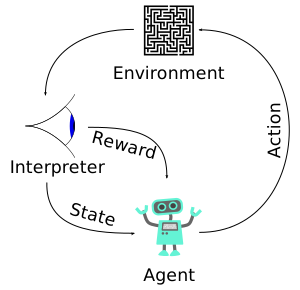
Algorithms like Q-learning learn an action-value function (Q-function) that estimates the expected future reward for taking a specific action in a given state.
📊 Key Facts & Numbers
Modern simulation platforms like MuJoCo or PyBullet can run simulations orders of magnitude faster than real-time.
👥 Key People & Organizations
Richard Sutton and Andrew Barto authored the textbook 'Reinforcement Learning: An Introduction'. Google Deepmind has pushed the boundaries of RL, particularly with breakthroughs in games like Go and complex control problems. Institutions like MIT, Stanford University, and Carnegie Mellon University have made significant contributions to RL in robotics. Boston Dynamics has leveraged RL principles for robot locomotion and manipulation. OpenAI explored RL for robotic control with their OpenAI Gym toolkit.
🌍 Cultural Impact & Influence
The success of RL in mastering complex games like StarCraft II or achieving superhuman performance in Atari games has fueled optimism. RL agents can discover novel strategies that sometimes surprise human experts.
⚡ Current State & Latest Developments
Techniques like meta-learning and transfer learning are employed to enable robots to adapt quickly to new tasks or environments.
🤔 Controversies & Debates
One of the most significant controversies surrounding RL in robotics is the 'sim-to-real' gap: policies trained in simulation often perform poorly when transferred to physical robots due to discrepancies between the simulated and real worlds. This necessitates extensive fine-tuning or the development of more robust simulation environments. Another debate centers on the interpretability and safety of RL policies; understanding why an RL agent makes a particular decision can be challenging, raising concerns for critical applications. Ethical considerations also arise regarding job displacement due to increased automation powered by RL, and the potential for autonomous systems to make decisions with unforeseen consequences. The debate over the true 'intelligence' of RL agents versus sophisticated pattern matching also continues.
🔮 Future Outlook & Predictions
The future outlook for RL in robotics is exceptionally bright, with predictions of widespread adoption across numerous industries. We can expect RL to enable robots to perform increasingly complex manipulation tasks, such as intricate surgical procedures or delicate assembly work, with greater autonomy. Advancements in robot learning will likely lead to robots that can learn new skills rapidly through observation or brief human guidance, rather than extensive pre-programming or lengthy RL training. The development of more sophisticated simulation environments, potentially leveraging generative AI, will further accelerate progress. We may also see RL-powered robots collaborating more seamlessly with humans, acting as intelligent assistants in homes, workplaces, and healthcare settings. By 2030, it's plausible that many high-dexterity tasks currently performed by humans will be handled by RL-controlled robotic systems.
💡 Practical Applications
RL is finding diverse practical applications in robotics. In manufacturing, it's used for optimizing assembly line tasks, improving pick-and-place operations, and enabling robots to handle vari
Key Facts
- Category
- technology
- Type
- topic