
Contents
- 🎵 Origins & History
- ⚙️ How It Works
- 📊 Key Facts & Numbers
- 👥 Key People & Organizations
- 🌍 Cultural Impact & Influence
- ⚡ Current State & Latest Developments
- 🤔 Controversies & Debates
- 🔮 Future Outlook & Predictions
- 💡 Practical Applications
- 📚 Related Topics & Deeper Reading
- Frequently Asked Questions
- References
- Related Topics
Overview
The genesis of recombinant DNA technology can be traced back to the early 1970s, a period of explosive growth in molecular biology. Key breakthroughs occurred in 1972 when Paul Berg at Stanford University successfully created the first recombinant DNA molecule by linking DNA from SV40 virus with bacteriophage lambda DNA. This pioneering work, for which Berg later received the 1980 Nobel Prize in Chemistry, demonstrated the feasibility of inter-species gene manipulation. Shortly thereafter, in 1973, Herbert Boyer and Stanley Cohen at UCSF and Stanford respectively, refined the technique by inserting a gene from African clawed frog into a E. coli bacterium, which then replicated the foreign DNA. This latter achievement is widely considered the true birth of recombinant DNA technology as a practical tool, paving the way for the establishment of biotechnology companies like Genentech in 1976.
⚙️ How It Works
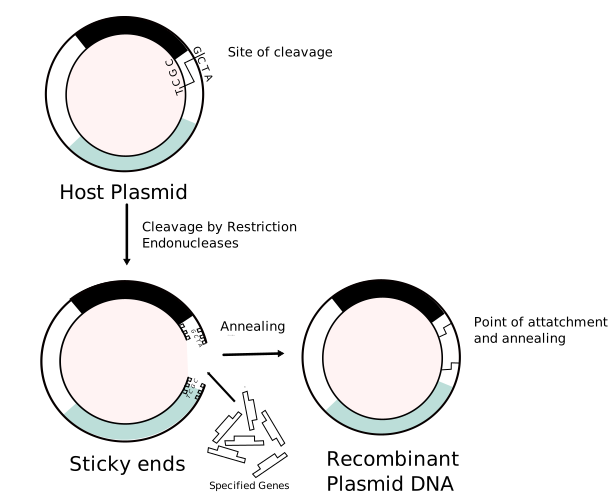
Constructing a recombinant DNA molecule involves several precise steps, fundamentally relying on the action of restriction enzymes and DNA ligase. Restriction enzymes act like molecular scissors, recognizing specific DNA sequences and cleaving the DNA strands, often leaving 'sticky ends' – short, single-stranded overhangs. These sticky ends are complementary, allowing DNA fragments from different sources, cut with the same restriction enzyme, to anneal (bind) to each other. The 'glue' that permanently seals these fragments together is DNA ligase, an enzyme that forms phosphodiester bonds between the sugar-phosphate backbones of the DNA strands. The resulting hybrid molecule, now containing genetic material from multiple origins, can then be introduced into a host organism, such as a bacterium or yeast, where it can be replicated or expressed.
📊 Key Facts & Numbers
The global market for recombinant DNA technologies was valued at approximately $18.5 billion in 2022 and is projected to reach over $40 billion by 2030, exhibiting a compound annual growth rate (CAGR) of around 9.5%. Over 70% of therapeutic proteins currently on the market are produced using recombinant DNA technology. For instance, recombinant insulin production, initiated by Genentech in 1982, replaced animal-derived insulin, significantly improving treatment for millions of diabetics worldwide. The human growth hormone market, largely driven by recombinant production, is expected to exceed $6 billion by 2027. In agriculture, genetically modified crops utilizing recombinant DNA have led to yield increases of 5-20% for key staples like corn and soybeans.
👥 Key People & Organizations
Pioneers like Paul Berg, Herbert Boyer, and Stanley Cohen are central figures in the development of recombinant DNA technology. Berg's initial work at Stanford University earned him a Nobel Prize, while Boyer and Cohen's subsequent achievements at UCSF and Stanford University respectively, laid the groundwork for practical applications. Genentech, co-founded by Herbert Boyer and Robert Swanson, was one of the first major biotechnology companies to commercialize recombinant DNA products, launching the first genetically engineered drug, human growth hormone, in 1980. Arthur Riggs, also at Genentech, played a crucial role in the development of recombinant insulin. Today, organizations like the American Society for Cell Biology and the International Society for Molecular Plant-Microbe Interactions continue to foster research and disseminate knowledge in this field.
🌍 Cultural Impact & Influence
Recombinant DNA technology has profoundly reshaped medicine, agriculture, and industry, ushering in the era of biotechnology. In healthcare, it has enabled the production of life-saving therapies like insulin, EPO, and numerous monoclonal antibodies for treating cancer and autoimmune diseases. The agricultural sector has seen the widespread adoption of genetically modified organisms (GMOs), leading to crops with enhanced nutritional value, pest resistance, and herbicide tolerance, such as Bt corn. Beyond these, recombinant DNA is used in industrial settings for producing enzymes for detergents, biofuels, and specialized chemicals. The very concept of 'designer organisms' and targeted genetic interventions, once science fiction, is now a tangible reality, influencing public perception of science and nature.
⚡ Current State & Latest Developments
The field of recombinant DNA is in constant flux, with recent advancements focusing on precision and efficiency. CRISPR-Cas9 gene editing technology, emerging in the early 2010s, has revolutionized the ability to precisely modify DNA sequences within recombinant molecules, making the process faster, cheaper, and more accessible than previous methods like zinc-finger nucleases and TALENs. Companies like Moderna and BioNTech have leveraged recombinant DNA principles to rapidly develop mRNA vaccines against pathogens like SARS-CoV-2, demonstrating the technology's agility in responding to global health crises. Furthermore, the development of cell-free protein synthesis systems, which bypass the need for living host cells, offers new avenues for rapid prototyping and production of recombinant proteins.
🤔 Controversies & Debates
The creation and application of recombinant DNA molecules are not without significant ethical and societal debates. Concerns surrounding GMOs in agriculture, including potential environmental impacts and long-term health effects, persist, leading to varying regulatory approaches worldwide. The use of recombinant DNA in human therapeutics raises questions about accessibility, cost, and the potential for unintended consequences, particularly with germline gene editing. The debate over 'playing God' and the inherent risks of altering natural biological systems remains a recurring theme. Furthermore, intellectual property rights surrounding engineered genes and organisms, as seen in patent disputes involving Monsanto (now Bayer), highlight the complex legal and economic dimensions of this technology.
🔮 Future Outlook & Predictions
The future of recombinant DNA technology points towards increasingly sophisticated and targeted applications. We can anticipate the development of more personalized medicines, where therapies are tailored to an individual's specific genetic makeup, potentially utilizing recombinant proteins or gene therapies. The use of recombinant DNA in synthetic biology will likely lead to the creation of novel biological systems for producing complex molecules, biofuels, and even materials with unique properties. In agriculture, the focus may shift towards climate-resilient crops and sustainable food production methods. The integration of AI and machine learning with recombinant DNA design is expected to accelerate the discovery and optimization of new genetic constructs, potentially leading to breakthroughs in areas like carbon capture and disease eradication. The ethical discussions will undoubtedly intensify as our ability to engineer life becomes more profound.
💡 Practical Applications
Recombinant DNA molecules are the workhorses behind numerous practical applications. In medicine, they are essential for producing therapeutic proteins like insulin for diabetes, erythropoietin for anemia, and interferon for viral infections and cancers. They are also used to manufacture vaccines, such as the hepatitis B vaccine, and diagnostic tools. In agriculture, recombinant DNA is used to create genetically modified crops resistant to pests (e.g., Bt cotton) or herbicides (e.g., Roundup Ready soybeans), and to improve nutritional content. Industrially, recombinant enzymes are employed in laundry detergents, food processing (e.g., rennet for cheese production), and the synthesis of biofuels. The technology also underpins fundamental research, allowing scientists to study gene function by inserting or deleting specific genes in model organisms.
Key Facts
- Year
- 1972 (first molecule)
- Origin
- United States
- Category
- technology
- Type
- concept
Frequently Asked Questions
What exactly is a recombinant DNA molecule?
A recombinant DNA molecule is a piece of DNA that has been artificially created by combining genetic material from two or more different sources. This is achieved in a laboratory by cutting DNA fragments from different organisms using restriction enzymes and then joining them together with DNA ligase. The resulting molecule contains genes or sequences that would not naturally occur together, forming the basis of much of modern biotechnology.
How was recombinant DNA technology first developed?
The foundational work for recombinant DNA technology was laid in the early 1970s. Paul Berg at Stanford University created the first recombinant DNA molecule in 1972 by linking DNA from different viruses. In 1973, Herbert Boyer and Stanley Cohen significantly advanced the field by successfully inserting foreign DNA into a bacterium, demonstrating its potential for replication and expression. This breakthrough paved the way for the establishment of companies like Genentech and the development of numerous applications.
What are the main applications of recombinant DNA?
Recombinant DNA technology has revolutionized several fields. In medicine, it's used to produce therapeutic proteins like insulin, erythropoietin, and monoclonal antibodies, as well as vaccines. In agriculture, it's employed to create genetically modified crops with enhanced traits such as pest resistance or improved nutritional value. Industrially, recombinant enzymes are utilized in detergents, food production, and biofuel synthesis. It also underpins fundamental biological research.
What are the key tools used to create recombinant DNA?
The primary tools for creating recombinant DNA molecules are restriction enzymes and DNA ligase. Restriction enzymes act as molecular scissors, cutting DNA at specific recognition sites, often creating 'sticky ends' with complementary sequences. DNA ligase then acts as molecular glue, permanently joining these DNA fragments by forming phosphodiester bonds in the DNA backbone. These enzymes allow for precise and targeted manipulation of genetic material.
Are there ethical concerns associated with recombinant DNA?
Yes, significant ethical debates surround recombinant DNA technology. Concerns include the potential environmental impact and health effects of GMOs, the accessibility and cost of gene therapy and other recombinant therapeutics, and broader philosophical questions about 'playing God' or interfering with natural processes. The development of CRISPR gene editing has amplified these discussions, particularly regarding germline modifications.
How does recombinant DNA differ from natural DNA?
Natural DNA exists within organisms as a result of biological evolution. Recombinant DNA, on the other hand, is a product of laboratory manipulation where DNA fragments from different organisms are deliberately joined together. While the fundamental chemical structure of DNA is the same across all life, recombinant DNA represents a novel combination of genetic sequences that would not typically be found together in nature, creating what are sometimes called chimeric molecules.
What is the future outlook for recombinant DNA technology?
The future of recombinant DNA technology is focused on increased precision, efficiency, and novel applications. Advancements in CRISPR gene editing are enabling more targeted modifications. We can expect further development in personalized medicine, synthetic biology for producing biofuels and materials, and climate-resilient agriculture. The integration of AI with DNA design is poised to accelerate discovery, leading to more complex and sophisticated engineered biological systems.